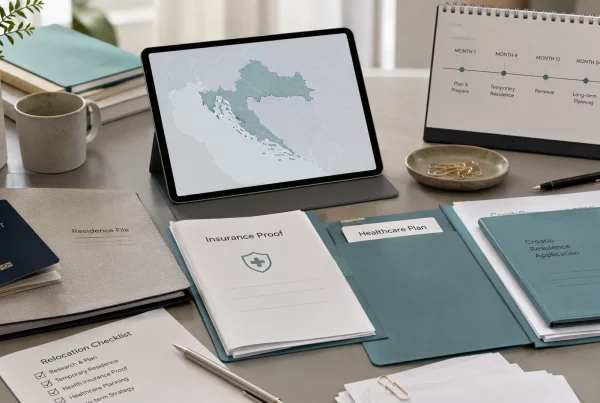



If you are a US citizen moving to Portugal in 2026, health insurance is not a single decision. It is a sequence of decisions. First, there is the visa application. Then there is your arrival and the post-entry AIMA process. After that comes the timing of access to Portugal’s public healthcare system through the SNS. Finally, there is the longer-term question: whether a Portugal-only private medical insurance policy is sufficient for your household, or whether internationally portable cover is still more appropriate.
Intro
For most Americans, the first clear dividing line is length of stay. Official Portuguese guidance says US citizens do not need a visa for short stays of up to 90 days, but third-country nationals who intend to stay in Portugal for more than 90 days will generally need the appropriate long-stay national visa. Residence visas are valid for four months and allow two entries. During that period, the holder is expected to request a residence permit. The standard published decision deadline for a residence visa is 60 days, except where the law provides otherwise.[1][2][3][4][5]
That is why the insurance question needs to be staged properly. The official sources reviewed for this article do not support a one-line answer such as “just use the public system” or “just buy private cover”. What they do support is a more practical framework: visa-stage cover, arrival-stage continuity, resident-stage registration, and then a considered choice between local private plans and IPMI, based on how stable your life in Portugal is likely to be over the next three to ten years.[8][9][10][14][15][16][21][22][23][24][25][26]
Executive brief
- More than 90 days changes the planning frame: you usually move out of the visa-free visitor framework and into Portugal’s national-visa framework.
- D7 and D8 are different evidence routes: D7 is built around passive or own-income evidence; D8 is built around remote-work evidence.
- Visa insurance proof is not the same as resident healthcare access: official D7 and D8 checklists refer to travel insurance, while AIMA’s residence-permit framework refers to health insurance or proof of SNS coverage.
- SNS access hinges on legal residence and linked records: gov.pt links healthcare cost coverage to identification, a NIF, a Portuguese address and a valid residence permit.
- Health-centre registration is a separate practical step: registering locally helps turn your SNS position into day-to-day access.
- Local private cover and IPMI solve different problems: local cover may suit a Portugal-only strategy; IPMI may suit mobility, wider territorial cover, evacuation, repatriation and continuity.
- Think in 3–10 years, not just visa day: permit renewals, family changes, US travel and future moves can all affect the right insurance structure.
Executive brief
If you are moving for more than 90 days, you usually move out of the visa-free visitor framework and into Portugal’s national-visa framework. Residence visas are valid for four months, allow two entries, and are used to progress to a residence permit.[1][2][3][5]
D7-style applications are built around passive income or own-income evidence. D8 remote-work applications are built around remote-work evidence and an official income benchmark of four times the Portuguese monthly minimum remuneration. Using the 2026 official minimum of €920, that gives a documentary benchmark of €3,680 per month.[6][7][8][9]
Official D7 and D8 checklists require valid travel insurance covering necessary medical expenses, urgent assistance and possible repatriation. AIMA’s general residence-permit page, by contrast, lists health insurance or proof of SNS coverage.[8][9][10]
Gov.pt states that legally resident foreign nationals can obtain an SNS user number. It also says that SNS cost coverage requires the user record to be linked to identification, a Portuguese tax number, a full address in Portugal and a valid residence permit.[14][15]
Gov.pt says foreign nationals with a Portuguese residence permit may register at a health centre. It lists the SNS user number, residence permit, Portuguese address, civil identification number, tax number and proof of entitled benefits as part of the document set.[16]
Official insurer materials consistently present IPMI as portable, internationally administered cover. That can matter if you expect future moves, need a wider territorial scope, or want features such as evacuation and repatriation.[21][22][23][24][25][26]
A–Z timeline: planning, arrival, registration, first year
The timeline below is a practical planning framework, not an official deadline table. It is based on the published residence-visa validity period, the standard residence-visa processing deadline, the AIMA residence-permit documentation pages, and gov.pt rules on SNS registration and health-centre enrolment.[3][4][5][10][11][14][15][16]
| Timing | What you should be doing | Why it matters for health cover |
|---|---|---|
| About 6–4 months before your intended move | Choose the likely visa route; check your consular jurisdiction; start gathering civil records, police records, accommodation evidence and financial evidence. If D8 is in scope, check whether your work is being documented as remote employment or remote services. | Insurance should be planned at the same time as the visa route, because the official D7 and D8 checklists both include travel-insurance proof and the D8 route uses documented income from the previous three months. |
| About 4–2 months before filing | Build the visa dossier around the exact route, not generic internet advice. Residence-visa decisions are generally published as 60 days, so allow margin for document corrections, authentication and resubmission risk. | This is when you decide what kind of insurance document you can actually file: not just what you want long term, but what is consistent with the visa checklist in front of you. |
| On visa issue | Treat the visa as an entry-and-conversion window, not as the final state. The official rule is four months / 120 days for a residence visa, with the post-entry residence-permit step following after arrival. | If your policy only solves the consular application and not the arrival window, you may create a continuity problem at the point when you need the most administrative flexibility. |
| First month in Portugal | Follow the route-specific AIMA instructions or the process indicated by your consular guidance. Keep your passport, visa, address evidence and insurance records ready in one file. | AIMA’s general page lists health insurance or proof of SNS coverage among the documents for residence-permit issue, and scheduling workflows changed during 2025. |
| Once you are legally resident | Obtain your SNS user number if you do not already have one. Then register with the health centre in your area of residence. | Gov.pt makes legal residence central to SNS access and to healthcare cost coverage. An SNS number is useful, but it is not the same as fully completed public-system registration. |
| First year | Reassess whether your household needs a Portugal-only private policy, a more portable IPMI structure, or a combination of SNS access and private top-up cover. | This is the point where your visa-stage insurance question ends and your real medium-term healthcare strategy begins. |
A simple way to think about the first year is this: your visa application asks, “What cover is acceptable for entry?”; your arrival period asks, “How do I stay covered while the residence file is being regularised?”; and your medium-term strategy asks, “What still fits once Portugal is my operational base?”[8][9][10][14][15][16]
Main visa routes (high level)
For most US households considering a permanent or semi-permanent move, the routes that matter most at the health-insurance planning stage are D7, D8, family reunification and, in some cases, the independent-work or entrepreneur route. Official Portuguese visa guidance distinguishes these routes clearly enough to support planning, but not clearly enough to justify assumptions where your circumstances sit on the boundary between categories. If the work is local to Portugal, or the revenue model is not genuinely passive, you should verify the correct route before arranging insurance around the wrong visa basis.[3][7][18]
D7-style residence visa: pensioners and people living on their own income / passive income
The official national-visa documentation page identifies a route for people living from passive income, and the official Washington D7 checklist describes the route as establishment of residence for pensioners and people living on their own income. The residency documentation page says the passive-income route uses documents certifying income from movable or immovable property, intellectual or industrial property, or financial investments. The Washington checklist also states that the applicant must show financial resources for at least 12 months.[7][8]
The important point for insurance planning is that D7 is not just “retirement”. It is a documentation route for people whose means of support do not depend on taking up local salaried work in Portugal. The means-of-subsistence page on the official visa portal says the 2026 benchmark is built from a monthly minimum salary of €920, with 100% for the first adult, 50% for the second and additional adults, and 30% for children and certain dependent non-minor children. The Washington D7 checklist also notes that the means-of-support amount can be reduced in certain situations, including where accommodation is already secured. You should therefore treat the published amounts as a documentary framework, not as a guarantee that any file above a single number will be granted.[6][8]
D8 residence visa: remote work / digital nomads
The official visa portal lists a residence visa for remote work / digital nomads, and the route-specific documentation states that remote workers must document the work relationship or services relationship, depending on whether the work is subordinate employment or independent professional activity. The official residency documentation also says the applicant must show average monthly income for the previous three months, with a value equivalent to four monthly minimum remunerations. Because the official 2026 minimum listed by the visa portal is €920, that gives a documentary benchmark of €3,680 per month in 2026.[3][6][7][9]
At the residence-permit stage, AIMA’s remote-work residence page says the permit is valid for two years from the date of issue and renewable for successive periods of three years. AIMA also lists the valid remote-work residence visa, the passport, the declaration confirming the employment or services relationship, and residence-address evidence as key documents for that route.[11]
Family reunification
The official visa portal states that foreign nationals with a valid residence permit are entitled to family reunification for family members outside national territory, and the residency documentation page says those family members apply for a family-reunification visa only after family reunification has been granted by AIMA to the legal resident in Portugal. AIMA’s family-reunification page for relatives outside Portugal states that after entry with the residence visa, the family member must go to AIMA to request the residence permit. AIMA also states that the family member’s residence authorisation is granted for the same period as that of the resident sponsor.[17][18]
That is particularly relevant for expat families in Portugal. If one family member is the main applicant and the rest of the household joins later, the insurance and registration sequence may not be identical for everyone. It is safer to review each person’s visa stage, permit stage and SNS stage separately.[17][18]
Independent work or entrepreneur route
The official visa portal also lists a residence visa for independent work purposes or entrepreneurs. If your life in Portugal is genuinely based on local economic activity, rather than remote work for entities outside Portugal, you should verify whether the entrepreneur / independent-work category is the correct route instead of D8.[3][7]
- D7: whether your consular post requires additional formatting or evidence around passive income, accommodation or 12-month funds.[6][8]
- D8: whether your file is being documented as remote employment or remote services, as the supporting evidence differs.[7][9]
- Family reunification: whether the offshore family-reunification authorisation must be in place before the visa filing for the family member abroad.[17][18]
- Independent work / entrepreneur: whether your activity should be filed as remote work or as a Portugal-facing business activity.[3][7]
Visa insurance proof
This is where many moves become muddled. The official sources support a distinction between visa-stage insurance proof and resident-stage healthcare access. They are related, but they are not the same.[8][9][10][14][15]
For the visa application, the official Washington D7 and D8 checklists both require valid travel insurance covering necessary medical expenses, including urgent medical assistance and possible repatriation. The official visa portal’s documentation pages also place travel / health insurance within the residence-visa documentation framework.[7][8][9]
For the post-arrival residence-permit stage, AIMA’s general residence-permit page lists “health insurance or proof of coverage by the SNS” as part of the required document set. This matters because it shows that the administrative question after arrival is broader than the consular travel-insurance question before departure.[10]
| Stage | Official requirement in the sources reviewed | What it means in practice |
|---|---|---|
| Visa application | Valid travel insurance with medical expenses, urgent assistance and possible repatriation. | You need a document set that fits the route-specific checklist, not just a policy that sounds suitable in general terms. |
| Residence-permit stage | AIMA general rules list health insurance or proof of SNS coverage. | If SNS registration is not yet fully in place, you may still need private cover continuity at this stage. |
| Living in Portugal as a resident | Gov.pt links SNS cost coverage to legal residence plus linked administrative data. | You should not plan for a same-day switch from consular insurance proof to fully functioning public healthcare cover. |
The key mistake is to assume that, because you intend to use the public system eventually, you can ignore the private-insurance bridge entirely. Gov.pt says legally resident foreign nationals can obtain an SNS number, but also says cost coverage depends on the associated record including a valid residence permit, NIF, full address in Portugal and identification document. That is why many moves require an overlap period rather than an instant transfer from “visa insurance” to “public healthcare”.[14][15]
A second mistake is to assume that any local private policy sold in Portugal will automatically satisfy every visa route or every consular post. In the official sources reviewed, I did not find a universal statement saying that every Portugal-issued domestic private policy is automatically acceptable as visa proof for all D7 or D8 filings. The official sources define the requirement. They do not publish a universal acceptance statement for every local policy structure. That is why this belongs in your verification list rather than your assumptions list.[8][9][10]
Arrange cover for the stage you are in, but do not lose sight of the stage that follows. Visa proof should support the application. Arrival cover should support the transition. Long-term cover should support your actual life in Portugal, not just your consulate appointment.[8][9][10][14][15][16]
SNS registration and timing
Official gov.pt guidance says that any foreign national who is legally resident in Portugal can obtain an SNS user number, which entitles them to medical assistance at public SNS units. The same official source says the number is usually issued the first time you visit a public health unit, such as a health centre or hospital. The specific gov.pt service page also states that the number is automatically allocated when you contact a public facility for care, but that you can also apply for it even when you do not yet need care. The service is free of charge.[14][15]
However, gov.pt is also clear that an SNS user number alone does not automatically guarantee that your healthcare costs will be covered by the SNS. For SNS cost coverage, the service page says the following information must be linked to the user-number record: an identification document, a Portuguese tax identification number, a full address in Portugal and a valid residence permit.[14][15]
This is the practical reason not to oversimplify SNS access. You may be able to obtain the user number quickly. That does not mean your file is fully mature for all cost-coverage purposes on the same day. For a new arrival, the relevant planning question is therefore not “Can I eventually use the SNS?” but “At what point in my move will my public registration be complete enough for me to rely on it comfortably?”[14][15]
Health-centre registration is the next step. Gov.pt says all foreign nationals with a Portuguese residence permit may register at a healthcare centre. If you do not already have an SNS user number, gov.pt says you can obtain one during the registration process. For foreign nationals, the official list of documents includes a residence permit, proof of the healthcare benefits to which you are entitled, your permanent residence address in Portugal, your civil identification number and your tax identification number. Registration is free and should preferably be completed at the healthcare centre in your area of residence.[16]
Arrive in Portugal with continuity of private cover still in place
    ↓
Complete the residence-permit steps indicated by your route and the current AIMA process
    ↓
Obtain the SNS user number
    ↓
Register at the health centre for your area
    ↓
Decide whether your private plan should be cancelled, reduced, or kept as a private-sector layer
If you become legally resident in Portugal and are also registered with SNS and Social Security, gov.pt says you may then be entitled to request the European Health Insurance Card for temporary stays in other EU states. That may be useful later, but it is not a substitute for thinking clearly about your first-year transition.[14]
Local private vs IPMI
This is the part most people care about once the visa question is under control.
When people say “private health insurance Portugal”, they can mean two very different things:
- a local private plan, usually issued for the Portuguese domestic market and primarily designed around treatment in Portugal; or
- IPMI, meaning internationally administered private medical insurance designed for people who live abroad, move between countries, or want broader geographic continuity.
The official insurer materials reviewed for this article from Cigna Healthcare, AXA Global Healthcare, APRIL International, Allianz Care, Bupa Global and Now Health International are consistent on one broad point: IPMI is positioned as mobile, private-sector cover, with portability, wider area of cover and international administration as core advantages.[21][22][23][24][25][26]
What official insurer materials say about IPMI
Cigna’s official international page emphasises local and global cover, access to treatment across a worldwide network, and portability, describing plans that can move with you across more than 200 markets and jurisdictions.[21]
AXA’s official international-health page highlights emergency cover, evacuation and repatriation, virtual doctor services, mental-health support and the ability to choose an area of cover, including US exclusion as a cost-control option. For US citizens moving to Portugal, that area-of-cover point can be more important than many people realise.[22]
APRIL’s official comparison guide describes international cover as globally portable and contrasts it with local plans that are tied to the country of residence. That does not make local cover “wrong”. It makes it more dependent on your long-term mobility assumptions.[23]
Allianz’s official international-plan page lists doctor visits, hospitalisation, surgery, diagnostics, prescription drugs and medical evacuation / repatriation among the core international-health features.[24]
Bupa Global’s expat page highlights direct access to a global network of specialists, potential cover for pre-existing conditions subject to underwriting, and medical evacuation / repatriation where needed.[25]
Now Health’s official expat page positions its plans as cover for people living and working abroad, with access to the private sector, portability in many cases, and plan structures ranging from in-patient / day-patient core cover to more comprehensive options. It also states that pre-existing conditions may be covered subject to underwriting.[26]
So when does local private cover make sense?
A Portugal-issued local private plan may make sense if your real strategy is: “Portugal is our base, we expect to stay, we are comfortable rebuilding cover if we move later, and we mainly want a domestic private-sector layer once SNS access is in place.” That is not an official legal rule. It is a planning logic consistent with APRIL’s local-vs-international framing and with the SNS registration structure described by gov.pt.[14][15][16][23]
When does IPMI deserve closer attention?
IPMI deserves a closer look if any of the following are true:
- you expect Portugal to be one stop in a multi-country life;
- you still want a clear private treatment pathway outside Portugal;
- your household includes children and you want continuity if plans change;
- you care about broader territorial scope, evacuation / repatriation, or virtual-care services;
- you expect regular US travel and want to think carefully about US inclusion or exclusion in the area of cover;
- you have ongoing medical needs and want to understand underwriting terms before moving, rather than after.[21][22][23][24][25][26]
| Question | Local private plan in Portugal | IPMI |
|---|---|---|
| Main fit | Domestic private access in Portugal | Cross-border private continuity |
| Geographic scope | Check the policy wording carefully | Usually broader and more portable in official insurer materials |
| Relationship with SNS | Often works as a domestic private layer once you are resident | Can sit alongside SNS if you want portability or broader private access |
| US relevance | Usually needs close checking for overseas use | Area-of-cover design is a central decision point |
| Future moves | May require rebuilding cover later | Portability is one of the main reasons people buy it |
| Complex needs | Depends entirely on policy wording, sublimits, renewability and underwriting | Official materials often highlight evacuation, repatriation, virtual care and broader administration |
A 3–10 year strategy table
Use this as a planning lens, not as a legal timetable. It is grounded in the official two-year then three-year permit cycle published by AIMA, the official SNS registration logic, and the portability framing in the insurer materials reviewed.[10][11][14][15][16][21][22][23][24][25][26]
| Horizon | If Portugal is likely to be your long-term single base | If your life may remain internationally mobile |
|---|---|---|
| Year 0–1 | Focus on visa compliance, AIMA continuity and completing SNS registration before reducing private cover. | Keep portability high during the visa-to-resident transition. |
| Year 1–3 | Compare actual domestic usage: SNS only, SNS plus local private cover, or a richer private layer. | Re-test whether an internationally portable structure is still earning its premium. |
| Year 3–5 | Review renewal terms, family changes, age, schooling, maternity plans and ongoing treatment. | Avoid becoming locked into a domestic-only structure if another move is plausible. |
| Year 5–10 | If you are firmly settled, a domestic strategy may become easier to justify. | Portability, underwriting continuity and area-of-cover design usually matter more, not less. |
Renewal and continuity planning
AIMA’s general residence-permit page states that, unless special legal rules apply, a temporary residence permit is valid for two years from the date of issue and renewable for successive periods of three years. AIMA’s remote-work residence-permit page says the same for the digital-nomad route. That means your insurance decision should not be built only around the visa and arrival phase. It should also be robust enough to survive at least one renewal cycle.[10][11]
The renewal process itself changed materially during 2025. The official IRN residence-renewal Q&A says that, from 1 August 2025, IRN ceased to have competence for appointments related to residence-authorisation renewals. The same IRN page directs users to AIMA’s renewals portal, and AIMA’s own renewals notice explains that requests are made via registration on the portal, followed by fee generation and payment.[19][20]
For 2026 movers, the practical implication is simple: do not assume that the process you saw in a 2024 article is still the process you will use at renewal. Even in 2025, the systems were still changing. For first grants, AIMA also introduced online scheduling functionality for certain non-CPLP holders of residence / work consular visas, which reinforces the need to verify the current booking route for your exact category.[12][13][19][20]
- Track passport expiry, visa expiry, permit expiry and policy renewal dates in one place.
- Keep your Portuguese address, email address and tax details consistent across AIMA, SNS and insurer records where relevant.
- Avoid allowing a visa-compliant plan to lapse before you know exactly what your resident-stage arrangement is.
- If you are using a domestic policy, review territorial scope and administrative requirements if your status changes.
- If you are using IPMI, re-check area of cover, US inclusion or exclusion, and any underwriting-sensitive benefits before family or lifestyle changes force the question.[10][12][19][20][21][22][23][24][25][26]
Family reunification adds another layer. AIMA states that a family member admitted through reunification receives a residence authorisation for the same period as the resident sponsor. For family households, it is worth tracking the entire family’s document cycle together, rather than only the main applicant’s.[17]
Checklists, FAQ, sources
Document checklist
- Passport and visa application documents required by the national-visa framework.[3][7]
- Route-specific financial evidence: passive-income evidence for D7-style cases, or remote-work relationship plus income evidence for the previous three months for D8.[7][8][9]
- Accommodation evidence.[8][10][11]
- Police-clearance / criminal-record documents where required by the checklist.[8][9][17]
- Valid travel insurance with medical expenses, urgent assistance and possible repatriation.[8][9]
- Passport and valid residence visa.[10][11]
- Proof of Portuguese address / residence arrangements.[10][11][17]
- The correct AIMA scheduling route for your category.[12][13]
- Health insurance or proof of SNS coverage for the residence-permit stage, where applicable under the route and current instructions.[10]
- NIF, identification details, and the data needed for SNS user-number registration.[14][15]
FAQ
Can you rely on SNS from day one of your move?
Not as a safe planning assumption. Gov.pt says legal residence is the basis for obtaining the SNS user number, and also says that SNS cost coverage depends on linked record data including a valid residence permit, tax number, ID and Portuguese address. That supports an overlap strategy rather than an instant handover from visa cover to public healthcare.[14][15]
Is D7 or D8 the right route for you?
At a high level, D7 is built around pension / own-income / passive-income logic, while D8 is built around remote work for entities outside Portugal. If your activity is really a Portugal-based business or independent-work setup, verify whether the entrepreneur / independent-work route is the better fit.[3][7][8][9]
Does a residence visa still come with an AIMA appointment automatically?
Do not assume that. Official Portuguese guidance on booking and scheduling changed during 2025, including category-specific online scheduling routes. Treat the current platform as a live item to verify on the official sources for your route.[12][13]
Once the residence permit is issued, can you cancel private cover?
Possibly, but that is a strategy question rather than a general rule. It depends on how much you want to rely on SNS, whether you want private-sector access inside Portugal, and whether you still need international portability or broader geographic cover.[14][15][16][21][22][23][24][25][26]
What should expat families in Portugal watch most carefully?
Route sequencing, not just price. Family reunification can create different timelines for different household members, and AIMA states that family-member permits are tied in duration to the resident sponsor. That makes continuity, paperwork and timing more important than a simple yes/no answer about one policy.[17][18]
Points to verify
- Whether your specific Portuguese consular post in 2026 is using the same checklist version reflected in the official public PDF or portal page you reviewed.
- Whether your residence-permit booking route is through an AIMA form, another AIMA platform, or instructions tied to the visa category itself.[12][13]
- Whether the private policy you are considering is acceptable as visa proof for your exact D7 or D8 application. The official sources reviewed define the requirement, but do not publish a universal “all local plans are acceptable” statement.[8][9][10]
- For D7, how your consular post expects accommodation evidence and household composition to affect the means-of-support calculation.[6][8]
- For D8, whether you should be documenting subordinate remote work or independent remote services.[7][9][11]
- For family reunification, whether the family member is applying from outside Portugal after prior authorisation or through a different in-country path.[17][18]
Book a free consultation with one of our experts
Choose your preferred adviser: Julien (English, French and Spanish) or Sean (English or Italian).
Julien — English, French and Spanish
Sean — English or Italian