

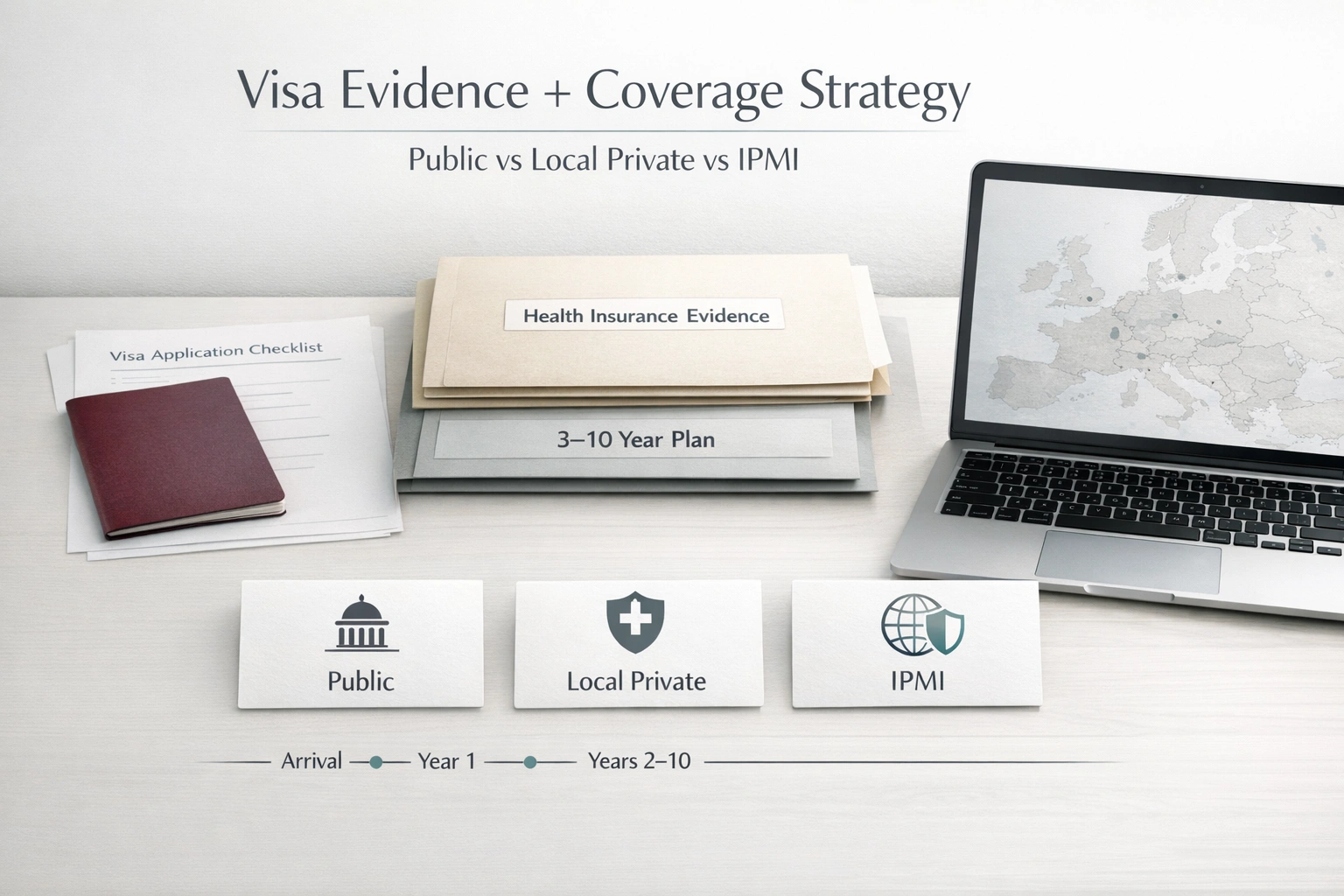

If you are an American moving to Europe in 2026, the first health insurance question is often not, “Which plan is best in the long term?” but, “What will the visa or residence authorities accept as evidence of cover?” That can vary by country, visa type, residence route and, in some cases, by the embassy, consulate or application centre handling your application. That is why many moves require two things at once: insurance that can be used as acceptable documentary evidence, and a realistic 3–10 year strategy that can adapt as you move from arrival to registration and, ultimately, longer-term residence.
In practice, many Americans face a genuine “bridge period” after arrival. You may already be in the country but still waiting for registrations, appointments, residence processing, work-based enrolment, or the point at which access to the public system actually begins. During that period, formal compliance and practical day-to-day access to healthcare are not always the same thing.
This guide explains the three main insurance routes you are likely to compare: public healthcare access, local private medical insurance, and international private medical insurance (IPMI). It is intended as a Europe-wide overview, not a substitute for country-specific legal or immigration advice. The aim is to help you ask the right questions, structure the period from your first 90 days through to Year 1 properly, and avoid ending up in the wrong arrangement for Years 2–10.
- Start with visa or permit evidence: what you want in the long term and what the official checklist will accept are not always the same.
- Expect a bridge period: arrival, registration and the timing of public-system access can create gaps if you plan only for the eventual end state.
- Public access is status-dependent: employment, residence stability and registration steps often determine when public cover actually begins.
- Local private cover serves different purposes: in some countries it is supplementary; in others, it forms part of the regulated local system.
- IPMI can help with mobility and continuity: especially if you may change country, change status, or want a more portable solution.
- Documents matter: certificate wording, dates, territorial scope, limits and deductibles can all affect whether your evidence is accepted.
- Build a 3–10 year strategy: choose a starting route that you can later adapt without creating compliance, continuity or underwriting problems.
- Executive brief: what to check first
- The three insurance “routes” (public vs local private vs IPMI)
- Visa or permit evidence: what is typically required (and why it varies)
- Arrival “bridge period” risks (the first 90 days to Year 1)
- When public cover may begin (country-dependent)
- When local private cover can help (and where it often does not replace public cover)
- When IPMI can still make sense (mobility and continuity)
- A 3–10 year strategy: how to avoid locking yourself into the wrong structure
- Document checklist and country-source checklist
Executive brief: what to check first
Before you compare public cover, local private plans and IPMI, check these four points in order. This sequence can help you avoid a common mistake: choosing a plan that looks sensible in medical terms but is not accepted as visa evidence for your route.
For Schengen destinations, the short-stay framework allows up to 90 days in any 180-day period. Longer stays usually move you into a national visa or residence route, which often changes the insurance evidence required.[1][2]
For each country, you will usually need three official checkpoints: the embassy or consulate page, the immigration authority page, and the public health or government portal explaining healthcare access.
Authorities may be concerned not only with whether you have a policy, but with how that cover is evidenced. Germany’s official D-visa guidance is a good example: travel insurance is not sufficient for national visas, and insurer certificates should clearly state the scope and level of cover, as well as any limitations or deductibles.[12]
Are you moving for work, as a non-working resident, or with uncertainty over where you will ultimately settle? The answer will often determine whether public cover, local private cover or IPMI is the most practical starting point.
- Your exact visa or residence route.
- The wording used in the official insurance requirement for that route.
- Whether “travel insurance” is accepted, rejected, or relevant only for short stays.
- Whether public cover may start immediately, only after registration, or only after a waiting or residence-stability condition has been met.
- Whether you may later be required to enter a local insurance arrangement even if you arrive with foreign cover.
The three insurance “routes” (public vs local private vs IPMI)
In Europe, these are not always three permanent alternatives. They are often three routes that become relevant at different stages of your move.
| Route | What it usually means | What it depends on | Typical advantage | Typical limitation |
|---|---|---|---|---|
| Public | Access to the national healthcare system as an insured resident. | Status, residence, work and registration. | Strong long-term alignment with the local system. | May not begin immediately on arrival. |
| Local private | Country-based private medical cover, sometimes supplementary and sometimes part of the regulated local system. | Local rules, insurer eligibility and plan design. | Often a good fit once you are settled in one country. | Usually less portable across borders. |
| IPMI | International Private Medical Insurance designed for long-term living abroad. | Underwriting, territorial scope, benefits and visa acceptance. | Mobility and continuity. | May not satisfy compulsory local insurance requirements. |
Route one: public healthcare access
Public systems vary across Europe, but a common pattern is that access depends on status and registration. France’s official PUMa guidance illustrates this clearly: if you work in France and your application is accepted, cover can start immediately; if you do not work, there may be a three-month residence-stability condition before entitlement begins.[9]
Germany’s Federal Ministry of Health also explains that residents are required to have health insurance and may fall into the statutory or private system depending on eligibility.[13] That is why public cover should often be treated as a status you become entitled to, rather than something that automatically applies on day one.
Route two: local private plans
“Local private” can mean very different things depending on the country. In some places it is mainly supplementary. In others, it is effectively part of the mechanism through which local compulsory cover is arranged.
The Netherlands is an important example. The Dutch government states that if you come to live or work in the Netherlands, you are required to take out Dutch health insurance with a Dutch insurer, even if you already hold foreign medical insurance; you generally have up to four months to arrange this.[10]
Route three: IPMI
IPMI is designed for people living abroad who may need portability, continuity and treatment access outside a single country. Official insurer material from Cigna, Allianz, Bupa, AXA, Now Health and APRIL shows recurring themes: direct billing may be available, portability can be a benefit, and pre-authorisation, underwriting and claims processes are part of the overall structure.[17][19][21][22][25][28][31]
Start
 ↓
Are you applying for a long-stay visa or residence route that requires proof of insurance before approval?
 • Yes → Go to the next step
 • Unclear → Treat it as yes until the official checklist confirms otherwise

Does the official guidance reject travel insurance for your route?
 • Yes → You are likely to need resident-style evidence of cover (public entitlement, local private cover, or IPMI depending on the route)
 • No / short-stay route → Travel medical insurance may still be relevant if that is what the official checklist requires

Is your first year likely to be stable in one country, with quick access to local or public enrolment?
 • Yes → Public or local cover may be the right starting route, with bridge cover if timing is uncertain
 • No → IPMI may be more practical for continuity during the first 12–36 months

Will you later be required to join a local system anyway?
 • Yes → Build an exit or transfer plan from day one
 • No / unclear → Verify this before assuming your starting arrangement can remain unchanged for years
Visa or permit evidence: what is typically required (and why it varies)
This is where many moves become more complex than expected. The insurance requirement is rarely governed by a single Europe-wide rule. It usually depends on the country, visa category, your status, and the authority processing the application.
Why it varies
Insurance evidence usually reflects how each route allocates responsibility for healthcare costs. Some routes assume that you will later join a local or public system. Others require you to demonstrate from the outset that you will not rely on public funds for healthcare costs.
France’s official visa portal makes the point indirectly by telling applicants to use the visa wizard because supporting documents differ by case, while longer tourist stays of more than three months require proof of medical cover in France.[7]
A short-stay baseline: Schengen travel medical insurance
For short-stay Schengen visas, official EU materials describe travel medical insurance requirements such as emergency medical treatment, hospital treatment and repatriation, commonly with a minimum cover limit of €30,000 and validity across the Schengen area for the full duration of the stay.[3]
This is useful as a baseline because it shows what authorities mean by “travel medical insurance”. It does not automatically tell you what will be accepted for a long-stay residence route.
Germany’s Federal Foreign Office guidance states that applicants for national category D visas must have health insurance cover equivalent to the German statutory minimum and that travel insurance is not sufficient. It also explains that insurer letters or certificates should clearly state the scope and level of cover, as well as any limitations or deductibles.[12]
France-Visas indicates that requirements vary by route and circumstances. For a tourist stay of more than three months, applicants are asked to show proof of medical cover in France, while public-facing France-Visas material also refers to insurance certificates covering medical and hospital expenses, repatriation and death-related costs.[7][8]
Portugal’s official visa portal includes valid travel insurance in the general documentation for national residence visas, covering necessary medical expenses including urgent medical assistance and possible repatriation, while noting that bilateral or international agreement arrangements may differ.[5]
Official Spanish guidance for the non-lucrative residence visa refers to proof of public or private health insurance arranged with an entity authorised to operate in Spain. Additional conditions may apply on the official route page, so the exact consular checklist matters.[15][16]
What proof documents typically need to show
- Who is covered: your full legal name and, where relevant, any dependants.
- When cover starts: and confirmation that it runs for the required period.
- Where cover applies: the country concerned, the Schengen area, Europe, or worldwide territorial scope.
- What is covered: usually at least a high-level summary of the benefits.
- Any material limitations: such as deductibles or exclusions, where the authority expects these to be disclosed.[12]
Some IPMI insurers also make formal proof documents available through member portals, including certificates of insurance and ID cards. Cigna’s member resources, for example, refer to access to policy documents including a Certificate of Insurance and ID cards.[36]
In practice, proof of insurance is often as much a document-management issue as an insurance issue. Getting the dates, names, territorial scope and wording right can matter just as much as the policy itself.
Arrival “bridge period” risks (the first 90 days to Year 1)
The bridge period is the gap between “you have arrived” and “your longer-term insurance arrangement is fully active, compliant and usable”. It can arise even if you ultimately expect to rely on public cover.
France shows why. A non-working adult may face a three-month residence-stability condition before entitlement under PUMa begins, whereas someone working in France may be covered immediately once the application is accepted.[9]
The Netherlands shows a different version of the same issue. You may be required to take out Dutch health insurance, but if you delay beyond the permitted set-up window, care costs incurred before the policy is arranged may not be reimbursed.[10]
| Timeline stage | What to focus on | Main risk |
|---|---|---|
| Before you apply | Identify the precise official insurance wording for your route and obtain acceptable evidence of cover. | Buying cover that looks medically adequate but is not accepted for visa purposes. |
| Arrival week | Keep digital and printed evidence of cover, emergency contact details and plan information readily available. | Being unable to demonstrate cover or use it effectively when needed. |
| First 90 days | Manage registrations, appointments and enrolment steps while keeping bridge cover in force. | Assuming public cover starts before it actually does. |
| Year 1 | Plan the transition into public or regulated local insurance where required. | Missing local deadlines or remaining in the wrong structure for too long. |
| Years 2–10 | Optimise for your settled reality: one country, a cross-border lifestyle, family needs, or retirement planning. | Remaining in an arrangement that no longer suits your status or geography. |
Common bridge-period risks
- The cover exists, but the evidence is rejected: Germany is explicit that travel insurance is not sufficient for national D visas.[12]
- Public cover is wrongly assumed to be immediate: France’s official timing rules show that this is not always the case for non-working residents.[9]
- Local compliance deadlines are missed: the Netherlands warns about delays in taking out the required Dutch insurance.[10]
- Cashflow surprises: even with international cover, you may sometimes have to pay first and claim later, depending on the provider, treatment type or pre-authorisation requirements.[28]
- Overestimating direct billing: official insurer material makes clear that direct billing can help, but remains subject to eligibility, provider arrangements, network rules and pre-authorisation in many cases.[21][22][25][26][31]
Plan for both evidence and practicality. Evidence is what the relevant authority will accept. Practicality is how you will actually access treatment and manage out-of-pocket costs until your longer-term arrangement is fully in place.
When public cover may begin (country-dependent)
The start date for public cover is often determined by two things: your status and your registration. That is why it is risky to assume that residence alone means immediate access to the public system.
Residence stability and employment status
France provides a clear official example. If you work in France and your PUMa application is accepted, you can be covered immediately. If you are an adult without professional activity, you may need to wait three months before entitlement begins, subject to exceptions.[9]
Compulsory insurance linked to arrival or residence-permit timing
The Netherlands shows another official pattern. The government states that if you come to live or work there, you must take out Dutch health insurance, generally within four months, and the rules are linked to your residence position.[10][11]
Immigration-linked access to healthcare
The UK operates differently. GOV.UK states that where you are required to pay the Immigration Health Surcharge, you can use the NHS free of charge from the date your visa starts, subject to the rules that apply in your case.[14]
This is a reminder that there is no single European model for when public cover begins. In some countries it is closely linked to employment or residence stability. In others, it is tied more directly to immigration status.
- Does my visa or permit category create a direct route into the public system?
- Does employment-based enrolment alter the start date?
- Is there a residence-stability condition?
- Which registrations must be completed first?
- What cover do I need until that point?
When local private cover can help (and where it often does not replace public cover)
Local private medical insurance can be very useful. The key is understanding the role it plays in the country you are moving to.
Where local private cover can help
In countries where public reimbursement leaves some costs to be met by the patient, supplementary private cover may help reduce the remaining out-of-pocket expense. France’s official public information describes supplementary health cover as a separate layer that can be arranged through mutuals, insurers, banks or provident institutions.[35]
In some countries, local insurance is not simply an optional add-on. The Netherlands is the clearest example here: Dutch health insurance with a Dutch insurer is generally compulsory for people living or working there, even if they already hold foreign insurance.[10]
Where local private cover often does not replace public cover
- It may not satisfy compulsory local insurance rules: foreign or non-local cover may still fail the local compliance test even if it pays for healthcare costs.[10]
- It is often jurisdiction-specific: local plans are usually built around one country’s network, pricing and rules, which may work well once you are settled but offer less flexibility if you move again.
- It may not solve pre-arrival evidence requirements: some routes require acceptable proof before the visa takes effect, not something arranged only after arrival.[12]
Local private cover is usually best aligned with one country’s compliance requirements and healthcare system. IPMI is usually better suited to mobility and continuity across borders, subject to underwriting, benefit design and local compliance constraints.
When IPMI can still make sense (mobility and continuity)
IPMI is not automatically the right answer for every American moving to Europe. However, it can make sense where your move involves uncertainty, more than one country, or a bridge period that local structures do not address neatly.
When IPMI is most practical
- You need a bridge while public eligibility is still maturing: particularly where official access rules create timing gaps.[9]
- You may move again within 3–10 years: Cigna describes portability as a core feature of its international health plans, and Allianz also presents portability as a consideration for people living abroad who may move again.[29][30]
- You value continuity across borders: especially where one-country local plans may become restrictive later on.
- You want access to direct billing arrangements where available: while recognising that direct billing is conditional and not guaranteed in every case.[21][25][26][28][31]
Direct billing and claims abroad
Official insurer documentation consistently shows that direct billing can reduce out-of-pocket costs, but it is usually tied to provider arrangements, eligibility and pre-authorisation. Allianz says it has direct billing arrangements with the majority of providers; Cigna says it pays most providers and hospitals directly; AXA describes pre-approval letters and also notes that, in rare cases, a hospital may still require payment before discharge, after which the member must claim reimbursement; APRIL and Now Health describe direct billing as provider-to-insurer settlement for eligible treatment.[25][26][28][31]
In other words, direct billing is a valuable service feature, but it is not a guarantee that every provider in every situation will bill the insurer directly.
Underwriting and pre-existing medical conditions
This is where long-term planning matters. Official insurer material from Cigna, Allianz and Now Health shows that cover for pre-existing medical conditions depends on the underwriting basis and the terms accepted. Cigna’s underwriting factsheet notes that pre-existing conditions may be excluded from cover at the outset under common full-medical-underwriting routes; Allianz states that cover for pre-existing conditions depends on the medical underwriting terms accepted; Now Health says that treatment for pre-existing conditions is not covered unless accepted in writing, subject to the policy terms.[17][18][19][20]
That is one reason to think beyond Year 1. If you may want to keep an IPMI policy beyond a simple bridge arrangement, underwriting is part of your long-term planning, not a minor detail.
Travel insurance vs IPMI
Travel insurance and IPMI are not the same thing. Official insurer material also distinguishes between them, particularly in relation to the scope of cover, pre-existing medical conditions and ongoing healthcare needs while living abroad.[38]
- Visa evidence of insurance: the certificate, letter or other official evidence used to show acceptable cover for a visa or permit application.
- Residence permit insurance: a broad practical term for the type of insurance evidence required for longer stays; this may differ from short-stay travel insurance.
- Public access timing: the point at which you can actually use the public system as an insured resident, often only after conditions have been met and registrations completed.
- Local private cover: private insurance linked to one country; it may be supplementary or part of a regulated compulsory system.
- IPMI: International Private Medical Insurance, designed for long-term living abroad with a more portable structure.
- Underwriting: the insurer’s assessment of medical risk, which helps determine the terms offered and how pre-existing conditions are dealt with.
- Direct billing: where the provider bills the insurer directly for eligible treatment, usually subject to network, pre-authorisation and policy conditions.
- Claims abroad: the process of reimbursement or settlement when you receive treatment outside your home country or outside a standard local system.
A 3–10 year strategy: how to avoid locking yourself into the wrong structure
A 3–10 year strategy is not about predicting every detail of your future move. It is about avoiding early decisions that later prove awkward, costly or non-compliant.
Phase 0: before you apply
Your priority at this stage is to satisfy the official checklist and reduce avoidable document friction. Check whether your route requires travel medical insurance, resident-style comprehensive cover, evidence of public entitlement, or a specific form of local private insurance.[3][5][12][15]
Phase 1: bridge period (arrival to first 90 days)
At this stage, “eventual public access” is not enough. You need workable cover for the gap between arrival and full enrolment or eligibility.
If your destination has timing barriers such as France’s residence-stability condition, or compulsory local enrolment windows such as those in the Netherlands, the bridge period needs to be planned deliberately rather than left to chance.[9][10]
Phase 2: stabilisation (months 3–12)
This is usually the stage at which your longer-term local arrangement becomes clearer. You may move into public cover, into a local private system, or into a mixed structure combining public access with supplementary insurance.
Phase 3: optimisation (years 2–3)
By this point, you will usually know whether your life is genuinely settled in one country or whether cross-border movement remains part of the plan. That distinction matters. Local arrangements often become more attractive once you are settled, whereas IPMI may remain useful if mobility is still part of your circumstances.[29][30]
Phase 4: long-term alignment (years 3–10)
This is the point at which many people realise they are either over-insured internationally or under-insured for the life they are actually living. A sound long-term arrangement should reflect your real country of residence, status, family circumstances and travel pattern, rather than the uncertainty that existed when you first moved.
| Phase | Main objective | Typical structure |
|---|---|---|
| Pre-application | Obtain acceptable visa evidence. | Whichever arrangement produces acceptable official documentation. |
| Arrival / first 90 days | Avoid gaps while registrations and eligibility are still pending. | Bridge cover, often private or international. |
| Months 3–12 | Move into the correct local or public arrangement once eligible. | Public, local private, or a mixed structure depending on country rules. |
| Years 2–3 | Optimise around your actual settled circumstances. | Local if stable; IPMI if still mobile; supplementary where appropriate. |
| Years 3–10 | Remain aligned with compliance requirements, geography and family needs. | An arrangement you can maintain without mismatch, duplication or avoidable cost. |
How to avoid lock-in mistakes
- Do not design Year 1 around an ideal Year 5 scenario. Your eventual arrangement may be public cover plus supplementary local insurance, but Year 1 may require stronger private evidence and more deliberate bridge planning.
- Prefer arrangements you can exit cleanly. This matters if a country later requires compulsory local insurance.[10]
- Treat underwriting as a future planning issue, not an afterthought. If IPMI might continue beyond the bridge period, understand the underwriting basis and the treatment of pre-existing conditions early on.[17][19]
- Be realistic about direct billing. Even with strong international cover, you may sometimes have to pay first and claim reimbursement later.[28]
Document checklist and country-source checklist
Document checklist
- A certificate or insurer letter showing your full name and any covered dependants.
- The policy start date and end date of cover.
- The territorial scope or area of cover.
- A clear high-level summary of what the policy covers.
- Any deductibles, excesses or material limitations, where the authority requires these to be shown.[12]
- The policy schedule or policy documents, if the official checklist or consulate asks for them.
- Confirmation that you can access membership documents and ID cards where relevant.[36]
- Printed and digital copies of your insurance evidence.
- Emergency contact details for the insurer.
- Your policy number or membership number.
- A note confirming whether pre-authorisation is required for in-patient treatment.
- A cashflow plan for situations where you may need to pay first and claim reimbursement later.[28]
Country-source checklist: how to find the right official page for your case
- Find the embassy or consulate page for the country and jurisdiction in which you will apply.
- Find the immigration authority page for the specific residence or permit route.
- Find the public health or government page that explains when healthcare entitlement begins.
- Cross-check terminology because countries use “travel insurance”, “medical cover” and “health insurance” differently.[5][7][12]
- Decide on your initial route and your exit plan before buying the policy, not after arrival.
For your particular case, the most reliable sequence is usually: official embassy or consulate page → official immigration authority page → official health or government portal → official insurer documentation, where you are relying on private cover as evidence. If any of those sources uses unclear language or inconsistent terminology, add the point to your own checklist of issues to verify before you commit.
Points to verify
- Whether your specific visa or residence route accepts travel medical insurance as sufficient evidence for a long-stay or residence application, or instead requires resident-style comprehensive cover.
- The exact wording expected by your consulate or application centre on insurer certificates, including whether deductibles, exclusions, waiting periods or territorial limits must be disclosed.
- Whether your route requires a policy issued by an insurer authorised to operate in the destination country, rather than simply a foreign insurer providing valid overseas cover.
- The exact start date of public-system entitlement for your category, especially if you are moving without immediate employment.
- Whether local private insurance in your destination country is supplementary, optional or part of a compulsory local arrangement.
- Whether you must join the local system within a defined time limit even if you already hold foreign or international cover.
- How direct billing works under the specific plan you are considering in your destination country, including pre-authorisation, network usage and circumstances in which you may still need to settle the bill yourself and claim later.
- Which underwriting basis applies to the policy under consideration and how pre-existing medical conditions will be treated under the accepted terms.
- Whether your route or consulate imposes any additional conditions not stated on general national pages, particularly where requirements vary by permit type or place of application.
Because this is a Europe-wide overview, any point that is unclear, route-specific or consulate-specific should be checked against the official sources for your exact permit and place of application before you rely on it.
Book a free consultation with one of our experts
Choose your preferred adviser: Julien (English, French and Spanish) or Sean (English or Italian).
Julien — English, French and Spanish
Sean — English or Italian