

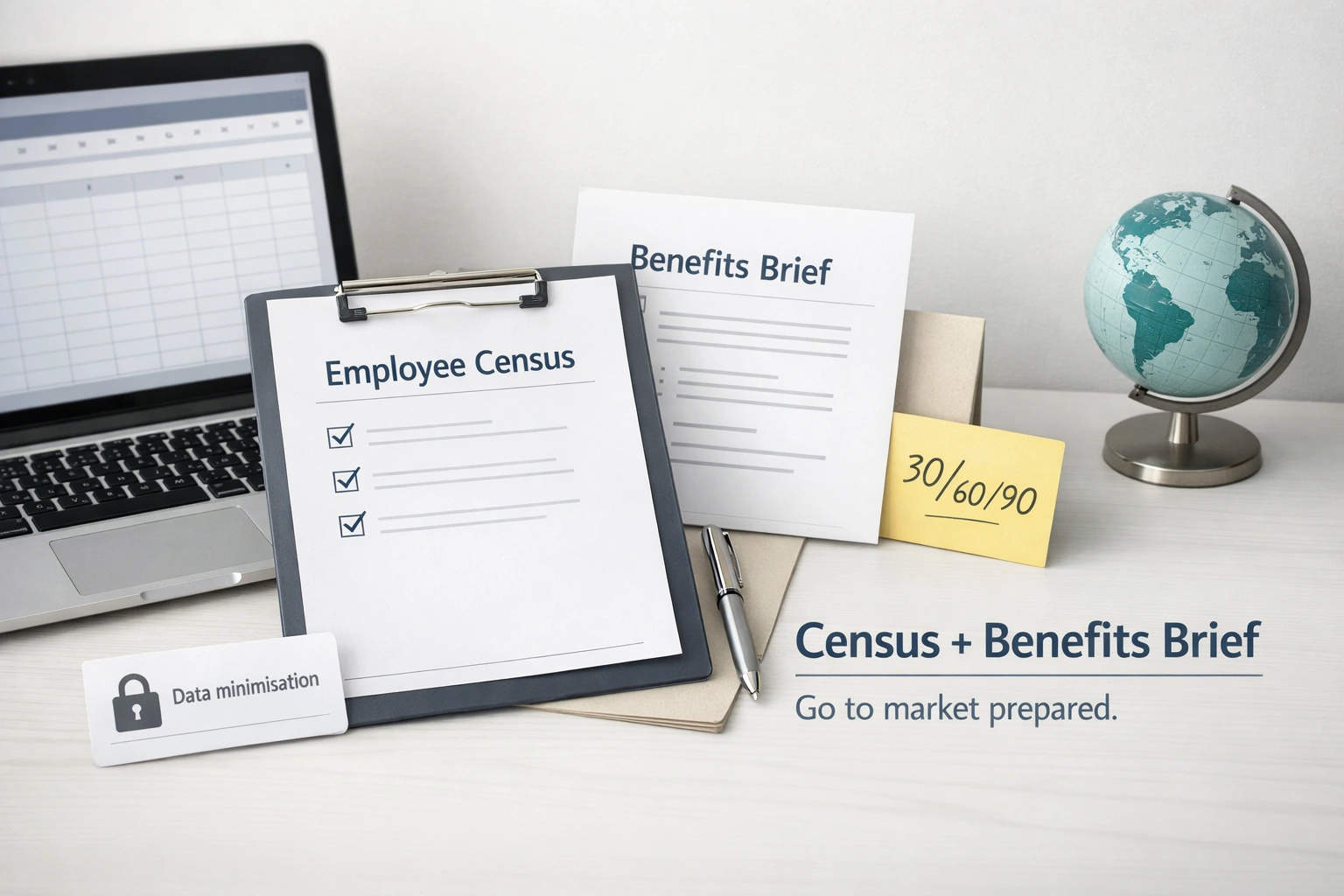

A group IPMI quote process usually runs more smoothly when HR prepares the market pack before approaching insurers. In practice, most quote requests depend on two things: a usable employee census and a clear benefits brief. This guide explains what insurers typically ask for, what data should sit within the quote pack, where privacy boundaries usually apply, and how to work to a practical 30/60/90-day plan.
You can copy the sample checklist in section 6 directly into an HR procurement tracker, implementation brief or internal tender document.
- Employee census prepared and checked
- Benefit design decisions documented
- Eligibility rules confirmed
- Data minimisation approach agreed internally
- 30/60/90-day responsibilities allocated
- Key policy wording points logged for verification
- Insurers usually need a structured census first: ages or dates of birth, countries of residence, employee categories, and dependant details where relevant are common quote inputs because they help underwriters assess the covered population and likely claims profile [1][2][3].
- A quote pack is more than a spreadsheet: HR also needs a benefits brief covering scope of cover, territorial area, optional modules, and cost-sharing choices such as deductibles or co-payments [1].
- Data minimisation matters: demographic and eligibility data may be appropriate for HR to handle at quote stage, but detailed medical histories and clinical documents should usually go directly to the insurer or administrator where required [2][3].
- Definitions should be clarified early: terms such as census, TPA, late entrant, actively at work, and MLR can mean different things in different contexts, so it helps to align internal stakeholders before comparing proposals [5][6].
- Work backwards from implementation: a 30/60/90-day plan can reduce last-minute amendments and gives HR, finance, and leadership enough time to approve key design decisions before the intended commencement date [4].
For HR teams, going to market for group IPMI can seem administratively straightforward at first. There is a workforce to insure, a preferred renewal or launch date, and a broker or insurer ready to quote. The difficulty usually appears one step later, when the market asks for clarifications that have not yet been resolved internally.
Those clarifications are not unusual. Group international private medical insurance is shaped by who is covered, where they live, how benefits are structured, and how the employer wants the plan to operate. If the initial pack does not answer those questions clearly, quotes may come back based on assumptions rather than on a consistent basis.
In practical terms, HR usually needs two linked documents before going to market. The first is the employee census. The second is the benefits brief.
The census tells insurers who the population is. The benefits brief tells insurers what type of cover the employer is looking to buy. Together, they form the core of a workable group health insurance data pack.
This article is written for employers, HR teams and procurement teams that want a verification-first approach. It does not suggest there is a single “correct” structure, because requirements can vary by insurer, policy wording, regulator and country. Instead, it sets out the standard building blocks that usually help a group quote exercise move forward efficiently.
For broader background on business cover, see BIG’s Businesses & Groups page. If you are already preparing to approach the market, you can also use BIG’s quote request page once your census and brief are ready.
1) What insurers typically ask for (and why)
At quote stage, insurers usually ask for enough information to understand the risk profile and the intended plan design. BIG’s group guidance notes that a typical employer data request may include employee names, dates of birth, countries of residence, and details of the cover required [1][2].
This is not purely administrative. These are core underwriting inputs. Underwriters generally need population, location and benefit information before they can decide how a case should be structured and priced [1][3].
Employee and dependant ages, family composition and headcount help insurers estimate the likely claims pattern of the insured group [1][2][3].
Country of residence, and sometimes work location, matters because medical cost environments, access and provider pricing can differ materially between countries [1][2].
Insurers need to know whether the employer wants inpatient-only cover, broader outpatient cover, optional modules, or cost-sharing features such as deductibles [1].
Why age and location matter so early
In group IPMI, age is often one of the clearest pricing drivers because expected claims costs tend to vary by age band. Country also matters because the cost of treatment, provider charging behaviour and network conditions vary by jurisdiction [1][2].
That does not mean HR needs to submit excessive data. It does mean that a quote request without reliable age and location fields is usually incomplete from an underwriting perspective.
Why a quote pack needs more than headcount
A simple headcount can be useful for early scoping, but it is rarely enough for a meaningful market exercise. Insurers typically need more detail to understand whether the group includes dependants, whether there are multiple locations, and whether all employees are entering the same plan.
BIG notes that cover can often be tailored by employee tier or location, and that premiums are generally influenced by plan design, employee ages, locations, and claims experience or claims context [1]. That is why a clear brief matters as much as the census itself.
| What insurers typically ask for | Why they ask for it | What HR should prepare |
|---|---|---|
| Employee census | To identify the covered population and price the risk [1][2][3] | One clean spreadsheet with standardised fields |
| Countries of residence / work | To assess jurisdictional cost and access differences [1][2] | Confirmed country fields and any mobility notes |
| Benefit design request | To obtain like-for-like quotations rather than quotes based on assumptions [1] | A written benefits brief with required and optional elements |
| Eligibility rules | To understand who joins, when cover starts, and whether dependants are included [3] | Clear rules for employees, families, joiners and leavers |
| Existing arrangement information | May help with continuity and underwriting discussions, depending on the case | High-level prior cover summary only, unless more is specifically required |
Definitions worth aligning internally
Early misunderstandings often come from terminology rather than substance. Three terms are particularly useful to define from the outset:
- Census: the structured employee and dependant data file used for quote preparation and later policy implementation.
- TPA: a third-party administrator that may handle claims, service, provider networks, or administrative functions on behalf of an insurer or scheme sponsor. The exact role varies and should be verified in each arrangement [5].
- MLR: medical loss ratio. In the US regulatory context, MLR refers to the proportion of premium income spent on medical claims and quality improvement rather than administration and profit [6]. The term may arise in wider insurance discussions, but it is not a substitute for a group IPMI quote methodology [6].
These definitions help HR, finance and procurement use the same language when reviewing proposals. They also reduce the risk of internal approval being delayed by terminology that could have been clarified earlier.
2) The minimum viable census pack
The most useful way to think about a census is as a minimum viable data pack. It should be sufficient for quoting, but not overloaded. That balance matters both operationally and from a privacy perspective.
BIG’s guidance on quote preparation notes that insurers commonly request names, dates of birth, dependant details where relevant, and countries of residence as part of the initial group information set [2]. Its underwriting guidance also points to standard census fields such as age, start dates, employment category and location [3].
- Employee full name
- Date of birth or current age
- Country of residence
- Work location, if relevant and different
- Employment category or benefit tier
- Hire date or benefit eligibility date, if needed for implementation
- Dependant names and dates of birth, if family cover is in scope
- High-level details of current cover or renewal context, where applicable
What usually belongs in the market-facing census
The market-facing version of the census should generally include fields needed for quoting and implementation planning. It does not usually need free-text notes about employee health or other sensitive personal commentary.
A practical rule is that the census should describe the population, not narrate medical circumstances. That distinction helps HR keep the exercise focused on legitimate quote-stage requirements.
| Field | Usually useful at quote stage? | Comment |
|---|---|---|
| Name | Usually yes | Helps keep later enrolment and implementation accurate [2] |
| Date of birth / age | Usually yes | Core pricing and population input [1][2][3] |
| Country of residence | Usually yes | Important for international cost assumptions [1][2] |
| Employment category / tier | Usually yes | Needed where plan design differs by class or location [1][3] |
| Dependant details | Usually yes, if dependants may be covered | Needed where spouses or children are in scope [2] |
| Detailed medical notes | Usually no | Should usually be excluded from HR census handling and routed directly if specifically required [2][3] |
What HR can standardise in an employee census template
The phrase employee census template is useful because repeatable structure is part of good process. A template reduces manual rebuilding at renewal and makes it easier to compare like-for-like data across years or across insurer submissions.
A practical template usually includes locked headers, standard date formatting, country fields with one naming convention, and a simple validation check before release. That may sound basic, but basic consistency often prevents later implementation errors.
Data quality checks before the file leaves HR
- Make sure each employee appears only once, unless tiering requires otherwise.
- Confirm date formats are consistent across all rows.
- Check dependants are matched to the correct employee.
- Confirm country names or codes are consistent.
- Remove redundant columns from internal HR exports.
- Check that benefit tier labels match the intended benefits brief exactly.
These checks are small, but they can reduce follow-up questions from both broker and insurer. They also make it easier to track what has changed if the group population moves during the quote process.
3) Benefit brief: what decisions HR must make
A census alone does not tell the market what sort of plan the employer wants. That is the role of the benefits brief. In practice, this is often the part of the quote pack that determines whether returned quotations are genuinely comparable.
BIG’s business guidance explains that employers can often shape premiums by adjusting plan design, benefit scope, deductibles, and co-payments [1]. That flexibility is useful, but it also means HR needs to make decisions before, or during, the market exercise rather than after quotations arrive.
Decide whether the plan should include inpatient-only cover, inpatient and outpatient cover, or a broader structure that also includes modules such as maternity or mental health [1].
State whether the intended cover is global, regional, or subject to exclusions or territorial carve-outs.
Decide whether to use deductibles, excesses, co-payments, or employer/employee contributions to help manage overall cost [1].
Questions HR should settle before the quote round
- Will all eligible employees enter the same plan, or will there be multiple classes?
- Is dependant cover included, optional, or excluded?
- What is the intended area of cover?
- Should maternity be included from day one, or only for selected groups?
- Is the plan expected to cover outpatient treatment comprehensively, partially, or on a limited basis only?
- Is a deductible or co-payment commercially acceptable?
- Will employees contribute towards the premium and, if so, how?
These are not purely technical questions. They usually involve budget, talent strategy, mobility policy and internal equity considerations. That is why the benefits brief is often a joint HR and finance document, even if HR leads the project.
Why a short written brief helps
Without a written brief, different stakeholders may hold different assumptions about the target plan. One person may expect comprehensive outpatient cover and maternity. Another may assume an inpatient-led plan with deductible options.
A short written brief turns those assumptions into decisions. It also gives brokers and insurers a more reliable basis on which to discuss alternatives.
- Population: who is eligible, by class or location if relevant
- Territory: intended area of cover
- Core benefits: inpatient, outpatient, emergency, evacuation, cancer care, mental health
- Optional benefits: maternity, dental, optical, wellness, preventive screening
- Cost-sharing: deductibles, excesses, co-payments, employer/employee split
- Administration: intended start date, joiner rules, leaver rules, dependant rules
- Comparison instructions: whether quotations should follow one base design or several design options
How this links to HR procurement
For HR procurement teams, the benefits brief becomes the purchasing specification. It tells the market what is required and what may be negotiable.
That matters because good procurement is not only about obtaining multiple quotations. It is also about obtaining quotations against a clear and consistent request.
A disciplined brief can also help internally. Leadership can review the intended design before the market responds, rather than reacting to multiple incomparable proposals later.
4) Data hygiene and privacy boundaries
Data hygiene in group IPMI is closely linked to privacy. The goal is not simply to collect accurate information. It is to collect accurate information in the right place and through the right channel.
BIG’s underwriting guidance notes that health data is sensitive and that HR teams should minimise collection and use secure channels when underwriting information is required [3]. BIG also notes that detailed medical history information should usually pass directly between the employee and the insurer or administrator, rather than being routed through general HR handling [2][3].
What minimisation usually means at quote stage
At quote stage, minimisation usually means HR handles demographic and eligibility data that supports quoting, while avoiding the routine collection of sensitive medical information. That is often sufficient for the initial market exercise.
| Usually appropriate for HR quote-pack handling | Usually better sent directly to insurer / administrator |
|---|---|
| Names, dates of birth, countries, benefit tiers, eligibility dates | Medical questionnaires, diagnoses, treatment histories, and supporting clinical documents [2][3] |
| Dependant ages and relationship, where needed for enrolment | Evidence relating to pre-existing conditions or underwriting declarations [3] |
| High-level current plan structure | Employee-specific claims details, unless specifically and lawfully required |
Why this distinction matters
Sensitive health information may attract stricter handling requirements under privacy law, internal governance, or both. Even where processing is lawful, there is still a practical question as to whether HR needs to see the information at all.
A verification-first approach usually leads to a simple answer: if the medical detail is needed for underwriting or claims assessment, it may be better for that detail to be submitted through secure insurer or administrator channels rather than retained within the general quote file.
Useful internal controls
- Keep a market-facing census version separate from wider HR exports.
- Limit access to the quote pack to those who need it for the procurement exercise.
- Use secure transfer methods rather than open email attachments, where possible.
- Remove free-text notes that do not help with quoting.
- Document who approved the census release and when.
These controls are operationally simple, but they can materially improve both privacy controls and project discipline.
Privacy note for HR teams
Legal bases, consent requirements, employment law and insurance regulatory expectations can vary by jurisdiction. Where personal data handling involves health information, cross-border transfers, or local employment rules, it is sensible to verify the process with legal or privacy advisers before implementation.
Why “consent” should be used carefully
Employers often assume consent is the default answer to every benefits-data issue. In practice, that can be too simplistic. Depending on the jurisdiction, employee-consent frameworks may not be the only, or primary, legal basis for processing benefits data.
That is why this article keeps legal specifics in the final verification section rather than presenting a single universal rule. The key operational principle remains minimisation and channel control.
5) Timelines: 30/60/90-day plan
Timing is one of the most common reasons a quote pack feels incomplete. HR teams often focus first on the renewal date or target launch date, but the more useful planning question is: what needs to be in place 90 days before that date?
BIG notes that group implementations often involve proposal comparison, internal decisions, enrolment, and policy set-up, which is why working backwards is generally sensible [4]. Exact timelines depend on group size, geography and underwriting approach, but a 30/60/90-day structure can still be a useful planning tool.
Set objectives, confirm the target population, assign owners, decide the base benefit structure, and build the first clean census draft.
Issue the quote pack, handle clarification questions, compare proposals, and test commercial options such as deductible levels or tiered structures.
Confirm the chosen structure, finalise member data, prepare communications, and verify implementation requirements before the intended commencement date.
90 days before start date
This stage is about preparation, not yet negotiation. HR should confirm who is eligible, whether dependants are in scope, what the intended plan structure is, and who internally signs off on cost and policy decisions.
It is also the right time to prepare the first version of the census and identify any likely data gaps. If multiple countries or employee classes are involved, early validation can save substantial time later.
- Confirm renewal or target commencement date
- Assign HR, finance, leadership and broker owners
- Build draft census and benefits brief
- Agree privacy boundaries and transfer method
- Decide whether the market will receive one design or multiple design options
60 days before start date
This is usually the active market phase. Brokers or insurers review the quote pack, ask questions, and return terms based on the information provided.
HR should avoid changing the design repeatedly during this period unless there is a clear reason. Controlled changes are manageable. Continuous redesign is what makes comparison difficult.
- Issue quote pack to market
- Answer clarification questions consistently
- Compare quotations against the same requested design
- Escalate policy wording questions for review
- Shortlist options with finance and leadership
30 days before start date
The final month is usually about implementation rather than market exploration. By this point, the preferred structure should have been chosen and operational requirements should be clear.
HR often needs to prepare member communications, final enrolment data, employee FAQs, and internal instructions for joiners and leavers. This is also the stage at which wording points left open earlier need to be fully verified.
- Confirm selected insurer and final design
- Validate final member data for implementation
- Prepare employee communications and FAQs
- Confirm service model, administrator roles, and contacts
- Verify all outstanding wording and compliance points before binding cover
90 days before commencement
↓
Define objectives, build census, draft benefits brief, agree privacy boundaries
↓
60 days before commencement
Issue quote pack, answer clarification questions, compare terms, narrow options
↓
30 days before commencement
Finalise selection, confirm implementation data, prepare employee communications
↓
Commencement date
Launch cover with verified membership data and agreed administration rules
Timelines do vary. Smaller or simpler groups may move faster, while multinational or medically underwritten cases may need more time. The value of the 30/60/90 model is not that it is universal. It is that it gives HR a stable planning framework.
6) Points to verify + sample checklist
Some issues in group IPMI depend too heavily on insurer wording, country rules, or provider structure to be stated as universal facts. Those belong on a verification list, not in the core operating assumptions.
That is especially true for areas such as underwriting method, waiting periods, late entrant rules, actively-at-work provisions, territorial exclusions, and local regulatory constraints. BIG’s related articles on underwriting and compliance are useful context, but each live case still needs specific confirmation [3][4].
- We have a clean employee census containing required fields only.
- Dates of birth, countries, and tier labels have been checked for consistency.
- Dependant data is included only where family cover is in scope.
- We have a written benefits brief, not just an informal request.
- Internal stakeholders agree the intended area of cover and benefit scope.
- Any deductible, co-payment, or contribution strategy has been approved internally.
- We have decided whether the market is quoting one structure or several options.
- Privacy boundaries are clear and sensitive medical data is not being routed through the wrong channel.
- We have logged the policy wording points that need verification before a decision is made or cover is bound.
- We have a 30/60/90-day ownership list for data, approvals and implementation.
If your team is at the stage of gathering materials, the most useful next step is usually not simply to ask for prices. It is to check that the quote pack is ready. That often saves more time than any later comparison exercise.
Get Started
If you are preparing a new market exercise or reviewing an existing international employee medical plan, BIG can help you structure the quote pack before it goes to market. Start with BIG’s Businesses & Groups page or submit your requirements through the quote request form.
For further reading, see BIG’s guide to group IPMI underwriting and how medical history affects an international employee plan and designing a compliant international employee benefits plan.
Points to verify
- Exact census fields: which employee and dependant data fields the target insurer requires at quote stage, and whether anonymised or partially anonymised data is acceptable initially.
- Underwriting approach: whether the case will be community-rated, experience-rated, medically underwritten, or handled under another structure.
- Late entrant and actively-at-work rules: how the insurer defines these terms and how they affect joiners or employees absent on the effective date.
- Dependant rules: who qualifies as an eligible dependant, how over-age children are treated, and whether documentary evidence is required.
- Territorial wording: what “worldwide”, regional cover, or territorial exclusions actually mean in the policy wording.
- Waiting periods and continuity: whether any waiting periods apply, how continuity from prior cover is treated, and whether prior medical exclusions are relevant.
- TPA role: whether a third-party administrator is involved and exactly which claims, network, or service functions it performs.
- Privacy and legal basis: what lawful basis, notices, or internal approvals are needed for census handling and any health-data processing in the relevant jurisdictions.
- Data transfer rules: whether any cross-border transfer safeguards, contractual terms, or information-security steps are required.
- Local compliance constraints: whether any country-specific insurance, employment, tax, or benefits rules affect the proposed design.