
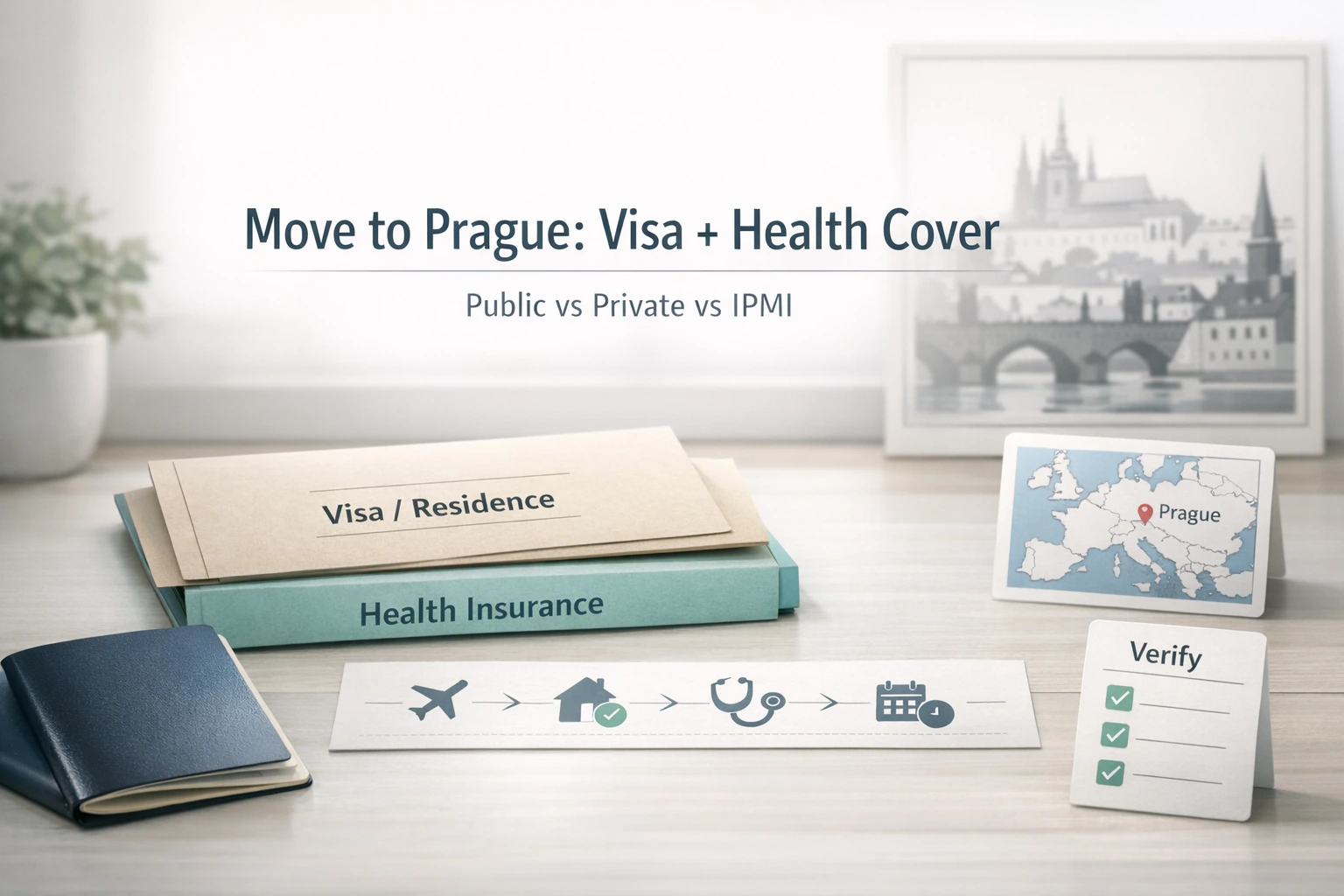

If you are planning a move to Prague, your health insurance decision usually needs to do two jobs at once. First, it needs to align with what the Czech authorities typically require as part of a long-stay visa or residence permit application. Second, it needs to work in practice once you arrive, including any gap period before you are clearly within the Czech public healthcare system. This guide is written for U.S. citizens who need a practical framework for Czech long-term visa and Czech residence permit planning, proof of insurance, Prague expat healthcare, and a 3–10 year strategy across public, private and IPMI options.[1][2][4][5][6]
- Your immigration proof and your long-term healthcare strategy are related, but they are not the same decision.
- Czech official guidance distinguishes between applications filed at a diplomatic mission and applications filed within Czechia.
- The main practical issue is often the gap period between visa stages, arrival, employer onboarding, registration and confirmed participation in the public healthcare system.
- Access to public healthcare depends on your status and timing, particularly for workers, dependants and children.
- IPMI can support mobility and continuity, but you should not assume an IPMI certificate will automatically satisfy Czech proof-of-insurance requirements.
- A sound 3–10 year strategy usually works in phases: application proof, arrival gap cover, status-linked public access, and then long-term continuity.
- Where official wording is unclear or may vary by permit type or consulate, treat it as something to verify rather than a settled rule.
Keep these official sources open while you plan:
- Czech Ministry of Foreign Affairs (MFA) long-stay visa guidance and route-specific consular pages.[2]
- Ministry of the Interior / Official Information Portal for Foreigners pages on medical insurance, long-term residence, registration after arrival, and processing periods.[3][4][7][8][9]
- Official Czech health-insurance guidance from VZP and related public-health pages.[6][17]
- Official insurer materials from Bupa Global, Cigna Healthcare, AXA Global Healthcare, Now Health International, Allianz, and APRIL International on portability, direct billing and network realities.[18][19][20][21][22][24][25][26]
- Executive brief + “Points to verify”
- Common long-stay routes (high level)
- What “proof of insurance” may mean in practice
- Arrival and registration timeline (practical steps)
- Public healthcare access: what to clarify early
- Local private vs IPMI decision framework
- Network/direct billing reality check
- 3–10 year strategy (mobility + continuity)
- Checklist: documents + questions
Executive brief + “Points to verify”
The central point is straightforward: the policy you use to satisfy visa or residence permit proof may not be the policy you want to keep for the next three, five or ten years. Czech official guidance focuses on legal status, where the application is filed, authorised insurers and documentary proof. International insurers, by contrast, focus on portability, territorial scope of cover, provider access, medical evacuation and claims handling. You need to consider both before you buy.[4][6][19][20][21][22][24][25][26]
For U.S. citizens, short non-profit stays can be visa-free for up to 90 days in any 180-day period, but moving to Prague for more than 90 days means using the correct Czech long-term visa or residence route.[1][2][3]
Czech official medical insurance guidance also makes clear that the documentary requirements depend on the type of application you are making and where you are making it. That is why “proof of insurance” is not a single, universal concept across every route.[4]
Employee Card, Blue Card, study, research, family reunification, business, or another long-stay category can affect what is typically required and when.[2][13][14][15][16]
Official Czech guidance distinguishes between filing at a diplomatic mission abroad and filing within Czechia. The required insurance wording is not identical in both cases.[4]
- Assuming a strong international private medical policy will automatically be accepted as Czech immigration proof.[4]
- Missing the distinction between applications filed abroad and those filed in-country.[4]
- Overlooking the possibility that official Czech translations and proof of premium payment may be requested when the visa is issued.[2][4]
- Assuming public healthcare starts the moment you arrive in Prague, rather than when your qualifying status takes effect in practice.[5][6]
- Leaving a gap between arrival, registration, employer onboarding and actual proof of public-insurance participation.[5][7]
Common long-stay routes (high level)
If you are moving to Prague rather than visiting, the starting point is that Czech official long-stay guidance is purpose-based. A long-term visa is for stays of more than 90 days and may be issued for up to one year. If you plan to remain for longer than one year, official guidance points instead to a long-term residence permit route.[2][3][9]
For many U.S. citizens moving to Prague, the most relevant routes are employment, highly qualified employment, study, scientific research, family reunification or business. Each of these categories has its own official guidance page and document requirements.[13][14][15][16]
Used for employment in the Czech Republic for more than three months. Official guidance also refers to route-specific documents such as the job vacancy reference number, employment contract and qualification evidence where relevant.[13]
Relevant if you are moving for highly qualified employment. It may also matter later if EU mobility becomes part of your longer-term residence strategy.[14]
Study and scientific research each have their own official route pages, and both can involve insurance steps at visa collection even where those documents are not submitted at the initial filing stage.[16]
There is also a practical entry stage that often causes confusion: the D/VR visa for the purpose of collecting a residence permit. Official guidance states that this visa is issued for six months but only permits a stay in Czechia of up to 60 days. It is not your long-term status itself. It is an entry step linked to collecting your residence permit and completing post-arrival formalities.[16]
Processing times vary by route, sometimes significantly. Official published time limits show that many in-country long-term residence applications or extensions can be processed within 60 days, while other routes can take much longer. This matters because your insurance bridge needs to be long enough to cover realistic processing times, not just the ideal timetable.[8]
What “proof of insurance” may mean in practice
This is often the point where U.S. applicants pause. Official Czech guidance says the required certificate depends both on the type of application and on where it is filed. In other words, “proof of insurance” is not one fixed document across all Czech long-stay routes.[4]
For applications linked to a Czech diplomatic mission abroad, the official medical-insurance page states that for stays exceeding 90 days you must have travel insurance covering comprehensive medical care, arranged with an insurer authorised to provide such insurance in the Czech Republic. The same page states that the agreed limit per insured event must be at least EUR 400,000, with no cost-sharing by the insured person.[4]
The same official source also explains that, before collecting a long-term visa or the D/VR visa, applicants can usually prove insurance either by combining cover for necessary and urgent care for the initial 90 days with comprehensive cover for the remainder of the stay, or by presenting a certificate of comprehensive medical insurance for the entire period of stay. The certificate must show, at a minimum, the period of validity and the scope of covered costs.[4]
MFA guidance adds an operational detail that matters in practice. When collecting a visa, applicants may be asked for an officially verified Czech translation of the insurance policy and general terms and conditions, and, if requested, proof that the premium has been paid. Route-specific MFA pages for employment, study and research repeat this point.[2][13][16]
If you are filing within Czechia, the official wording is slightly different. The same medical-insurance page states that your certificate must prove valid insurance for comprehensive healthcare, and that since 20 September 2023 it may be arranged with any insurance company authorised to provide it in the Czech Republic.[4]
You should separate two questions. First: what exact insurance proof does Czech immigration typically require for your route, filing location and stage of application? Second: what type of cover do you actually want once you are living in Prague and may be moving into the public system, adding dependants, or planning future mobility across Europe or back to the U.S.?
- Certificate wording that does not clearly show the period of validity and scope of cover.[4]
- Assuming a group, employer or IPMI certificate meets Czech format requirements without checking the issuing entity and wording.[4]
- Needing an official Czech translation later and not allowing enough time for it.[2]
- Overlooking the fact that proof of premium payment may be requested when the visa is collected.[2][4]
- Buying purely for immigration purposes and then discovering the policy is weak for routine outpatient treatment or future mobility.
Arrival and registration timeline (practical steps)
Once your application is approved, the sequence after travel matters almost as much as the policy itself. Your health insurance planning should be mapped against registration deadlines, biometrics, employer onboarding and residence-card collection.[7][16]
Before you collect the visa or D/VR visa
Make sure you understand what your official route page says is typically needed when the visa is issued. Depending on the case, that may include the insurance certificate, policy wording, official Czech translation and proof of premium payment if requested.[2][4][13][16]
Immediately after arrival
Official guidance states that third-country nationals must usually register with the Foreign Police within 3 working days of arrival, unless the accommodation provider has fulfilled that obligation on their behalf. If you entered on a D/VR visa to collect a residence permit, official guidance says you register with the Ministry of the Interior within 30 calendar days instead, and this is also where biometric steps are arranged.[7][16]
What is commonly required for registration
The official registration page lists the travel document, registration form and proof of travel medical insurance among the documents you may need. That is one reason why the gap-period policy should not be treated as a minor detail.[7]
Approval granted
↓
Collect visa / D/VR visa
↓
Present insurance-related documents required at collection
↓
Travel to Prague
↓
Register after arrival within the official deadline
↓
Complete biometrics / residence-card steps if applicable
↓
Employer onboarding and public-insurance participation (if your route qualifies)
↓
Review whether you still need private, local or IPMI cover for the gap period or longer term
One practical lesson is not to design your policy too narrowly around a single appointment date. Official registration and residence-card processes often involve several steps across several visits. Delays are not unusual in practice, even where you remain lawfully present during processing.[7][8][9]
For renewals and in-country extensions, official government guidance says that many applications may be filed no earlier than 120 days before expiry and no later than the last day of the current permit, while lawful stay may continue during processing. That protection is important, but it does not automatically solve healthcare continuity. Residence status and healthcare access are related, but they are not the same thing.[8][9]
Public healthcare access: what to clarify early
The safest way to think about Czech public healthcare is this: access depends on your status, your route and your timing. You should not assume that simply because you are resident in Prague, you are automatically within the Czech public system from day one.[5][6]
Official VZP guidance states that a foreign national without permanent residence may participate in Czech public health insurance as an employee of an employer with its registered office or permanent residence in the Czech Republic, or under certain treaty or European-regulation arrangements. The same VZP page also notes, in relation to the Czech Republic’s agreements with the U.S., that an insured person employed or carrying on business in the Czech Republic becomes a participant in the Czech system, while those treaty arrangements do not apply to tourist stays, including studies.[6]
The Ministry of the Interior’s treaty overview says something similar from the immigration side. U.S. citizens who carry out gainful activities in the Czech Republic participate in Czech public health insurance and submit a Czech public-insurance card, while posted workers and certain exceptions are treated differently.[5]
Permanent residence is another major threshold. Official Czech guidance states that permanent residence holders have access to public medical insurance and associated long-term rights in the Czech Republic.[10]
If you are moving with children, one more recent rule matters a great deal. Official guidance states that from 1 January 2024, foreign nationals under 18 with a valid long-term residence permit automatically become participants in the public health insurance system, regardless of purpose of stay. The same official page also states that this does not apply in the same way to minors who hold only a long-term visa.[12]
If you are genuinely working in the Czech Republic under qualifying conditions, participation in the public system may begin because of that employment status.[5][6]
Permanent residence changes the public-healthcare position materially and is often the clearest long-term threshold for public access.[10]
Family structure matters. Children with long-term residence now fall under a specific official rule, but long-term visas are not the same as long-term residence permits.[12]
In practical Prague expat healthcare planning, the key questions are not simply “Will I qualify?” but “When does that qualification begin?” and “When will I have usable documentary proof?” That timing issue is where local private cover or IPMI may still be relevant even if your long-term destination is the Czech public system.[5][6][7]
Local private vs IPMI decision framework
A useful way to compare your options is to split the issue into three layers: immigration compliance, local access to care, and long-term mobility. Public insurance is status-based. Local private or commercial cover is often the practical answer where you are outside public insurance but need Czech-focused proof and local cover. IPMI tends to matter more where you want continuity across borders, broader access to private providers, medical evacuation features, or an optional worldwide territorial scope.[4][6][17][18][20][21][22][24][25]
| Option | When it typically fits | What it may do well | What to watch |
|---|---|---|---|
| Czech public system | You are clearly within a qualifying status such as Czech employment or permanent residence, or your child qualifies under the minors’ long-term-residence rule.[5][6][10][12] | Access to the public system and contracted providers for covered care under the statutory framework.[10][17] | Access is status-based, not simply a matter of choice. It may not solve your initial gap period after arrival.[5][6][7] |
| Local private / commercial cover | You are not yet within public insurance and need cover centred on a Czech stay and Czech proof-of-insurance requirements.[4][6] | May be the more natural fit for Czech-specific immigration proof during the period when you are outside the public system.[4] | You still need to verify wording, insurer authorisation, and whether it will remain suitable if your life becomes more mobile.[4] |
| IPMI | You expect regional or global mobility, want a broader private-provider strategy, value medical evacuation and portability, or may move again in a few years.[18][20][21][24][25] | Territorial options, portability, direct-billing support within parts of the network, and international treatment flexibility are common features in official insurer materials.[19][20][21][22][24][25][26] | Do not assume immigration acceptance. You still need to verify the issuing entity, Czech authorisation, certificate wording, and the practical position on claims and direct billing in Prague.[4][19][20][22][24][26] |
For many households, the answer over 3–10 years is not a permanent “public vs private” binary. It is more often a staged combination: private or commercial cover first, public participation later if eligible, and IPMI either as the main private framework or as the continuity solution if mobility remains part of your future.[4][6][10][20][21][24][25]
If you want help comparing what that staged strategy might look like for your family, see BIG’s Individuals & Families page or request a tailored comparison through Get a Quote.
Network/direct billing reality check
This is where brochure language and day-to-day reality can diverge. Official insurer materials show that direct billing does exist, but it is not universal across all treatment settings, providers, countries or plan levels.[19][20][22][24][26]
Cigna states that it offers in-network direct billing and that inpatient and day-patient treatment requires prior authorisation. Bupa states that pre-authorisation helps it settle claims directly with network providers. Allianz states that pre-authorisation usually applies to inpatient and high-cost treatment. Now Health indicates that inpatient direct billing is available across its plans, while outpatient direct billing is more limited. APRIL’s direct-billing material highlights selected regions rather than presenting direct billing as universal. AXA also notes that for outpatient treatment, members may need to pay first and then submit a claim for reimbursement.[19][20][21][22][24][26]
If you are arranging private or international Prague expat healthcare, do not assume every outpatient appointment will be cashless simply because the plan has a network. Inpatient care is usually where direct billing is strongest. Routine outpatient consultations, diagnostics and smaller claims are often more mixed.
- Which Prague hospitals and clinics are genuinely in-network today?
- Is direct billing limited to inpatient treatment, or does it also apply to outpatient specialists and diagnostics?
- Is prior authorisation required before admission or a planned procedure?[19][24]
- Will you still need to pay deductibles, co-payments or co-insurance at the point of treatment?
- If you are outside your usual area of cover, are you limited to emergency treatment only?
For planning purposes, it is usually safer to keep enough available funds for routine outpatient costs unless the insurer confirms that your specific Prague provider and treatment type can be direct-billed. That is not a criticism of IPMI. It is simply a more realistic reading of how official insurer materials describe networks and claims handling.[19][20][22][24][26]
3–10 year strategy (mobility + continuity)
The most durable Prague health insurance strategy is usually phased. The right question is not simply “What gets me through this application?” It is also “What will still make sense after arrival, after registration, after a change of employer, after children arrive, or after a second move within Europe?”[4][6][10][20][21][24][25]
Phase 1: application and pre-move
Your first goal is admissibility and continuity. You need proof of insurance that matches official Czech expectations for your filing location and route, and you need to avoid an uninsured gap between visa collection, travel and arrival.[2][4][7]
Phase 2: the arrival gap period
This is the phase many movers underestimate. You may be lawfully in Prague and still not yet fully operating within the public system with documentary proof in hand. If your route is employment-based, confirm when employer registration actually translates into public-insurance participation and usable proof. If your route is not employment-based, assume you may need contractual cover for longer.[5][6][7]
Phase 3: years 1 to 3
At this point, the decision becomes more strategic. Are you now clearly within Czech public insurance? Do you still want faster private access in Prague? Are you likely to move country, change employer, add dependants, or spend meaningful time back in the United States? Those are the questions that start to separate a local-only solution from an IPMI-led one.[6][17][18][20][21][24][25]
Phase 4: years 3 to 5
This is where your residence strategy and healthcare strategy begin to connect more clearly. Official Czech guidance states that five years of continuous temporary residence can lead to permanent residence, and permanent residence then changes access to public medical insurance. Official guidance also notes that only qualifying long-term statuses count towards that residence period in the relevant way.[10][11]
If you are on a Blue Card route, official sources also point to a wider EU mobility dimension. That can make portability and continuity more valuable than a purely Prague-only policy structure.[14][10]
Phase 5: years 5 to 10
By this stage, the question is often less about acceptance and more about lifestyle. Permanent residence can make the public system a more stable long-term base. At the same time, official insurer documentation shows that IPMI is designed around territorial scope, international treatment flexibility, medical evacuation and continuity if you move again. If your life remains mobile, a purely local strategy may still feel restrictive even after you qualify for public insurance.[10][20][21][24][25]
Solve the immigration-proof issue first, but do not create a long-term problem in the process. The cleanest structure is usually one that gets you through the Czech proof stage, covers the arrival gap period, and still makes sense if your status, family circumstances or geography change over the next 3–10 years.
Checklist: documents + questions
Official Czech pages vary by route, but there is still a recognisable pattern in what is commonly required. Use the checklist below as a planning tool, then verify your exact route page and consular instructions before you submit anything.[2][13][16]
- Passport / travel document.[2]
- Completed application form.[2]
- Photographs, where required.[2]
- Proof of purpose of stay, such as work, study, research, family or business documents.[2][13][16]
- Proof of accommodation.[2][13][16]
- Proof of financial means, where applicable.[2][16]
- Criminal record extract, where applicable.[2][13][16]
- Travel medical insurance or comprehensive medical insurance at the stage officially required for your route.[2][4]
- Official Czech translations of foreign-language documents, where requested.[2][16]
- Apostille or superlegalisation for public documents, where required.[16]
- Proof that the insurance premium has been paid, if requested when the visa is issued or reviewed.[2][4]
| Question | Why it matters |
|---|---|
| Am I proving insurance for an application at a Czech consulate abroad or for an application filed within Czechia? | The official wording is not identical, and that can affect the certificate format expected.[4] |
| Does my route place me within Czech public insurance immediately, later, or not at all? | This determines whether you are solving only a short gap period or a longer phase outside the public system.[5][6] |
| Does the issuing insurer meet the “authorised in the Czech Republic” requirement? | This is central to the acceptance of Czech proof of insurance.[4] |
| Does the certificate clearly show the period of validity and scope of cover? | Official Czech guidance expects those details to be visible in the insurance proof.[4] |
| Will I need an official Czech translation and proof of premium payment? | These are recurring operational issues at the visa-collection stage.[2][4] |
| If I rely on private or IPMI networks in Prague, which providers are genuinely offering direct billing today? | Being in-network and offering cashless settlement are not the same thing in practice.[19][20][22][24][26] |
| If I move again in two or three years, will this cover move with me? | This is where local private cover and IPMI can diverge most clearly.[20][21][24][25] |
If you want help turning this checklist into an insurance shortlist, BIG’s Individuals & Families page is the best starting point. If you are ready to compare options, use Get a Quote.
Points to verify
- Your exact long-stay route and whether it is a long-term visa, long-term residence permit, Employee Card, Blue Card, family reunification, study, research or business case.[2][3][13][14][15][16]
- The exact insurance-proof wording and visa-issue requirements for your specific Czech diplomatic mission or consulate, especially translation and proof-of-payment requirements.[2]
- Whether your U.S.-citizen case is treated as gainful activity under the Czech–U.S. treaty framework, or whether you fall within a posted-worker or exception category.[5][6]
- The actual start date of Czech public-insurance participation for you and each dependant family member.[5][6][12]
- Whether your chosen insurer’s issuing entity is authorised in the Czech Republic and whether the certificate format matches current Czech expectations.[4]
- Whether any child in your household will hold a long-term residence permit or only a long-term visa, because the 2024 minors’ public-insurance rule does not apply equally to both.[12]
- Whether the Prague hospitals and clinics you care about are within your chosen insurer’s network now, and whether direct billing applies only to inpatient treatment or also to outpatient treatment.[19][20][22][24][26]
- If permanent residence is part of your long-term plan, whether your current status counts towards the residence period in the way you expect.[10][11][14]
These are points to verify, not defects. They are the areas where official wording, route-specific practice or insurer operational detail may matter enough that you should confirm them directly before relying on a policy for a Czech visa or residence step.
Book a free consultation with one of our experts
Choose your preferred adviser: Julien (English, French and Spanish) or Sean (English or Italian).
Julien — English, French and Spanish
Sean — English or Italian