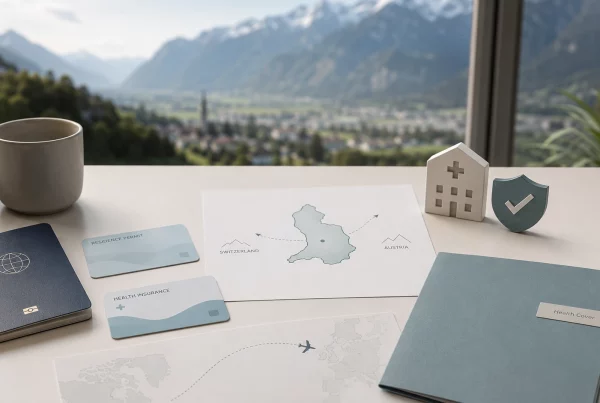



For US citizens moving to Croatia in 2026, health insurance is not just a practical healthcare decision. It is also part of the residence file. Croatia’s official temporary-stay guidance says third-country nationals must have health insurance, and the digital nomad route specifically asks for proof of health insurance covering the territory of the Republic of Croatia.[1][2]
The challenge is the “bridge period”: the time between leaving the US, applying for Croatia temporary residence, entering Croatia, registering your address, receiving residence status, and arranging any public or longer-term private cover. This article explains how to think about that bridge period, what official sources typically ask you to prepare, and how to build a 3–10 year cover strategy without assuming that one policy or one insurer will be accepted in every case.
Croatia can be attractive if you want an EU base, a slower pace, a coastal lifestyle, or a remote-work setup in a European time zone. But if you are a US citizen, you are usually treated as a third-country national for Croatian residence purposes. That means you need to plan beyond “I can enter for a short stay” and look carefully at what happens if you intend to remain.
Official Croatian guidance distinguishes short-term stay, temporary residence, long-term residence and permanent residence. It also lists the purposes for which temporary residence may be granted, including family reunification, education, research, humanitarian grounds, life partnership, work, other purposes, and stay of digital nomads.[1][4]
Health insurance sits inside that wider residence structure. It is not the only requirement, and it does not replace proof of purpose, funds, accommodation, clean-record documentation where required, or police registration. But it is one of the documents you should treat as a central planning item, not an afterthought.
This is not legal or immigration advice. It is an editorial and insurance-planning guide based on official Croatian and official insurer sources. For your own case, verify the exact route, wording, certificate, insurance type, dates and any local police or consulate preferences before you apply.
Executive brief (what to verify first)
- Residence route first: Croatia temporary residence is route-specific, so confirm whether you are applying as a digital nomad, worker, student, family member, researcher, or under another purpose.[1]
- Insurance proof is central: Official Croatian guidance lists health insurance among the conditions for temporary stay, and gov.hr lists proof of health insurance among documents to enclose.[1][4]
- Digital nomad Croatia insurance has explicit wording: the MUP digital nomad page asks for proof of health insurance for the planned period in Croatia, stating that travel or private health insurance must cover Croatia.[2]
- Visa-stage travel medical insurance is different: the Ministry of Foreign and European Affairs describes travel medical insurance for visa purposes, including urgent medical assistance, urgent hospital treatment and return home due to health reasons, with a minimum insured sum equivalent to €30,000.[3]
- Public healthcare Croatia access is status-dependent: HZZO states that health insurance in Croatia is compulsory and sets out categories required to obtain insurance, including certain third-country nationals with temporary stay, subject to exceptions in EU law, treaties or special laws.[5]
- The bridge period needs planning: arrange cover from the day you leave the US through application, entry, police registration, permit processing, and any public-system enrolment.
- 3–10 year thinking matters: avoid short-term gaps in cover, keep renewal evidence, and re-check your strategy before permit renewals, family changes, treatment needs, or a future move.
Before relying on any policy, verify the following with the Croatian embassy, consulate, MUP/police office, HZZO and your insurer:
- Whether your specific permit route accepts travel insurance, private medical insurance, public insurance evidence, or a combination.
- Whether the policy must cover the full requested residence period, the visa period, or only the bridge period until Croatian compulsory insurance status is obtained.
- Whether any minimum sum insured, excess/deductible rule, repatriation wording, policy language, certificate wording, or translation is required.
- Whether dependants need separate certificates or can be listed on one family policy.
- Whether your local police station or consulate has route-specific practice that is not visible on the general official pages.
- Executive brief (what to verify first)
- Typical residence routes (high level)
- Health insurance as a residence requirement: what to prepare
- Arrival admin timeline (what happens after entry)
- Public system access: what’s route-dependent
- Local private vs IPMI (decision framework)
- Claims/direct billing considerations (practical reality)
- 3–10 year strategy (continuity, future moves)
- Checklist (documents + questions)
Typical residence routes (high level)
For US citizens moving to Croatia, the first planning question is not “which health plan should I buy?” It is “which residence route am I actually using?” Health insurance proof is tied to the route and to the stage of the process.
Croatian official guidance uses the term third-country national for people who are not nationals of EU/EEA countries or Switzerland. gov.hr explains that third-country nationals may have short-term stay, temporary residence, long-term residence or permanent residence in Croatia.[4] For a move, the relevant starting point is usually temporary residence.
The Ministry of the Interior says temporary stay may be granted for several purposes. These include family reunification, secondary school education and university studies, scientific research, humanitarian grounds, life partnership, work, posted work, stay of persons with long-term residence in another EEA member state, other purposes, and stay of digital nomads.[1]
Croatia defines a digital nomad as a third-country national who works through communication technology for a company, or their own company, that is not registered in Croatia and who does not perform work or provide services to Croatian employers.[2]
Temporary stay for work is treated as a stay and work permit under MUP guidance. Your employer and the Croatian employment process may be part of the file, depending on the role and category.[1][6]
Students need to check the education route and health insurance rules carefully. Study in Croatia states that international students applying for temporary residence for study are not required to register for Croatian compulsory health insurance if they can provide another proof of valid health insurance.[7]
Family reunification and life partnership appear as temporary-stay purposes in official guidance. Documentation will typically focus on the relationship, the sponsor’s status and the general conditions for temporary stay, including health insurance.[1][4]
“Other purposes” appears in the official list of temporary-stay grounds. Because it is less self-explanatory than work or study, you should verify the exact documents and insurance expectations with the competent Croatian authority before relying on a general checklist.[1]
Long-term residence is a separate later stage. MUP states that it may be granted after an uninterrupted period of legal stay in Croatia, subject to conditions including funds, health insurance and Croatian language knowledge.[8]
For digital nomads, the official MUP page is particularly useful because it gives a route-specific definition and a route-specific document list. It says temporary stay is granted for up to a maximum of eighteen months, possibly less. It also says a new digital-nomad stay application can be submitted six months after the expiry of a previously granted stay for other purposes, digital nomad stay, family reunification or life partnership with the digital nomad.[2]
For US citizens, this matters because a digital nomad route is often discussed as if it were a lifestyle product. Officially, it is a residence category with defined conditions. Your digital nomad Croatia insurance plan should therefore be treated as part of a government-facing file, not simply as a travel purchase.
For work permits, your health insurance strategy may be different. If you will be employed in Croatia, your employer and the Croatian contribution system may become central after status is granted. However, you should still expect a bridge period in which you need application-ready proof of health insurance and a plan for what happens before payroll registration or public-system status is active.
For students, the official study portal creates a different planning angle. It says that international students are not required to register for Croatian compulsory health insurance if they can provide another proof of valid health insurance, such as comprehensive private health insurance.[7] That does not mean every private student policy is automatically accepted. It means you should verify the student-specific requirements and prepare a certificate that meets the authority’s expectations.
For family members, the health insurance question can be more complex than for a single applicant. A spouse or child may be included on an international family policy, listed on a local policy, or treated differently once Croatian public cover is arranged. The official route will tell you what the Croatian authority needs for residence; the policy terms will tell you what the insurer actually covers.
Do not start by asking whether Croatia accepts “international health insurance” in the abstract. Start by identifying your route, application location, intended stay dates, family members, and bridge-period length. Then ask the authority and insurer whether the certificate you have will satisfy that route.
Health insurance as a residence requirement: what to prepare
The phrase “proof of health insurance” sounds simple. In practice, it can mean different documents at different stages. You may need visa-stage travel medical insurance, temporary-residence health insurance proof, and later public-system or long-term private evidence.
MUP’s general temporary-stay page says third-country nationals will be granted temporary stay if they prove the purpose of temporary stay, have a valid travel document, have funds to support themselves, have health insurance, meet first-application criminal-record requirements where applicable, are not subject to entry/stay bans or SIS alerts, and are not considered a threat to public policy, national security or public health.[1]
gov.hr’s temporary-residence page lists documentation to enclose with the application, including a photo, copy of valid travel document, proof of health insurance, proof of means of support, proof of grounds for temporary residence, and other documents depending on the situation.[4] It also states that foreign documents must be originals or certified copies and, where applicable, provided as certified Croatian translations and certified pursuant to special regulations.[4]
For digital nomads, MUP gives a more specific insurance instruction. The digital nomad application documentation includes “proof of health insurance for the period of time that you plan to be in Croatia,” and it states that travel or private health insurance must cover the territory of the Republic of Croatia.[2]
That wording is important. It does not name a specific insurer. It does not say a specific international private medical insurance policy is guaranteed to be accepted. It says the proof must cover the planned period and the Croatian territory.
Visa-stage travel medical insurance
A US citizen may be able to enter Croatia without applying for a short-stay visa, depending on the rules that apply to their stay and the Schengen 90/180-day calculation. But if you apply for a Croatian visa, the travel medical insurance rules become relevant.
The Ministry of Foreign and European Affairs says appropriate, valid travel medical insurance covers expenses that may arise during the applicant’s stay in Croatia for return home on health grounds, urgent medical assistance, urgent hospital treatment, or transport costs in the event of death.[3] The same official page states that the minimum sum insured must be the equivalent of €30,000.[3]
For long-term visa D, the official travel-medical-insurance page says the cover should apply for the period until the applicant obtains the status of insured person under compulsory health insurance in Croatia. It also states that applicants for long-term visas must provide evidence of an appropriate and valid travel medical insurance policy corresponding to the number of days and the period of validity of the visa for their stay in Croatia.[3]
This is where the bridge period becomes visible. Visa insurance may not be the same as your long-term healthcare strategy. It may be designed to cover the period until you have Croatian compulsory health insurance status, or until a different arrangement is documented.
Temporary-residence proof
For the residence file, you should prepare a clear insurance certificate rather than only a receipt or website confirmation. The certificate should typically show:
- Your full name as shown on your passport.
- Names of any covered dependants, if they are applying with you.
- Policy number or certificate number.
- Insurer name and contact details.
- Start date and end date.
- Territory of cover, including Croatia or a region that clearly includes Croatia.
- Type of cover, such as travel medical insurance, private medical insurance, or international health insurance.
- Benefits relevant to official proof, such as emergency medical treatment, hospital treatment and, where required, repatriation.
- Any excesses/excess/deductibles, limits or exclusions that the authority has asked to see.
Do not invent a minimum limit if the official route page does not state one. Where the Croatian visa-insurance page states €30,000, you can cite that for visa-stage travel medical insurance. Where the temporary-residence or digital-nomad page asks for health insurance but does not publish a specific limit, treat that as a point to verify.
Travel insurance vs private medical insurance vs IPMI
It is common to see these terms used interchangeably online. For residence planning, you should keep them separate. Travel medical insurance is often built for short stays and urgent events. International private medical insurance is usually built for longer stays, private treatment access, outpatient benefits, annual renewals, and multi-country portability.
Official insurer materials reflect that difference. Allianz Care describes international health insurance plans for people spending long periods overseas and notes that they are not just for emergency treatment, while its nomad-health page distinguishes international health insurance for sustained relocation from travel insurance for emergency treatment during shorter periods abroad.[9][10]
AXA Global Healthcare similarly describes international health insurance as designed for people living in another country or travelling overseas often, with cover for both emergency and routine healthcare depending on the plan and region of cover.[11] These are insurer descriptions, not Croatian immigration rules. They help you understand product design; they do not guarantee residence acceptance.
| Cover type | Typical role in a Croatia move | What to verify |
|---|---|---|
| Travel medical insurance | Often used for visa-stage or short bridge-period proof, especially where official visa rules refer to urgent medical assistance, urgent hospital treatment and return home due to health reasons. | Minimum insured sum, dates, territory, repatriation wording, visa D requirements, and whether it is accepted for your residence route. |
| Private local insurance | May help with private clinics Croatia, outpatient access or supplementary needs, depending on the insurer and plan. | Whether it satisfies residence proof, whether it is supplementary only, and whether it includes inpatient or emergency benefits. |
| International private medical insurance (IPMI) | Can be useful where you want multi-country private healthcare access, treatment outside Croatia, continuity through future moves, or US/global options. | Certificate wording, Croatia territory, renewal terms, exclusions, pre-existing condition handling, direct billing, and whether the authority accepts it for your permit. |
| HZZO / compulsory public cover | May become relevant after residence or employment status, depending on your route and category. | When you must apply, contribution basis, dependants, co-payments, supplementary cover, and whether any special-law exception applies. |
The bridge-period cover problem
The bridge period is the time when your US cover may no longer be practical, your Croatian status may not yet be fully settled, and your application still needs proof of insurance. This can include the period before you submit, while you are waiting for a decision, while you register your address, and while you arrange public-system or longer-term private cover.
The risk is not only medical. A lapse in cover may create an administrative problem if you are asked to show continuous proof or updated documents. It can also create a treatment problem if you need urgent care before your next cover arrangement begins.
For a careful file, align the dates. Your certificate should not begin after your intended entry date if the authority expects cover from entry. It should not expire before the period for which you are requesting residence, unless the official route specifically allows a shorter bridge policy until HZZO registration or another event.
Ask your insurer for a certificate that states the insured person, policy period, territory of cover and relevant medical benefits. If a Croatian authority asks for repatriation wording, a minimum insured sum, or Croatian/English language wording, ask the insurer to confirm whether the certificate can include that wording. Do not assume a generic membership card is enough.
Arrival admin timeline (what happens after entry)
A move to Croatia is easier when you think in phases. Insurance proof is only one part of the file, but the file changes as you move from planning to application to arrival to public-system or private-care use.
Before you apply
• Identify the correct residence route.
• Confirm whether you apply abroad, online, or at a Croatian police administration/police station.
• Prepare passport, proof of purpose, proof of funds, accommodation evidence and insurance certificate.
• Check whether translations, certified copies, apostilles or route-specific documents are needed.

Arrival
• Track your Schengen/short-stay days if relevant.
• Register your temporary residence address within the official deadline.
• Keep copies of entry evidence, accommodation documents and insurance proof.
• Follow police/consulate instructions for biometrics, fees and residence card steps.

First 90 days
• Monitor application status and any requests for additional documents.
• Keep insurance active through the full bridge period.
• If required, apply for Croatian compulsory health insurance through HZZO within the applicable deadline.
• Choose doctors, understand public/private billing, and decide whether to keep IPMI or private top-up cover.
Before you apply
Start with the official route. MUP says an application for temporary stay is submitted at a diplomatic mission or consular post of the Republic of Croatia, and third-country nationals who are not required to have a visa to enter Croatia may also apply at a police administration or police station according to their intended place of stay, employer’s head office or place of work.[1]
gov.hr similarly states that applications for temporary residence are submitted at the competent Croatian diplomatic mission or consular office before entry, while a third-country national who does not need a visa for entry may apply at the competent police administration or station at the place of intended stay.[4]
For digital nomads, MUP also provides an online application route and states that documents should be submitted in Croatian or English.[2] That does not remove the need to verify the exact document format. It means you should prepare clean, readable files and be ready for the caseworker to request additional documentation.
Your insurance certificate should be ready before you submit. Avoid buying a policy so late that the certificate is not issued in time. Also avoid using a certificate that does not show Croatia, the policy period, or covered people clearly.
Arrival
If you enter Croatia before the residence decision or after approval, address registration becomes important. MUP states that foreign nationals must report their temporary residence address at the competent police administration or police station not later than three days from entry into Croatia.[1]
This is a practical point many movers underestimate. You may be thinking about a lease, mobile phone, bank account and shipping. The police registration deadline is more immediate.
Keep your accommodation evidence accessible. If you are in a hotel or temporary rental first, verify who reports what and whether you still need to attend the police station. If you move into a longer lease, keep the lease and landlord details available for your file.
Residence card and fees
MUP states that if a temporary-stay application is approved, the applicant is issued a biometric residence permit. If the application is submitted at a diplomatic mission or consular post, the person is notified once a decision has been issued and is instructed to attend the competent police administration or police station to provide biometric data.[1]
The same official temporary-stay page also lists administrative fees for temporary stay and biometric residence permit production when applying at a police administration or police station.[1] Fees can change over time or depend on procedure, so verify the current payment instructions with the competent authority before paying.
From an insurance perspective, this matters because your policy should remain in force while the administrative process unfolds. Do not let your bridge policy expire while waiting for biometrics or a card pickup. If the authority asks for updated proof, you should be able to produce it quickly.
First 90 days
The first 90 days are often when assumptions are tested. You may find that a private clinic asks for payment at the appointment. You may learn that your insurer needs pre-approval for inpatient care. You may receive a request from a Croatian office for updated or clearer proof.
If you expect to rely on public healthcare Croatia, confirm your HZZO obligations early. HZZO says application, changes and cancellation of compulsory health insurance can be executed at any CHIF branch office within eight days from the day of occurrence of the changes or termination of the circumstances on the basis of which one obtains insured-person status.[5]
If your route is student-specific, check the student rule separately. Study in Croatia states that international students applying for temporary residence for study are not required to register for Croatian compulsory insurance if they can provide another proof of valid health insurance.[7] That is not a general exemption for all US citizens.
- Passport and copies.
- Temporary residence application confirmation, if already submitted.
- Insurance certificate and policy schedule.
- Accommodation evidence.
- Police registration confirmation.
- Fee payment evidence.
- OIB / personal identification number evidence, once issued.
- Biometric appointment or card pickup instructions.
- HZZO documents, if you are required to register.
- Insurer app, portal login and emergency assistance number.
Public system access: what’s route-dependent
Public healthcare Croatia planning should be careful and status-specific. It is tempting to say “Croatia has public healthcare, so I will simply use it.” That is too broad for a US citizen moving from outside the EU.
HZZO states that health insurance in Croatia is compulsory and that compulsory health insurance is implemented by the Croatian Health Insurance Fund (CHIF/HZZO).[5] The same HZZO page explains that health insurance and healthcare for aliens is governed by a special act.[5]
HZZO lists categories of people required to obtain health insurance. These include persons with permanent residence in Croatia, aliens with approved permanent stay or long-term residence, and nationals of non-EU/EEA/Swiss/UK or non-contracting states with temporary stay in Croatia, unless otherwise stated by EU law, international treaties on social security, or special laws.[5]
This is why you should not assume that the same rule applies to every US citizen in every situation. Employment, study, family status, special laws and route-specific practice may affect when you register, how you contribute, and what proof is needed.
What HZZO cover includes at a high level
HZZO’s National Contact Point page states that rights under compulsory health insurance in Croatia include financial compensation and healthcare services. It lists healthcare rights including primary healthcare, specialist-consultative healthcare, hospital healthcare, medicines determined by CHIF lists, certain dental prostheses, orthopaedic and other medical prostheses, and cross-border healthcare rights.[5]
It also explains that healthcare is carried out at primary, secondary and tertiary levels. Primary care includes general or family medicine, healthcare for preschool children, women’s healthcare, field nursing care, in-house healthcare treatment, dental healthcare, sanitary-epidemiological services, laboratory diagnostics, pharmacy and emergency medical assistance.[5]
Secondary and tertiary healthcare is provided based on a referral from the selected primary healthcare physician. That referral structure matters if you are used to US private access, where you may be able to book directly with specialists depending on your plan.
Cost participation and supplementary cover
Public cover does not mean every service is free at the point of use. HZZO states that insured persons are obliged to participate in the costs of healthcare for services not entirely covered by CHIF. It gives a minimum participation amount of €1.32 and a maximum of €530.88 per one invoice.[5]
The same page states that a person with compulsory health insurance regulated by CHIF is entitled to enter into an agreement with CHIF on supplementary health insurance to cover participation costs.[5] This is one reason some residents combine HZZO with supplementary or private cover.
Students
Students need separate attention because the Study in Croatia page provides a specific statement. It says that when applying for temporary residence for the purpose of studying, international students are not required to register for Croatian compulsory health insurance if they can provide another proof of valid health insurance, such as comprehensive private health insurance.[7]
That statement is useful, but it should not be overextended. It does not automatically apply to a digital nomad, a self-funded retiree-type applicant, a worker or a family member. It also does not mean every student travel policy is suitable for a full academic year, chronic care, mental health, maternity, outpatient medication or private-clinic access.
Workers
If your move is employment-based, health insurance may ultimately be tied to Croatian employment and contributions. However, do not rely on a future payroll event to satisfy a current application requirement unless the authority confirms that is acceptable. You may need proof at the application stage, before employment registration is fully active.
Employer-based cases also create family questions. If your spouse or children move with you, verify whether they are covered through family status, separate public registration, private cover, or another arrangement. This is one of the points where public-system eligibility can become route- and household-dependent.
Digital nomads
For digital nomads, the MUP application list expressly allows travel or private health insurance that covers Croatia for the planned period.[2] That is application-stage proof. It does not answer every question about what happens later with HZZO, private treatment, renewals or family members.
Because digital nomads do not work for Croatian employers under the MUP definition, the pathway to public contributions may differ from a local employment case. Verify this with HZZO or the competent authority for your status. Do not assume that remote work for a foreign company automatically creates the same public-system steps as Croatian employment.
Use cautious language when planning public healthcare Croatia access. HZZO is central to Croatia’s compulsory system, but your access, timing, contributions and documents depend on your status. Confirm your own route with HZZO or the relevant Croatian office after your permit status is clear.
Local private vs IPMI (decision framework)
Once your residence file is under control, the next question is broader: what healthcare experience do you want in Croatia over the next 3–10 years? The answer may be different from the minimum insurance proof required for the permit.
You can think in three layers:
- Compliance layer: what the Croatian authority asks you to show for visa, temporary residence, renewal or long-term residence.
- Healthcare-access layer: how you will actually see doctors, use hospitals, manage prescriptions and access private clinics Croatia.
- Continuity layer: how cover behaves if you move again, visit the US, develop a condition, add family members, or need treatment outside Croatia.
Local public + supplementary/private options
If you become enrolled in HZZO and expect to live mainly in Croatia, the public system may become the base layer. It can provide access to primary care, referrals, hospital care and medicines under the Croatian system, subject to rules, participation costs and provider pathways.[5]
You may still want private options. Private clinics Croatia can be useful for faster appointments, English-language comfort, direct specialist booking, diagnostics or second opinions. But local private clinic billing is a practical issue: you may need to pay directly and claim from an insurer if your plan covers it.
Local private insurance may be sufficient if your life is Croatia-centred and your main concern is supplementary access. It may be less suitable if you want treatment in multiple countries, US cover, international evacuation, or continuity through future moves.
IPMI as a long-term portability tool
International private medical insurance can be useful if you want a plan that is designed for people living abroad and moving between countries. Allianz Care describes its international health insurance plans as intended for people who spend long periods overseas and notes that they can include diagnosis, post-treatment care and health and wellbeing checks depending on the table of benefits.[9]
AXA Global Healthcare describes international health insurance as designed for people living in another country or travelling overseas often, with emergency and routine healthcare depending on plan design and region of cover.[11] These descriptions are helpful for product comparison, but they are not Croatian immigration approval.
The main advantage of IPMI is continuity. If you move from Croatia to Portugal, Spain, Germany, the UAE, Singapore or back to the US, a well-structured international policy may give you a more stable underwriting and claims framework than restarting a local policy each time. However, region of cover, US inclusion, pre-existing condition rules and renewal terms need careful review.
Decision table
| Your situation | Likely planning emphasis | Questions to ask |
|---|---|---|
| You are testing Croatia for 6–18 months | Bridge-period proof, flexible private access, clear exit strategy. | Does the policy cover the full residence period? Can it be renewed? What happens if you leave Croatia early? |
| You are a digital nomad | Digital nomad Croatia insurance certificate plus multi-country portability. | Does the certificate state Croatia? Does the policy cover remote-work travel patterns? Is repatriation included if required? |
| You are moving with family | Family certificates, paediatric access, maternity, dependants, school documents. | Are all dependants named? Are children covered from day one? Are maternity and newborn rules clear? |
| You expect Croatian employment | Public-system integration plus bridge cover until employment/public status is settled. | When does employer registration start? Do family members need separate cover? Do you still want private access? |
| You expect to stay 5+ years | HZZO obligations, renewal evidence, long-term residence file, chronic-care continuity. | How will you prove health insurance at renewal and long-term residence stage? Are pre-existing conditions protected if you switch insurers? |
| You travel back to the US often | IPMI with or without US cover, or separate travel/short-term US planning. | Is the US included? Is it emergency-only? What are the excesses/excess/deductibles and networks? |
What not to do
Do not choose cover only by price. A low-cost emergency-only policy may look attractive until you need outpatient care, ongoing medication, oncology support, mental health care, maternity, physical therapy, or non-urgent diagnostics.
Do not assume that a private clinic will bill your insurer directly. Direct billing depends on the insurer, the provider, the treatment type, pre-approval, and local practice. Even major insurers often distinguish between inpatient direct settlement and outpatient reimbursement.
Do not switch insurers casually after diagnosis. If you develop a condition during year one, moving to a new policy in year two may create underwriting, exclusion or waiting-period questions. Continuity can be more valuable than a small premium saving.
We can help you compare how different international plans approach area of cover, certificate wording, excesses, outpatient benefits, direct billing, renewals and pre-existing condition treatment. We cannot guarantee Croatian authority acceptance, and we do not replace legal or immigration advice.
Claims/direct billing considerations (practical reality)
A residence certificate proves that you have cover. It does not tell you how a Croatian clinic will bill, whether a hospital will accept direct settlement, or how quickly reimbursement will be paid. For real-world planning, claims mechanics matter.
AXA Global Healthcare’s member guidance describes a process where members check cover, arrange care, and, where possible, the insurer usually settles the bill directly. It also says that if the member has paid up front, they can upload the invoice and receipt to their online account for reimbursement, subject to the insurer having the required information.[12]
AXA’s bill-payment guidance distinguishes inpatient/day-patient treatment from outpatient treatment. It says a pre-approval letter can be arranged for inpatient or day-patient treatment and that some providers request it as confirmation they can send the bill directly. For outpatient consultations, tests and treatment, it says members normally need to pay at the time of appointment and keep itemised invoices and receipts.[13]
Allianz Care’s public materials state that it has a provider search tool for hospitals, doctors and health practitioners worldwide, including providers with direct settlement agreements, and that members can submit and track claims online through MyHealth.[14] Again, this is insurer process information, not a guarantee that a specific Croatian provider will direct-bill for a specific treatment.
Direct billing
Direct billing means the insurer pays the provider directly for eligible treatment. It is most common for planned inpatient or day-patient treatment, especially where the provider has a relationship with the insurer and approval is arranged before treatment.
For Croatia, you should verify direct billing before treatment. Ask your insurer:
- Which hospitals, clinics or doctors in Croatia are in-network.
- Whether the provider has a direct settlement agreement.
- Whether treatment requires pre-authorisation or a guarantee of payment.
- Whether direct billing applies only to inpatient/day-patient care.
- Whether you still pay the excess/deductible, excess, coinsurance or excluded items yourself.
Reimbursement
Reimbursement means you pay the provider first and then claim back eligible costs from the insurer. This is common for private clinics Croatia, outpatient appointments, laboratory tests, prescriptions and small specialist invoices.
Keep itemised invoices and receipts. A card transaction alone may not be enough. Insurers typically need the patient name, provider details, treatment date, diagnosis or reason for visit, service breakdown, amount paid and proof of payment.
Pre-authorisation
Pre-authorisation is the insurer’s approval before certain treatment. It is commonly required for hospital admissions, surgery, high-cost diagnostics, cancer treatment, maternity admissions and planned procedures. Your policy wording and benefits table control this.
If you are in Croatia and a doctor recommends a procedure, pause before booking unless it is an emergency. Contact the insurer, send the medical report and estimate, and ask whether pre-approval is required. Missing pre-authorisation can lead to delays or reduced reimbursement depending on policy terms.
Public vs private claim experience
If you are using HZZO-contracted public care as an insured person, the experience is different from private insurance reimbursement. You follow the Croatian public pathway, choose or use contracted providers as applicable, obtain referrals where required, and pay participation costs where due.
If you use a private clinic outside the public pathway, you may pay privately even if you also have HZZO. Your private or international insurer may reimburse some or all eligible expenses if the plan covers that service and you follow the claims rules.
- Save your insurer’s 24/7 assistance number.
- Register for the insurer’s app or member portal before you need care.
- Download your insurance certificate and policy schedule.
- Check pre-authorisation triggers for inpatient, day-patient and high-cost outpatient care.
- Use provider search tools, but confirm direct billing with the insurer and provider.
- Keep itemised invoices, receipts, prescriptions and medical reports.
- Ask whether documents need to be in English, Croatian or another accepted language.
- Track every claim reference number and submission date.
Common mistakes list
- Assuming travel insurance works like long-term medical insurance: travel insurance is often designed for emergencies and short stays, not multi-year chronic-care planning.
- Letting cover lapse during the bridge period: a gap can create medical and administrative risk if you are asked for updated proof.
- Submitting a certificate with unclear territory: if Croatia is not named or clearly included, ask for a better certificate.
- Forgetting dependants: spouse and children may need to be named separately.
- Paying for private treatment without pre-authorisation: for larger treatment, check before you book.
- Assuming direct billing is automatic: even with a major IPMI insurer, some Croatian providers may require payment up front.
- Not keeping documents: no invoice, no receipt, no medical report can mean a slow or incomplete claim.
3–10 year strategy (continuity, future moves)
A 3–10 year strategy starts with a simple idea: the insurance you use to enter Croatia may not be the insurance you should rely on after several years. Your needs change as your residence status, health, family, income and travel pattern change.
MUP states that temporary stay is granted for a period of up to one year, while the digital nomad route is granted for up to a maximum of eighteen months, possibly less.[1][2] Later, MUP states that long-term residence may be granted after five years of uninterrupted legal stay in Croatia, subject to rules and conditions.[8]
That creates natural planning phases:
Focus on route selection, certificate wording, bridge-period cover, police registration, and avoiding gaps while the file is reviewed.
Learn how you actually use care in Croatia. Test public access, private clinics, insurer reimbursement and provider availability.
Review whether your policy still fits your residence route, health history, travel pattern, dependants and budget.
Start building clean evidence of residence, insurance continuity, funds and system integration before any long-term residence plan.
Decide whether Croatia is your base, whether you need EU mobility, whether IPMI remains valuable, and how future moves affect underwriting.
Years 0–1: avoid fragile cover
In year one, the goal is stability. Your policy should cover the application period, arrival, address registration, permit card process and any public-system transition. It should also give you a practical way to access care if something happens before your Croatian arrangements are settled.
If you choose travel medical insurance for the bridge period, diarise the expiry date. Do not assume you can extend it from Croatia. Some travel policies have maximum trip-length rules, residence restrictions or no renewal once you have already left the US
If you choose IPMI from the beginning, ask for the certificate before submission. Check whether the plan is annual, renewable, medically underwritten, moratorium-based, or subject to exclusions. Also confirm whether the policy is valid for someone resident in Croatia rather than simply travelling there.
Years 1–3: test your actual healthcare use
After the first year, you will know more about your own healthcare pattern. You may find public care sufficient for primary needs, with private clinics for occasional speed. Or you may decide that international private cover is worth keeping because you travel often, want access outside Croatia, or prefer private specialist pathways.
This is also when claims experience matters. If every outpatient visit requires payment up front and slow reimbursement, you may want a different plan structure. If your insurer has good direct billing for inpatient care but weak outpatient benefits, you may adjust your excess/deductible or add outpatient cover at renewal.
Avoid switching purely because another plan looks cheaper. If you have received treatment, developed symptoms, started medication or received investigations, a new insurer may treat that history differently. Maintaining continuous cover can matter more than headline premium.
Years 3–5: prepare for long-term residence questions
If you expect to remain in Croatia long enough to explore long-term residence, organise your evidence early. MUP states that long-term residence requirements include a valid travel document, funds to support yourself, health insurance, knowledge of the Croatian language and Latin script, and no threat to public policy, national security or public health.[8]
Your insurance evidence should be clean. Keep policy schedules, renewal notices, certificates, HZZO confirmations, contribution evidence and dependant documents. If your route changes, keep proof of the change and the insurance basis attached to it.
If you plan to rely on public cover at that stage, understand your HZZO status and contributions. If you plan to rely on private or international cover, verify whether that is acceptable for the long-term residence file. Do not assume a temporary-stay certificate format will automatically satisfy a later long-term residence application.
Years 5–10: permanence, EU mobility and family changes
Between years five and ten, your strategy may move from “How do I get approved?” to “How do I protect continuity?” You may buy property, start a family, marry, divorce, change employment, retire, or move between countries. Each event can change your insurance needs.
If Croatia becomes your permanent base, HZZO plus supplementary/private options may become more natural. If you remain internationally mobile, IPMI may still have value. If you plan to return to the US, you need to think about US cover, eligibility, networks and timing well before you leave Croatia.
If you move to another country, check whether your existing international policy can move with you. Some IPMI plans allow changes to the area of cover; others require new underwriting or new pricing. A move may also affect public-system eligibility and residence-proof requirements in the next country.
Treat insurance as a continuity asset. The longer you are abroad, the more valuable clean renewal history, stable underwriting, clear documentation and predictable claims processes become. The cheapest first-year solution may not be the right 10-year solution.
Checklist (documents + questions)
Use this checklist as a planning tool. It does not replace the official list for your route. It helps you organise the insurance and healthcare side of a Croatia move before you speak with the authority, insurer or broker.
- Valid US passport with sufficient validity for the intended stay and permit period.
- Completed temporary residence application form or online application confirmation.
- Passport photo in the required format.
- Proof of purpose for the route, such as employment documents, remote-work documents, study enrolment, family documents, research documents or other-purpose evidence.
- Proof of means of support.
- Proof of accommodation or intended address.
- Proof of health insurance covering Croatia and the relevant period.
- Clean-record certificate or criminal-record evidence where required for first temporary residence.
- Certified copies, certified translations or apostilles where required.
- Fee payment evidence.
- Police registration evidence after arrival.
- HZZO registration evidence, if required for your status.
- Insurance certificate naming each applicant.
- Policy schedule showing start date, end date and territory.
- Benefit summary showing emergency, inpatient, outpatient and repatriation benefits where relevant.
- Proof of premium payment if requested.
- Insurer contact details and emergency assistance number.
- Claims instructions, including portal/app access.
- Pre-authorisation instructions.
- Provider search or network instructions.
- Written confirmation of any certificate wording the insurer can or cannot provide.
Route-dependent items
| Route | Route-dependent items to prepare | Insurance questions |
|---|---|---|
| Digital nomad | Remote-work contract, employer letter, own-company documents, proof that work is performed through communication technology for a foreign employer or own foreign company. | Does the certificate cover the full planned Croatia period? Does it clearly cover Croatia? Is it travel or private health insurance as accepted by the authority? |
| Work | Employer documents, work/stay permit process documents, contract or role evidence, labour-market or employer submissions where applicable. | What covers the bridge period before Croatian employment/public registration is active? Are dependants covered? |
| Study | Acceptance/enrolment letter, proof of study, tuition or scholarship evidence where applicable. | Does the student rule allowing other proof of valid health insurance apply to you? Is the policy comprehensive enough for the study period? |
| Family | Marriage certificate, birth certificate, life partnership evidence, sponsor status, proof of genuine relationship where required. | Are all family members named? Does the sponsor’s public or private cover extend to dependants? Is separate cover required? |
| Other purposes | Purpose evidence requested by the competent authority and any supporting documentation specific to the case. | Does the authority accept travel cover, private cover or require a different arrangement? Is the cover period aligned with the requested stay? |
Questions for the Croatian authority
- Which residence route should I apply under based on my facts?
- Can I apply from inside Croatia, or should I apply through a diplomatic mission or consular post?
- For my route, what exact health insurance proof is accepted?
- Must the insurance cover the full requested residence period?
- Is travel medical insurance acceptable, or is private health insurance required?
- Is there a minimum insured sum for this permit route?
- Must the certificate mention repatriation?
- Does the certificate need to be in Croatian, English, or both?
- Do family members need separate certificates?
- When, if at all, must I register with HZZO?
Questions for your insurer
- Can you issue a certificate that names Croatia as part of the covered territory?
- Can the certificate show the full policy period and each insured person?
- Can the certificate mention emergency medical treatment, hospital treatment and repatriation if required?
- Is the policy valid if I become resident in Croatia rather than a temporary traveller?
- Can the policy be renewed from Croatia?
- Are pre-existing conditions covered, excluded, underwritten or subject to a waiting period?
- Does the policy include outpatient care, prescriptions, diagnostics, mental health, maternity or dental benefits?
- Which Croatian providers are in network?
- Which treatments require pre-authorisation?
- How are claims submitted and reimbursed?
Questions for your 3–10 year strategy
- Is Croatia a one-year test, a five-year base, or a potential permanent home?
- Will you travel to the US often?
- Do you want US cover included or excluded?
- Would you be comfortable using Croatian public pathways for routine care?
- Do you expect to use private clinics Croatia for language, speed or specialist access?
- Are you likely to move to another EU country?
- Do you need family, maternity, newborn or chronic-care continuity?
- How much up front payment can you manage if reimbursement is required?
- How important is direct billing for inpatient treatment?
- What evidence will you need for renewals and long-term residence?
Points to verify
Keep these items in your working file. They are deliberately separated from the main guidance because official rules may vary by route, consulate, police office, timing, family status or policy wording.
- Permit route: Confirm whether your facts fit digital nomad, work, study, family, other purposes, or another Croatian category.
- Application location: Confirm whether you should apply at a Croatian diplomatic mission or consular post, online, or at a competent police administration or police station in Croatia.
- Insurance type: Confirm whether your specific route accepts travel medical insurance, private health insurance, IPMI, public insurance evidence, or a bridge arrangement.
- Minimum insured sum: The official visa insurance page states a €30,000 minimum for travel medical insurance, including long-term visa insurance, but route-specific residence pages may not publish the same figure. Verify whether any minimum applies to your temporary residence route.[3]
- Certificate wording: Verify whether the certificate must mention Croatia, repatriation, urgent hospital treatment, emergency care, no excess/deductible, full residence period, or other wording.
- Certificate language: Digital nomad guidance says copies of documents should be submitted in Croatian or English; verify whether your route or office requires translation, certified translation or originals.[2]
- Cover period: Confirm whether the certificate must cover the full planned stay, visa validity, first stay, bridge period until compulsory insurance, or another period.
- Dependants: Verify whether each family member needs separate insurance proof and whether public-system eligibility differs by family status.
- HZZO timing: Verify when you must register with HZZO, whether any exception applies, what contributions are due, and what documents are needed.
- Student exception: If applying as a student, confirm whether the Study in Croatia rule applies to your institution and study level, and whether your private proof is accepted.[7]
- Digital nomad public-system position: Verify whether and when digital nomads must register with HZZO after approval, because application-stage acceptance of travel/private cover does not answer every later public-insurance question.
- Private clinics: Verify which providers are in-network and whether direct billing exists before booking treatment.
- Pre-authorisation: Verify which treatments require pre-approval and what happens if treatment is urgent.
- Renewals: Verify what updated insurance proof is required for permit renewal, route change or long-term residence.
- Long-term residence: Verify which years count toward long-term residence in your route, because MUP excludes or partially counts certain stay types for the five-year calculation.[8]
Book a free consultation with one of our experts
Choose your preferred adviser: Julien (English, French and Spanish) or Sean (English or Italian).
Julien — English, French and Spanish
Sean — English or Italian