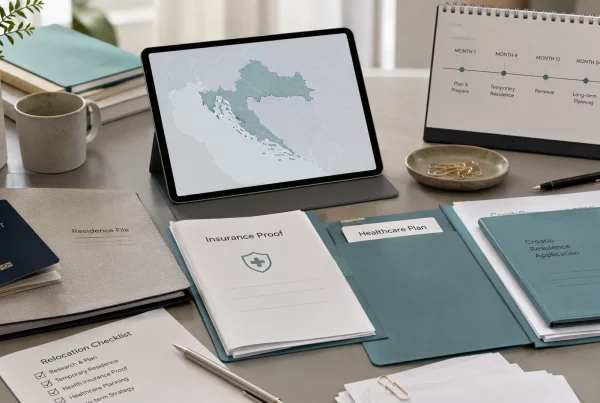



If you are planning to reside in Monaco, your health insurance strategy should not start with nationality alone. It should start with your residence pathway, employment position, expected where you expect to receive treatment, and whether you need local, cross-border or international continuity. This guide explains how to think about Monaco health insurance for expats using official Monaco demographic data, practical planning lanes, and a long-term 3–10 year strategy.
Health insurance “requirements” are typically driven by residency status, administrative pathway, employment situation, where care is accessed, and policy terms. They are not purely determined by nationality. This article therefore uses nationality data only as a planning lens, not as a nationality-specific rulebook.
Executive brief (what matters most)
- Status first, passport second: Monaco health insurance for expats is usually shaped by your residence route, employment position, and where you expect to receive treatment — not nationality alone.
- Official demographics matter: Monaco’s latest official census counted 38,857 residents and 144 nationalities in 2025, with France and Italy the largest foreign communities. [1]
- Residence timing matters: Monaco’s official information says anyone aged 16 or over who wants to stay for more than three months in a year, or take up residence, must apply for a residence permit. [4]
- Employment changes the route: Monaco’s own guidance refers to health-insurance arrangements for salaried workers and the self-employed, so employed households should not assume an IPMI-only answer. [5]
- France is part of daily reality: France–Monaco coordination and nearby French care can be relevant, especially for workers and households using care in the Alpes-Maritimes. [2]
- Policy wording decides private cover: For private or international plans, check area of cover, exclusions, underwriting, waiting periods, medical evacuation, direct billing and continuity. [3]
- Build beyond arrival: The strongest Monaco expat health insurance strategy looks at today, the next 12 months, and your 3–10 year family or executive plan.
- Executive brief (what matters most)
- Monaco in one page: what to verify before you arrive
- Top 20 foreign nationalities residing in Monaco (official statistics)
- Why “nationality” isn’t the real driver (status is): how to think in planning lanes
- Planning lanes: grouped needs and what to verify (by nationality clusters)
- Cross-border reality: Monaco–France care and daily life (high-level)
- Choosing a cover structure: local/private/IPMI (practical decision framework)
- Checklist: documents and questions to prepare (Monaco + cross-border + insurance)
- Points to verify
- Resources / Sources
- Disclaimer
Monaco in one page: what to verify before you arrive
A Monaco move can look simple from the outside. In practice, the health-cover conversation sits inside a wider administrative file: residence route, identity documents, accommodation evidence, financial resources, work status, family situation, and the countries where you expect to use care.
That is why you should not begin by asking, “What does my nationality require?” A safer first question is: “What is my residency pathway into Monaco, and what does that route make me prove?”
Monaco’s official information says that any person aged 16 or over who wishes to stay in Monaco for more than three months in a year, or to take up residence, must apply for a residence permit. [4]
Entry and residence are not the same thing. Monaco’s official guidance distinguishes routes depending on nationality and country of residence, including long-stay visa steps in some cases. [4]
A salaried worker, a self-employed person and a self-funded household can have very different health-cover questions. This is often more important than nationality.
Decide whether your realistic pattern is Monaco only, Monaco plus nearby France, or multi-country care. That will influence whether local, mixed or IPMI Monaco planning is more suitable.
Monaco’s official accommodation information is also relevant. Residents who are neither owners nor tenants may need to provide a certificate of free accommodation as proof of residence. Monaco residence-permit guidance also refers to documentary proof of sufficient financial resources. [4]
None of that tells you which insurance product to buy. It does tell you that your Monaco residency health cover should be coherent with the rest of your move file.
- Your residence-permit route and timing.
- Whether a visa step applies before residence.
- Your accommodation evidence route.
- Whether you will be employed, self-employed or self-funded.
- Whether dependants follow the same route as you.
- Whether routine care is likely to happen in Monaco, France or multiple countries.
- Whether you need evidence of insurance cover required for Monaco residency for a residence, school, employer or private administrative file.
Employment changes the discussion further. Monaco’s official “Settling in Monaco” and health-insurance pages refer to a system for salaried workers and the self-employed. So, if you will work in Monaco, you should verify the local route before assuming that a standalone international private medical insurance policy is your only credible option. [5]
Finally, your situation may change after arrival. Monaco’s official information includes processes for renewing a residence permit and notifying changes in circumstances. A health-cover structure that works for the first year may need review if you change employer, marry, separate, have a child, retire, or shift from employed to self-funded life. [4]
Top 20 foreign nationalities residing in Monaco (official statistics)
The latest official demographic base used here is IMSEE’s 2025 census material. IMSEE says Monaco counted 38,857 residents in 2025 and was home to 144 different nationalities. The census material identifies French and Italian residents as the two largest foreign communities, followed by a sizeable British community and several other European and non-European communities. [1]
For health-cover planning, the list is useful because it shows the practical spread of Monaco’s foreign-resident population. It includes nearby EU nationalities, Swiss nationals, post-Brexit British residents, and non-EU globally mobile households. That mix is exactly why nationality alone is not enough.
| Nationality | Estimated resident count | Year | Source |
|---|---|---|---|
| French | 8,270 | 2025 | IMSEE 2025 census [1] |
| Italian | 7,559 | 2025 | IMSEE 2025 census [1] |
| British | c. 3,070 | 2025 | IMSEE 2025 census [1] |
| Swiss | c. 1,240 | 2025 | IMSEE 2025 census [1] |
| Russian | c. 1,200 | 2025 | IMSEE 2025 census [1] |
| Belgian | c. 1,050 | 2025 | IMSEE 2025 census [1] |
| German | c. 970 | 2025 | IMSEE 2025 census [1] |
| Dutch | 503 | 2025 | IMSEE 2025 census [1] |
| Portuguese | 492 | 2025 | IMSEE 2025 census [1] |
| American | 485 | 2025 | IMSEE 2025 census [1] |
| Greek | 454 | 2025 | IMSEE 2025 census [1] |
| Canadian | 416 | 2025 | IMSEE 2025 census [1] |
| Spanish | 366 | 2025 | IMSEE 2025 census [1] |
| Swedish | 350 | 2025 | IMSEE 2025 census [1] |
| Australian | 276 | 2025 | IMSEE 2025 census [1] |
| Danish | 269 | 2025 | IMSEE 2025 census [1] |
| Austrian | 233 | 2025 | IMSEE 2025 census [1] |
| Cypriot | 225 | 2025 | IMSEE 2025 census [1] |
| Irish | 223 | 2025 | IMSEE 2025 census [1] |
| Lebanese | 223 | 2025 | IMSEE 2025 census [1] |
Method note: rows marked “c.” are approximate counts derived from IMSEE’s published 2025 nationality shares and the official total resident population of 38,857. Rows without “c.” reflect counts surfaced in IMSEE’s 2025 census material and associated table snippets. Use the IMSEE census report as the authoritative demographic source and verify any publication-ready figure against the current IMSEE table before final upload. [1]
France and Italy together account for a very large share of Monaco’s foreign residents. That means many Monaco private healthcare conversations naturally involve EU mobility, French-language care, nearby specialists and day-to-day life across the Riviera corridor.
Further down the list, the administrative mix becomes more varied. British, American, Canadian, Australian, Russian and Lebanese households may have different visa, documentation, employment and private-cover considerations. Swiss nationals sit in another practical category again.
The planning lesson is simple: use nationality data to understand Monaco’s resident mix, but do not use nationality as a shortcut for cover requirements. Your real lane is administrative and practical.
Why “nationality” isn’t the real driver (status is): how to think in planning lanes
Many people search for Monaco health insurance for expats as if the answer were hidden in a table of passports. That is understandable, but it can lead to poor decisions.
Nationality can influence an administrative pathway. It can affect whether a visa step applies, which documents are requested, and which route you follow into residence. But that is different from saying “Nationality X requires Policy Y.”
Unless an official Monaco authority states a nationality-specific rule, it is safer to avoid nationality-specific claims. Monaco’s official materials point instead to route, residence, employment, accommodation and documentation. French coordination sources point to worker status and cross-border arrangements. Insurer materials point to policy features and terms. [2] [3] [4] [5]
Your entry route, residence-permit process and document checklist shape the timing and evidence you may need.
Employed, self-employed and self-funded households can have very different planning questions.
Monaco-only care, Monaco-plus-France care and multi-country care each point to a different cover structure.
For private or IPMI cover, the wording decides how benefits, exclusions, waiting periods, underwriting and medical evacuation work.
A planning lane is therefore not a legal category. It is a practical way to ask better questions. You may fit more than one lane at the same time.
For example, a French executive employed in Monaco, a British retiree with multiple residences, and a Swiss family with children at school in Monaco can all need different structures. Not because one passport is “better” or “riskier” than another, but because the administrative and healthcare-use pattern is different.
- What is my official residence route?
- Will I be employed, self-employed or self-funded?
- Will my spouse or children have the same status?
- Where will routine and specialist care realistically happen?
- Do I need local-only cover, a supplementary layer, or portable IPMI?
- What does the policy wording say, not just the brochure?
Planning lanes: grouped needs and what to verify (by nationality clusters)
The lanes below regroup the top 20 foreign nationalities into practical cover-planning clusters. They are not stereotypes. They are a way to connect official Monaco demographic data with the real drivers of Monaco residency health cover: EU/EEA/Swiss status, non-EU pathways, employment, self-funding, cross-border care and international mobility.
Lane 1: EU/EEA nationals — mobility and coordination questions
Common top-20 nationalities in this lane include French, Italian, Belgian, German, Dutch, Portuguese, Greek, Spanish, Swedish, Danish, Austrian, Cypriot and Irish residents. These communities represent a major share of Monaco’s foreign-resident population. [1]
The planning risk is assuming that EU or EEA mobility makes the health-cover answer automatic. It does not. A person may be employed in Monaco, self-employed, self-funded, recently arrived, part of a split household, or still using care across France or another country.
Typical planning questions include whether you will be locally employed, whether dependants follow your route, whether you expect routine care in Monaco or France, and whether you need a supplementary private layer for comfort, provider choice or wider portability.
- Your Monaco residence-permit route and timing.
- Whether you are employed, self-employed or self-funded.
- Whether your household’s care pattern is Monaco-centred or Monaco-plus-France.
- Whether any coordination document or French-side step is relevant in your specific case.
- Whether you need local support, international claims support, or both.
Lane 2: Swiss nationals — Switzerland-adjacent coordination questions
Swiss nationals are one of Monaco’s largest foreign communities. The Swiss lane deserves separate treatment because it is European-adjacent but not identical to the EU/EEA lane. [1]
Monaco’s official entry information groups EEA and associated states together for certain visa-entry purposes, while French public coordination materials handle Swiss and cross-border situations within their own framework. That means Swiss nationals should verify the practical route rather than assume that every EU-style pattern applies. [2] [4]
Typical questions include whether you are moving from a Swiss-based status into Monaco employment, whether dependants stay aligned with one system, and whether a wider international plan still makes sense for travel, family or second-home reasons.
- Whether your route is Monaco-employed, Swiss-anchored, self-employed or self-funded.
- Whether any France-side healthcare coordination step applies.
- Whether your private medical insurance policy’s area of cover matches your actual where you expect to receive treatment.
- Whether your household needs one structure or a split solution.
- Whether emergency, medical evacuation or out-of-area benefits are important for your travel pattern.
Lane 3: Non-EU high-mobility nationals — private/IPMI-led planning questions
Common top-20 nationalities often seen in this lane include British, American, Canadian and Australian residents. This does not mean everyone in those groups needs the same plan. It means the planning conversation often includes portability, underwriting, multi-country living, employer benefits, family travel and continuity.
This is where IPMI Monaco searches commonly begin. International private medical insurance can be relevant when a household is self-funded, highly mobile, split across countries, or seeking one portable structure. But policy terms still matter: area of cover, waiting periods, exclusions, pre-existing conditions, medical evacuation and emergency rules all need checking. [3]
British nationals are a useful example of why route matters. Monaco’s official materials include specific guidance for British citizens in some long-stay contexts. That is an administrative route point, not a universal health-insurance product requirement. [4]
- Visa and residence sequencing.
- Whether your move is employer-led or self-funded.
- What evidence of insurance cover required for Monaco residency is actually requested in your case.
- Whether your policy includes the countries where you expect routine care, not just emergencies.
- How the policy treats pre-existing conditions, maternity, waiting periods and medical evacuation.
- Whether the plan is designed for long-term residence abroad rather than short travel.
Lane 4: Non-EU other nationals — status and permit-driven documentation questions
Common top-20 nationalities in this lane include Russian and Lebanese residents. These communities are not the same in lifestyle or circumstances, so they should not be treated as one “type” of person. The shared planning point is usually that the route is permit-led and documentation-led before it becomes product-led. [1] [4]
Some households in this lane may be employed in Monaco and should verify local affiliation. Others may be self-funded and may rely more heavily on private or international cover from the outset. The correct answer depends on status, timing and documentary expectations.
- Your exact visa or entry route.
- Your residence-permit checklist for your nationality and current country of residence.
- Accommodation proof and sufficient-resource evidence.
- How dependants are documented.
- Whether the chosen private or IPMI policy supports your actual care and travel pattern.
Lane 5: Employed in Monaco versus self-funded — the overlay that changes almost everything
This lane applies across all top-20 nationalities. It is often the most important lane in practice.
Monaco’s official health-insurance information refers to arrangements for salaried workers and the self-employed. If you are employed in Monaco, your starting point may be local affiliation, employer onboarding and dependant coordination. If you are self-funded, the starting point may be residence evidence, resources, evidence of insurance and private/IPMI structure. [5]
A person’s nationality may tell you something about the residency pathway into Monaco. It does not tell you whether their employer provides a scheme, whether dependants are attached, or whether supplementary cover is needed.
- Your precise work status in Monaco.
- Whether an employer, local fund or private policy is the first layer.
- Whether you need supplementary cover or standalone private cover.
- How spouse and children are treated.
- What happens if you change employer, stop working, retire or leave Monaco.
Lane 6: Frequent travellers and multi-residence households — area of cover and continuity questions
This lane can apply to any nationality. It is common among internationally mobile executives, families with several homes, cross-border households, and people who expect to use care in more than one country.
Policy wording is central here. Official insurer resources commonly distinguish between geographical area of cover, out-of-area emergency treatment, annual limits, waiting periods, exclusions, underwriting and medical evacuation or repatriation features. [3]
A plan that is suitable for a Monaco-centred couple may not be suitable for a family splitting time between Monaco, France, London and another international location. The right plan is the one that fits the real calendar.
- Your actual travel calendar.
- Where routine care, not only emergency care, is likely to happen.
- Whether the area of cover includes the countries you genuinely need.
- Whether medical evacuation, repatriation and global assistance are included or optional.
- Whether the structure remains workable after a move, job change or family change.
Cross-border reality: Monaco–France care and daily life (high-level)
Monaco is not an island in practical healthcare terms. Daily life for many residents sits within a Riviera corridor that includes Monaco, nearby French municipalities and, for some households, Italy.
Official French coordination material states that all branches of social security are coordinated between France and Monaco, and that healthcare coordination is not limited only to salaried French or Monegasque nationals. [2] That is a strong reminder that cross-border healthcare France planning should be based on status and coordination rules, not assumptions about passport labels.
For workers, official French guidance explains that when a person works in Monaco, they contribute to the Monegasque social security scheme and receive benefits under that scheme. It also discusses care delivered in the French department of residence and points to different handling depending on care location. [2]
You do not need to become a technical claims expert before moving. You do need to know whether your family is likely to use care in Monaco only, in Monaco plus the Alpes-Maritimes, or across several countries.
A family moves to Monaco with two school-age children. One parent will be employed in Monaco. The children will attend school in Monaco, but the family expects to use a specialist in nearby France because of existing relationships and language comfort.
The right planning question is not “What does our nationality require?” It is: how does the Monaco-employed parent’s route work, how do dependants attach, where will routine and specialist care happen, and would a supplementary private layer make the Monaco–France pattern easier to manage?
This is why Monaco private healthcare planning is often less about luxury and more about friction. The goal is to reduce uncertainty around access, reimbursement, documentation, provider choice and language support.
Any cross-border entitlement or reimbursement point should be verified with the relevant official body. The aim here is to identify the planning issue, not to provide legal, immigration, medical or claims advice.
Choosing a cover structure: local/private/IPMI (practical decision framework)
Most Monaco expat health insurance decisions can be organised into three broad structures: local or public-anchored, mixed, and IPMI-led. The right answer depends on your route, your work status and your where you expect to receive treatment.
Often relevant where you are employed or self-employed in Monaco and most care is expected in Monaco or nearby France. The planning question is whether you need a supplementary private layer.
Often relevant for households anchored in Monaco but using private access, French-side specialists or wider support for family members.
Often relevant for self-funded, internationally mobile or multi-residence households that need portability and continuity across countries.
Official insurer materials commonly focus on policy features and terms such as area of cover, benefit limits, exclusions, pre-existing conditions, waiting periods, direct billing and medical evacuation. These mechanics matter more than the marketing label on the plan. [3]
Which cover structure fits your Monaco life?
Start: How will your Monaco life be structured?

1. Will you be employed or self-employed in Monaco?
   ├─ Yes → Map the local/public route first.
   │        Then ask whether supplementary private cover is useful.
   │
   └─ No / self-funded → Move to question 2.

2. Will routine care mainly happen in Monaco and nearby France?
   ├─ Yes → Consider a mixed structure.
   │        Verify cross-border use, provider choice and reimbursement handling.
   │
   └─ No / multi-country → Move to question 3.

3. Do you have multiple residences, frequent travel or family members in different countries?
   ├─ Yes → Explore IPMI-led planning.
   │        Check area of cover, underwriting, medical evacuation and continuity.
   │
   └─ Not sure → Build a flexible first-year structure and review after real usage.

4. Are there pre-existing conditions, maternity plans or specialist needs?
   ├─ Yes → Verify underwriting and waiting periods in writing.
   └─ No → Still check exclusions, limits and claims process before applying.
The three layers of planning
Your priority is administrative coherence. Make sure your residence route, employment route, accommodation evidence and initial cover story all align.
Your real usage pattern becomes visible. You learn whether care is Monaco-centred, France-facing or international, and whether a supplementary or IPMI layer is useful.
Your planning shifts to continuity. Think about job changes, dependants ageing, retirement, pre-existing condition history, and whether the structure remains portable.
An executive keeps a Monaco residence, travels frequently, and has family members who spend meaningful time outside Monaco. A local-only answer may not reflect how the household actually uses care.
The planning conversation should focus on area of cover, portability, medical evacuation, underwriting, continuity and whether the policy supports the countries where care may realistically happen. This is an IPMI Monaco discussion, but it still depends on policy wording and underwriting rather than nationality.
BIG can help you compare structures and stress-test your current position. For individuals and families, visit https://big-brokers-health.com/individual-families/. To request a quote, visit https://big-brokers-health.com/quote/. If you are already covered and want a review, visit https://big-brokers-health.com/already-insured/.
Checklist: documents and questions to prepare (Monaco + cross-border + insurance)
A well-prepared relocation file is calm, complete and consistent. It should help you answer the same questions clearly whether they come from a residents’ office, employer, school, insurer or adviser.
- Passport or national identity document.
- Visa or residence-route documents where relevant.
- Accommodation proof, including tenancy, ownership or certificate of free accommodation where relevant. [4]
- Evidence of sufficient financial resources where required by your route. [4]
- Marriage, civil status or dependant documents if relevant.
- Copies of correspondence with Monaco authorities.
- Employment contract or employer confirmation.
- Self-employment or company registration documents where relevant.
- Employer benefits summary if a scheme is provided.
- Confirmation of which family members are included, if any.
- Any local fund or social-security correspondence.
- Certificate of insurance.
- Policy schedule.
- Table of benefits.
- Full policy wording.
- Underwriting decision or special terms.
- Emergency assistance details.
- Claims, pre-authorisation and direct billing instructions.
- Where routine care is likely to happen in the first year.
- Whether any specialist care is expected in nearby France.
- Whether children need cover aligned with school and travel patterns.
- Whether language support matters for claims or provider access.
- Whether family members live or travel in different countries.
For international families Monaco attracts, also ask whether the plan is built for the next school year only or for a genuine 3–10 year strategy. Children grow, work status changes, travel changes, and underwriting history can become more important over time.
For further reading, BIG’s IPMI Abroad guide is available at https://big-brokers-health.com/preparing-life-abroad/. For quick questions, visit https://big-brokers-health.com/faq/.
Points to verify
Some Monaco health-cover details are too route-specific to state as universal rules. Verify these points before you treat them as settled.
- Residence-permit document list: Verify the exact checklist for your nationality, current country of residence and household status with Monaco’s Residents’ Section and MonServicePublic. [4]
- Visa sequencing: Verify whether a long-stay for Monaco visa or other entry step applies before residence. [4]
- Accommodation evidence: Verify whether you need ownership evidence, tenancy evidence or a certificate of free accommodation. [4]
- Financial-resource evidence: Verify what evidence is requested for your route and timing. [4]
- Employment status: Verify whether you are Monaco-employed, Monaco-self-employed, employed elsewhere, retired or self-funded. [5]
- Dependants: Verify how your spouse, partner and children attach to any local, employer or private structure.
- Cross-border France use: Verify whether care in Monaco, Alpes-Maritimes or elsewhere in France is handled differently in your case. [2]
- French coordination documents: Verify whether documents such as S1 or other coordination routes are relevant to your exact circumstances. [2]
- Area of cover: Verify whether your private or IPMI policy includes the countries where you need routine care, not just emergency treatment. [3]
- Pre-existing conditions: Verify underwriting decision, exclusions, loadings or special terms in writing. [3]
- Maternity and waiting periods: Verify whether waiting periods apply and whether timing affects usefulness. [3]
- Evacuation and repatriation: Verify whether these benefits are included, optional or excluded. [3]
- Direct settlement: Verify whether preferred providers can bill directly, or whether reimbursement is more likely.
- Long-term changes: Verify what happens if you change employer, stop working, move country, retire, marry, separate or add dependants.
- Longer-residence support: Verify whether any Monaco aid or supplementary-cover support is relevant after longer residence and subject to eligibility conditions. [5]
Book a free consultation with one of our experts
Choose your preferred adviser: Julien (English, French and Spanish) or Sean (English or Italian).
Julien — English, French and Spanish
Sean — English or Italian