
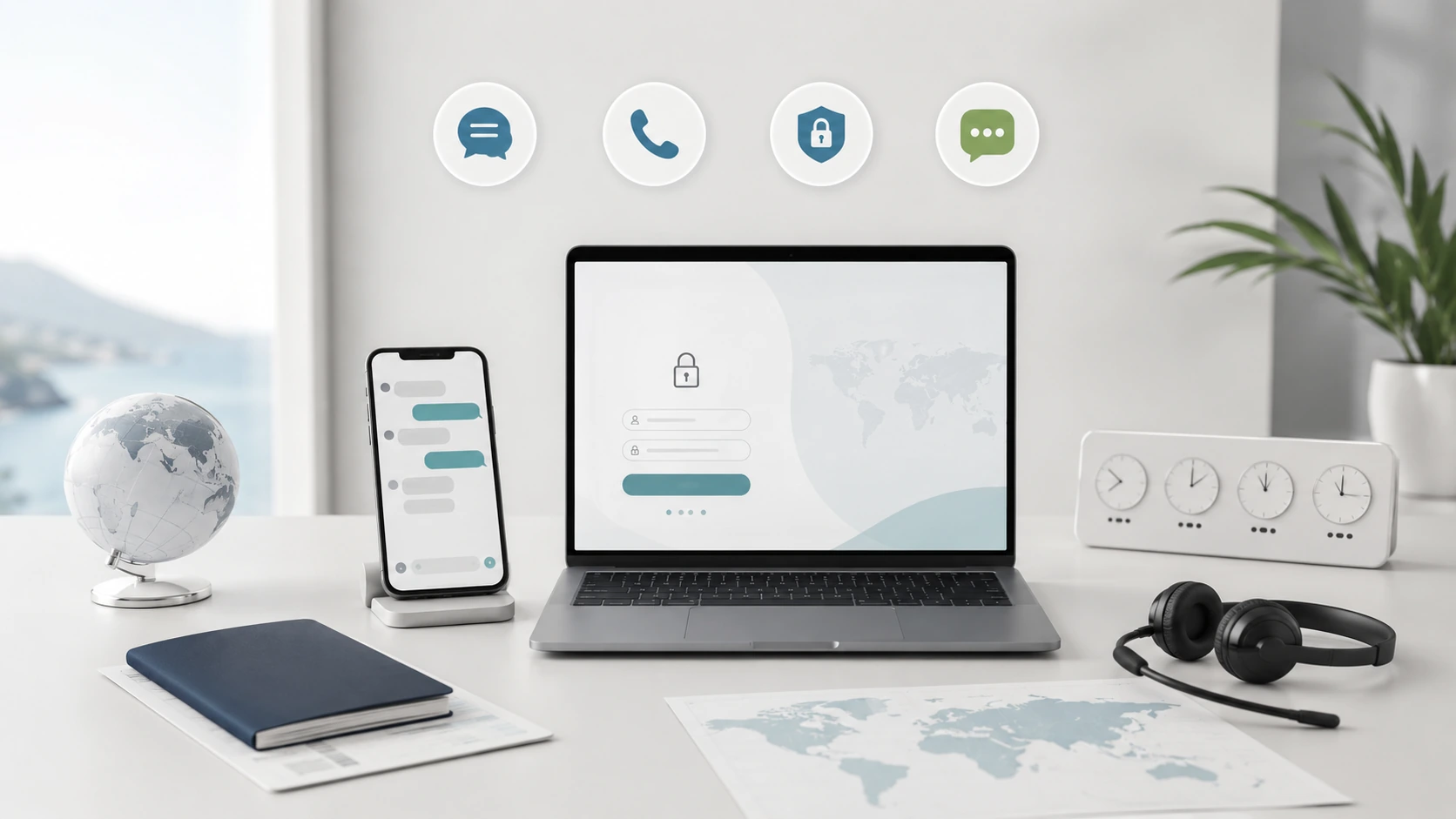

When you are abroad, “contact options” become part of the insurance experience. Phone numbers, live chat windows, portals, secure messages and everyday WhatsApp habits all shape how easy it feels to get help when you need it.
When people compare international private medical insurance, they usually look first at benefits, limits, excesses or deductibles, exclusions and areas of cover. All of that matters.
But IPMI customer support channels matter too. The moment you need help, the “contact us” experience becomes part of the product: which number do you call, which time zone is the team in, is live chat available, do you need to log in, and can anyone give you written confirmation quickly enough?
Many insurers are investing in portals, apps, secure messaging and live chat. At the same time, many internationally mobile clients default to WhatsApp in daily life because it is quick, familiar and already where much of their admin happens.
The tension is simple: WhatsApp is commonly how clients prefer to message, but official insurer support via WhatsApp is not universal and must be verified insurer by insurer. This guide explains what each support channel is good for, where friction tends to appear, and how concierge broker support can change the experience without changing the insurer’s decision-making role.
- Live chat and in-app messaging can reduce friction, but availability, opening hours and scope vary by insurer, product family and region.
- Phone support can be effective, especially for urgent or complex situations, but hold times, international calling and time zones can create real stress.
- Many clients prefer WhatsApp as their natural channel, but official IPMI WhatsApp support is not universal and must be verified insurer by insurer.
- Portal messaging can be useful for document-heavy admin, because it connects the message trail to your policy, claims and secure account.
- BIG clients typically contact us directly by phone or WhatsApp, and we can help handle insurer back-and-forth where appropriate.
- BIG can help reduce administrative hassle, but we do not control insurer decisions, authorisations, claim outcomes or policy terms.
- BIG offers a free review of existing cover; you can appoint us or not.
- The “support channel” is part of the product
- Phone vs live chat vs portal messaging: what each is good at
- The WhatsApp reality: what clients want vs what insurers typically offer
- Insurer-by-insurer: verified support channels (phone, web chat, app/portal, messaging)
- How BIG reduces friction: concierge support by phone + WhatsApp
- If you’re already insured: why a free policy review matters for service, not just benefits
- Checklist: how to choose a plan with support experience in mind
- Bottom line
- Points to verify
- Resources / Sources
- Disclaimer
1) The “support channel” is part of the product
Most insurers now present support as a broader member ecosystem rather than a single phone line. Bupa Global directs existing customers towards MembersWorld for secure messaging, claims, pre-authorisation and policy documents.[1] Cigna documents different digital routes depending on whether a member uses Global Individual tools or Envoy-based services.[2]
Allianz Care promotes MyHealth digital services alongside phone support and live chat.[3] AXA Global Healthcare points members to an online account for managing plans, claims and secure questions, and has also announced newer app-based support features.[4]
Now Health International and APRIL International also show a mix of phone, digital account, app, chat and messaging routes in official member-facing materials.[5][6]
That matters because support friction is rarely about one dramatic failure. More often, it is about accumulated micro-frictions.
You may have the right cover, but still lose time because you are sent from a public contact page to a secure portal, from a portal to a phone line, and then from a phone line to an email address or attachment upload.
The gap between “I know I am insured” and “the right person now has my case with the right documents” is where international health plan support starts to feel either reassuring or draining.
It is whether the channel can actually solve the problem you have: authorisation, document upload, provider confirmation, reimbursement, dependant access or a simple policy question.
Adult dependants may need their own secure accounts or permissions before another person can discuss policy details or manage documents on their behalf.
A channel that feels fine at home can feel very different when you are abroad, the clinic is waiting, and you are calling across regions.
Privacy design is part of the experience too. Bupa says adult dependants need their own MembersWorld accounts and specific permissions for someone else to view or alter details.[1] Allianz likewise says adult dependants should register separately for MyHealth and manage their own personal data and claims access.[3]
For internationally mobile families, assistants, family offices and HR teams, that is not a minor detail. It affects who can help, what they can do, and how quickly the next step can happen.
2) Phone vs live chat vs portal messaging: what each is good at
Phone support still matters, and it probably always will in IPMI. When something is urgent, ambiguous or emotionally loaded, a real-time conversation can be the fastest route to clarity.
Allianz documents a 24/7 multilingual helpline and live chat on its contact pages.[3] AXA provides member phone support and an online account route.[4] Now Health publishes telephone, email, chat and WhatsApp routes.[5]
But phone is also the channel where international friction is easiest to feel.
You may be dialling across borders, aligning your day with someone else’s support structure, repeating identity checks and sometimes re-telling the same story after a transfer. Even when the insurer is helpful, the channel can still be tiring.
International health insurance live chat is attractive because it can sit between voice and email. It is often quicker than email, less disruptive than a phone call, and easier to refer back to than a conversation that was not recorded in writing.
Portal and in-app messaging are slightly different again. They are not always instant, but they can be strong for claim-specific admin because they combine secure identity, documents and policy context.
Bupa’s MembersWorld is a clear example: messaging sits alongside claims, pre-authorisation and policy documents.[1] Cigna’s secure customer area and Envoy tools combine contact, claims and policy information.[2] AXA says members can ask questions securely through the online account, while Allianz’s MyHealth app and portal consolidate claims, policy data and contact tools.[3][4]
| Situation | Best channel | When it works | Common friction | What to prepare | What to ask for |
|---|---|---|---|---|---|
| Cover check before treatment | Phone or secure portal pre-authorisation | When timing matters and the provider needs confirmation | Call queues, time zones, needing provider details to hand | Policy number, provider name, hospital details, proposed date | Reference number and written confirmation |
| Simple admin question | Live chat or portal message | When the issue is short and you want a written trail | Chat hours may be limited; some routes require login first | Policy number, screenshot, concise summary | Chat transcript, case ID or message confirmation |
| Need documents quickly | App or portal | When you need an ID card, policy wording or claims history | Forgotten password, multi-factor login, dependant permissions | Login details, device access, member number | Downloadable document or screen confirmation |
| Want to avoid long hold times | Live chat, portal messaging or email/web form | When the issue is non-urgent and can be handled in writing | Not every insurer offers every route; some may route you back to phone | Policy number, clear question, attachments if relevant | Written reply with next steps |
| Clinic asks for confirmation or authorisation | Phone first, then written follow-up | When a live conversation may unblock the case quickly | Repeating facts to multiple teams; provider still wants written evidence | Policy number, treatment details, provider contact, estimate or referral | Guarantee, approval reference or written confirmation route |
| Multi-party admin | Concierge broker support plus insurer contact | When insurer, provider and member all need different information | Information becomes fragmented across calls, emails and uploads | Timeline, invoices, referral, provider contacts, previous messages | One written recap of who is doing what next |
The key is not to assume that one channel is always better. Phone can help when something is urgent. Live chat can help when you need quick written clarification. Portal messaging can help when the issue involves documents and secure identity.
3) The WhatsApp reality: what clients want vs what insurers typically offer
Here is the practical debate in plain English. Many internationally mobile people live by messaging.
They message family, landlords, schools, assistants, travel agents, house managers, accountants and brokers. So when an insurance issue appears, the instinct is not always “open the portal”. It is often “send a message”.
That instinct is understandable. Messaging is asynchronous, easy to translate, easy to forward, and easy to fit into a working day.
The problem is that insurer workflows do not always mirror that reality. In the official sources reviewed for this article, WhatsApp support is clearly documented by Now Health and APRIL.[5][6] Allianz has official announcements about a Digital Health Assistant that referenced WhatsApp and other conversational platforms, but current routine member WhatsApp support was not clearly verified on the reviewed member contact pages.[3]
For Bupa, Cigna and AXA, the reviewed current member-facing pages did not identify a clear official WhatsApp member support route. That does not mean a client will never encounter WhatsApp in a local or future context. It means it should not be assumed unless the insurer confirms it for that plan and region.
It is 9pm where you are. A clinic wants confirmation before tomorrow morning that your insurer will authorise, or at least recognise, the treatment pathway.
You open the insurer contact page and now have several options: a regional phone number, perhaps live chat, perhaps a login, perhaps a general form, or perhaps a member app.
None of these are wrong. But each one asks you to do something different. You need your policy number, the clinic name, the practitioner’s details, the proposed treatment, the date, and ideally a reference number plus something in writing.
This is where the WhatsApp question keeps resurfacing. It is not because WhatsApp is inherently better than secure insurer channels. It is because, in real life, the least disruptive channel often wins psychologically.
That is why “IPMI WhatsApp support” needs careful language. It might mean a true customer service channel. It might mean a sales route. It might mean a regional service. It might mean a digital assistant. Or it might not exist for routine member servicing.
For personal health information, verification matters.
4) Insurer-by-insurer: verified support channels (phone, web chat, app/portal, messaging)
The table below is verification-first and limited to official insurer sources reviewed for this article. “No” means no current official member-facing route was identified on the reviewed official pages. “Unclear” means there was some official evidence pointing towards a channel or development, but not enough to confirm a current general member contact route.
| Insurer | Phone | Web live chat | In-app / portal messaging | Email / web form | Notes / limitations | |
|---|---|---|---|---|---|---|
| Bupa Global | Yes | No | Yes | Yes | No | Bupa’s current member flow centres on MembersWorld secure messaging, with regional phone and email contacts for members. The reviewed pages did not show a public live chat or official member-facing WhatsApp route.[1] |
| Cigna | Yes | Yes | Yes | Yes | No | Global Individual materials document live chat, direct message and call-back routes; Envoy-based services use secure email and app/account tools. The channel mix may vary by plan family.[2] |
| AXA Global Healthcare | Yes | Yes | Yes | Yes | Unclear | AXA directs members to phone and the online account for secure questions. Its app launch references live chat and secure messaging, while a separate intermediary article referenced WhatsApp development. A current general member WhatsApp route was not verified on the reviewed member pages.[4] |
| Now Health International | Yes | Yes | No | Yes | Yes | Now Health’s official pages state that support is available by telephone, online chat and WhatsApp, and document online portfolio and app access for claims, documents and provider search. A dedicated secure portal inbox was not clearly documented in the reviewed sources.[5] |
| Allianz Care | Yes | Yes | Yes | Yes | Unclear | Allianz documents a 24/7 helpline, website live chat and MyHealth app/portal. Historical Digital Health Assistant announcements mention WhatsApp, but current reviewed member contact pages do not present a general WhatsApp helpline.[3] |
| APRIL International | Yes | Yes | No | Yes | Yes | APRIL’s official FAQ lists contact form, chat, Facebook Messenger, WhatsApp and telephone. The Member Portal and Easy Claim app are documented for admin and claims, but a native secure portal inbox was not clearly verified in the same way as some other account flows.[6] |
| One Health | Yes | No | No | Yes | No | The official source reviewed was One Health . It documents phone and email contact, plus a member portal and mobile app for claims, benefits, ID cards and EOBs. No live chat or WhatsApp member channel was identified on the reviewed pages.[7] |
A few patterns stand out.
First, official insurer WhatsApp support is not the baseline. In this review, Now Health and APRIL are the clearest current examples.
Second, several insurers are strong digitally without necessarily solving the WhatsApp question. Bupa is a good example: its proposition is not public live chat, but secure MembersWorld messaging tied to claims, documents and pre-authorisation.
Third, phone still underpins the market. Even where live chat is available, official sources often send members back to helplines for urgent, complex or emergency matters.
5) How BIG reduces friction: concierge support by phone + WhatsApp
This is where concierge broker support can change the feel of the experience for many clients.
BIG’s own quote and review pages allow clients to choose email, WhatsApp or phone call as their preferred contact route.[8][9] BIG also positions its role as ongoing support for internationally mobile individuals and families, not just initial plan placement.[10]
That does not make insurer channels irrelevant. It changes who you start with.
Instead of personally deciding whether a problem belongs to a helpline, a web form, a provider contact, a secure portal or a claims team, you can start with one human route and let us help structure the next step.
Many BIG clients use WhatsApp as a practical extension of service. They message us rather than starting a website chat or searching for the right overseas number.
We can help manage the administrative hassle and insurer communications where appropriate. We can help gather the right information, keep the timeline coherent, follow up through established servicing routes with insurers we place business with, and reduce the number of portals, menus and repeated explanations you personally need to manage.
We do not control insurer decisions, underwriting, authorisation rules, claims adjudication or provider billing decisions. The value is not a promise of a different outcome. It is a calmer, more organised route through the process.
Same situation as before. It is late, the clinic wants confirmation, and you do not want to begin with a public website chat or an overseas switchboard.
Instead, you message BIG on WhatsApp or call us directly. We ask for the essentials once: policy number, provider details, what the clinic is asking for, when treatment is planned, and any referral or estimate you already have.
Then, where appropriate, we take the insurer conversation forward as your intermediary and keep you updated on what is still needed.
The insurer still sets the rules. The insurer still decides whether cover applies and what needs formal authorisation. But you are no longer personally carrying every hand-off between provider, insurer and policy wording.
6) If you’re already insured: why a free policy review matters for service, not just benefits
A review of an existing policy is often framed as a benefits-and-premium exercise. That is too narrow.
BIG’s Already Covered page invites a free expert review of existing cover and asks what kind of help the client wants, including reviewing insurer choice, renewal price, exclusions and benefits.[9]
That matters because service friction is often hidden behind those objectives.
A plan may be broadly acceptable on paper, yet still feel wrong in daily use because the support channels do not suit how you live.
A useful review should ask more than “How much cover do you have?” It should ask:
- Do you need after-hours support across multiple regions?
- Are you relying on phone support when you really want written digital follow-up?
- Are adult dependants forced into separate logins and permissions?
- Are you doing too much of the admin yourself?
- Do you have a broker who can help when the issue becomes multi-party admin?
A review does not have to mean an immediate switch. Perhaps the right answer is a new insurer. Perhaps it is a change in how the policy is serviced. Perhaps it is simply a clearer use of the channels you already have.
For retention and renewal decisions, that is often the overlooked point. People do not only stay with or leave an insurer because of benefits. They also react to how international health plan support feels when life is busy, travel is constant and the admin load lands at the wrong moment.
7) Checklist: how to choose a plan with support experience in mind
Use this experience-first checklist when comparing a new plan, reviewing an existing policy, or deciding whether your current support model still works for your lifestyle.
- Do you need after-hours support outside UK or EU business hours?
- Do you prefer messaging over calls for non-urgent issues?
- If you prefer messaging, is there verified international health insurance live chat on your plan?
- Is there verified insurer member portal messaging, or only claims upload and document access?
- Do you want one human point of contact who already knows your situation?
- Do you want someone to handle admin with insurers and providers for you where appropriate?
- What is your tolerance for portals, passwords, app registration and multi-step logins?
- What is your tolerance for waiting on hold, navigating phone menus or being transferred?
- Do you move between countries often enough that regional numbers and time zones become a real issue?
- Do you need multilingual support that matches where you actually live and travel?
- Will a spouse, PA, executive assistant, HR team or family office ever need to help with admin?
- If so, how do consent and adult dependant permissions work?
- Do you need written confirmation trails after important conversations?
- How often do you think you will need pre-authorisation support rather than simple reimbursement?
- Can your insurer’s app or portal handle attachments easily from your phone?
- Can you get a clear reference number or case ID every time you contact support?
- If IPMI WhatsApp support matters to you, is it officially documented or are you only assuming it exists?
- When a clinic asks for something quickly, who will chase it: you, your assistant or your broker?
- Would you rather start with the insurer each time, or with a broker who can coordinate the next step?
- Is the support model good enough for how you actually live, not just for how the brochure looks?
8) Bottom line
The practical debate is not whether phone, live chat, portal messaging or WhatsApp is the single right answer. It is whether your insurer’s channel mix matches the way you live abroad.
Phone support can still be the most effective route for urgent or complicated issues. Live chat can be useful for quick written clarification. Portal and app-based servicing are often strongest for secure, document-heavy admin.
WhatsApp feels natural to many clients, but official insurer WhatsApp support is not universal and must be verified one insurer at a time.
That is why IPMI customer support channels deserve real weight in plan selection and renewal reviews. If you are internationally mobile, juggling family or work across borders, or simply tired of being asked to become your own case manager every time something small happens, service design is not a side issue. It is part of what you are buying.
BIG’s model is deliberately human-sized. You can start with us by phone or WhatsApp, and we can help carry the administrative load and insurer communication where appropriate. We work as adviser and intermediary, not as the insurer, so we do not control insurer decisions.
What we can often do is reduce the friction between your first question and the insurer process that follows.