

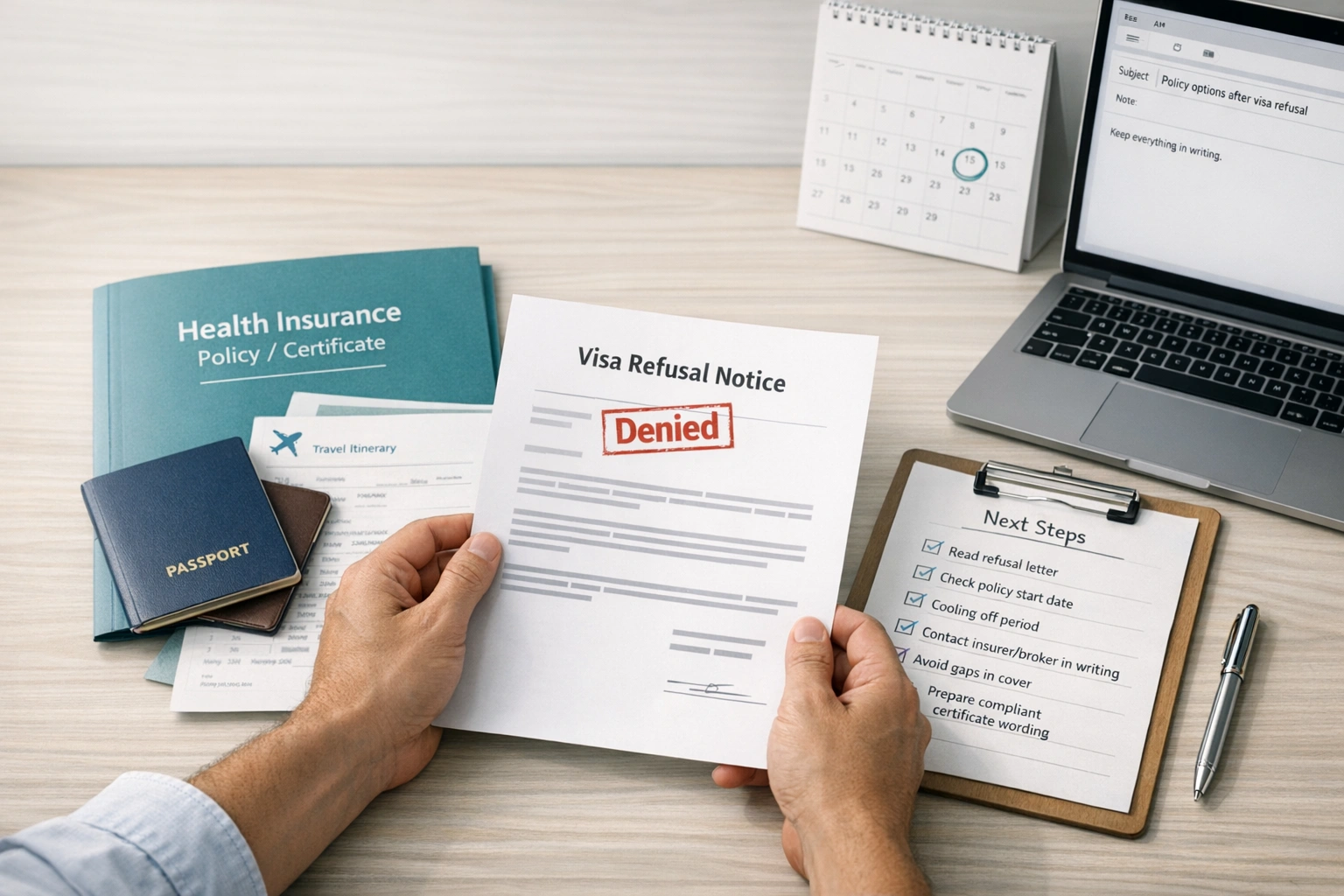

A visa refusal is stressful, but you do not need to make rushed decisions about your health insurance. Your priority is to protect your cover, avoid unnecessary cost and keep your options open for an appeal or a fresh application. This guide focuses on the insurance side of the issue: what usually happens to your policy, what to ask your insurer or broker, how refunds and waiting periods may work, and how to prepare compliant insurance evidence for your next step. In practice, timing is often the key issue. You may already have paid for a policy, received a certificate for the consulate, or set a future inception date for your move. Cancelling too early can create new problems, while waiting too long can mean losing cooling-off rights, triggering unwanted renewal, or incurring avoidable premium costs. A calm, documented approach usually works best. This article is written for individuals and families who need a clear action plan. It does not provide legal or immigration advice. For the refusal itself, refer to official consular guidance and qualified immigration lawyers where needed. For the insurance side, keep everything in writing, check the policy terms carefully, and avoid assumptions about refunds, cancellation rights or the prospects of a successful re-application.
- Read the refusal letter first: understand the reason, any deadlines, and whether your next step is an appeal or a re-application.[1]
- Do not cancel too quickly: if you may re-apply soon, keeping or adjusting the policy may be better than starting again.
- Refunds are not automatic: outcomes usually depend on the policy terms, start date, claims paid and the insurer’s processes.[3]
- Cooling-off rights may help: some policies can be cancelled shortly after purchase, but timing and deductions still matter.[3]
- Travel cover is not the same as residency-compliant cover: interim cover may help in the short term, but it may not meet visa requirements.[4]
- Prepare your documents carefully: keep the refusal letter, policy schedule, certificate, invoices and insurer correspondence together.
- Use official guidance and qualified advisers: consular rules, appeal rights and acceptable insurance wording vary by country and by case.[1][2]
- Visa refusal / denial: a consulate or immigration authority has decided not to grant the visa. Official guidance will usually explain the reason or legal basis for the refusal.[1]
- Appeal vs re-application: an appeal challenges the refusal decision; a re-application is a new application. Some systems do not offer a general right of appeal and instead require a fresh application.[1]
- Inception date: the date on which your policy starts.
- Cooling-off period: a short period after purchase during which you may be able to cancel and receive a refund, usually subject to deductions for time on cover and any claims or charges, depending on the product and applicable rules.[3]
- Cancellation: bringing the policy to an end before its scheduled expiry date.
- Refund: a return of premium, in full or in part, if the insurer agrees under the policy terms and any applicable rules.
- Waiting period: a period after inception during which certain benefits may not yet be available.
- Underwriting: the insurer’s assessment of the application, medical information and terms of acceptance.
- Policy schedule / certificate: the insurer document showing the insured person’s details, dates and key cover information. Consulates often ask for this or similar proof.
Common reasons for visa denials
Visa refusals can happen for many reasons, and the first practical step is to separate the immigration issue from the insurance issue. The refusal itself comes from the consulate or immigration authority. Your health insurance policy is a separate contract, even if you bought it specifically to support the application.
Official visa guidance generally points to a few broad categories. These include incomplete applications, missing supporting documents, failure to demonstrate eligibility for the visa category, and inadmissibility concerns such as certain criminal, fraud or previous immigration issues.[1] In practice, many refusals are administrative rather than permanent. That distinction matters, because a missing document may lead to a relatively straightforward re-application, whereas a more serious refusal may require legal advice.
Applications are commonly refused where supporting documents are incomplete, inconsistent, out of date, untranslated where required, or do not match the visa checklist.[1]
A consulate may conclude that the applicant has not shown that they qualify for the visa category applied for. This can include financial, residence, purpose-of-stay or category-specific insurance issues.[1]
Some refusals arise from previous immigration history, criminal matters or misrepresentation concerns. These cases are usually outside the scope of insurance administration and may require legal review.[1]
Health insurance can also form part of the refusal. This does not necessarily mean the insurance itself was unsuitable. Often, the issue is that the certificate wording, insurer status, dates of cover, territorial wording, deductible structure or benefit description did not align precisely with the consulate’s requirements. Spain is a useful example: for some residency routes, consular guidance may require cover with no co-payments or deductibles, valid for the required period, and issued by an insurer authorised to operate in Spain; travel insurance is not accepted for that purpose.[4]
That is why the refusal letter matters so much. Official sources explain that a refusal should identify the relevant basis or section, and that the next step depends on the system involved.[1] In some cases there may be no general right of appeal, and you would instead submit a fresh application with updated documents. In others, a formal appeal may be available and subject to a strict deadline.[1][2]
- Obtain the full refusal letter, not just a verbal summary.
- Highlight the exact reason given.
- Check whether the issue relates to insurance, timing, documents, eligibility or something else.
- Do not assume your insurance must be cancelled immediately.
- Do not assume a fresh application will require a completely new policy; in some cases, a change of date or wording may be enough.
What happens to your health insurance policy
The short answer is that your policy does not usually fall away automatically because your visa was refused. Unless the insurer expressly links the effectiveness of the policy to visa approval, you will usually still have a live contract that must be managed in line with its own terms. That may mean cancelling it, deferring it, changing the dates, or keeping it in force while you decide what to do next.
Start by checking where you are in the policy timeline. The key practical questions are straightforward: has the policy started, have any claims been made, has underwriting been completed, and do you still need health cover where you are currently living? The answers will shape your options.
If the inception date is still in the future, insurers may be more willing to discuss cancellation, deferral or changes to the certificate dates. Cooling-off rights may also be relevant if the policy was purchased recently.[3]
Once the policy is in force, refund and cancellation outcomes will usually depend on the policy wording, time on cover, any claims paid and the insurer’s administrative processes.[3]
If benefits have already been used or claims paid, the insurer may reduce or decline any refund in line with the policy terms and any applicable rules. This is one of the first points to verify in writing.
There is also a practical cover issue. If your move is delayed but not abandoned, you may still need health cover for yourself or your family in the meantime. That could mean keeping the existing policy in force for a short period, moving the inception date if the insurer allows it, or arranging separate short-term cover in your current location. What you should not do is create a gap in cover because you assumed the visa refusal automatically voided the policy.
If the consular issue related only to certificate wording or acceptable insurer status, the policy itself may not be the main problem. A plan change, endorsement, revised certificate or replacement policy aligned to the official requirements may be the better route. This is especially important if you may re-apply soon and want to avoid resetting waiting periods, repeating underwriting or creating unnecessary administration.
get the refusal letter
        ↓
understand the reason
        ↓
is the issue legal/eligibility, missing documentation, or insurance compliance?
        ↓
decide the path
  • appeal (if official rules allow and legal advice supports it)
  • fresh application
  • change of plan / new certificate / defer dates
        ↓
adjust insurance
  • keep current policy temporarily
  • request cancellation
  • request deferment or amended inception date
  • replace the policy with compliant cover
        ↓
confirm everything in writing before making changes
The calmest approach is not to treat every visa refusal as a reason to cancel immediately. Sometimes cancellation is appropriate. Sometimes it creates a new problem. A short pause to review the refusal letter, your policy schedule and the likely next immigration step can save both time and money.
How to request policy cancellation or adjust cover
Once you understand the reason for the refusal and the likely next step, move on to the administration. Keep the process simple, factual and documented. The insurer or broker needs clear information, not a detailed immigration narrative.
Gather the right documents first
Before contacting anyone, put the following in one folder:
- The refusal letter or refusal notice from the consulate or immigration authority.
- The policy schedule, certificate and any visa-specific insurance letter.
- The invoice, receipt or payment confirmation for the premium.
- The policy wording or summary of cancellation terms, if available.
- Any email correspondence with the broker or insurer about the intended start date, visa requirement or certificate wording.
Contact the insurer or broker with a clear request
Keep your first message brief. State that the visa has been refused, identify the policy number, attach the refusal letter, and ask what options are available. The most useful opening question is usually not “Can I get a refund?” but “What options are available under this policy now that the visa has been refused?” That opens the door to cancellation, postponement, endorsement or a revised certificate, depending on the circumstances.
- Can this policy be cancelled, and if so, from what effective date?
- Can the policy start date be postponed or deferred instead?
- Can the certificate wording or validity dates be amended for a fresh application?
- Will any refund be considered, and on what basis?
- Will waiting periods reset if I cancel now and buy again later?
- If I keep this policy active for now, what cover do I actually have where I am currently living?
- Will the policy renew automatically if I do nothing?
Avoid cancelling too early
This is one of the most common mistakes. If you expect to re-apply soon, especially within a few weeks, immediate cancellation may not be the most practical option. A fresh application may require the same or very similar insurance evidence, and an existing live policy may be easier to amend than replace from scratch. It may also reduce the risk of waiting periods restarting or underwriting having to be repeated.
On the other hand, if the visa plans are no longer going ahead, or if the policy was purchased solely for the refused application and offers no useful cover where you now live, an early cancellation request may make sense. Timing matters, especially where cooling-off rights may apply.[3]
Do not let the policy lapse by accident
If you decide not to keep the policy, cancel it properly. Consumer guidance warns that insurance may renew automatically unless you stop it in time.[3] Do not assume that silence, non-use or stopping payment instructions will resolve the matter cleanly. You need a written record showing what has been agreed, from what date, and whether any refund or other adjustment is being processed.
Be accurate when describing the situation
Accuracy matters on both the immigration and insurance side. Do not reshape the facts to improve the chance of a refund or a revised certificate. If the visa was refused, say so. If the issue was that the insurance did not meet the consulate’s requirement, say so. Misstating the reason or the policy history can create unnecessary complications later.
Refund policies and waiting periods
This is often the most stressful part of the process, because many readers want a simple answer and there usually is not one. Refund and cancellation outcomes depend on the product, jurisdiction, contract wording, policy status and the insurer’s procedures. A visa refusal does not automatically entitle you to a refund.
Cooling-off periods
Consumer guidance in the UK explains that many insurance products include a minimum cooling-off period of 14 days, during which you can cancel for any reason, although the insurer may retain an amount for the days on cover and may apply administration charges depending on the circumstances.[3] That principle is useful, but you still need to check the exact terms of your own policy and the rules applicable in the relevant country.
In practice, this means timing matters. If you bought the policy recently and the inception date is near or still in the future, you may be in the best position to ask about cancellation rights, a return of premium or a change of date. If you are well beyond that period, the insurer will usually look first to the contract wording.
After the cooling-off period
Consumer guidance also notes that many insurers may refund part of the premium after the cooling-off period if no claims have been made, but often subject to administration charges and the specific policy terms.[3] Once claims have been paid, the position can change significantly. Some insurers may deduct claims costs or retained premium. Others may offer little or no refund. That is why you should ask the insurer for its calculation rather than rely on assumptions.
| Scenario | What typically happens | What to ask your insurer | Documents needed | Risks / pitfalls | What to verify |
|---|---|---|---|---|---|
| Policy purchased very recently, start date not yet reached | Cancellation or deferral may be possible; cooling-off rules may be relevant depending on the product and jurisdiction.[3] | Can I cancel during the cooling-off period? Can I move the inception date instead? | Refusal letter, policy schedule, premium receipt | Missing the cooling-off window; assuming a full refund is automatic | The exact deadline, deductions, charges, and whether written proof of the visa refusal is required |
| Policy active, no claims made | The insurer may consider a pro-rata or partial refund, often subject to the policy terms and administration charges.[3] | What refund basis applies? From what cancellation date? | Policy documents, proof of payment, cancellation request | Assuming unused cover guarantees money back | Administration charges, minimum retained premium, notice period, renewal status |
| Policy active, claims or benefits already used | Any refund may be reduced substantially or not offered at all, depending on how the policy treats prior claims | How do paid claims affect cancellation and any refund? | Policy documents, claims history if requested | Ignoring claim deductions when planning next steps | Whether claims paid, pre-authorisations issued or treatment started affect the outcome |
| Visa refusal caused by certificate wording or insurer acceptability | Changing the plan or issuing a new certificate may be more practical than cancelling | Can you amend the wording, dates or replace the policy with compliant cover? | Refusal letter, consular requirement, existing certificate | Cancelling a workable policy too early | Whether the consulate accepts the insurer, wording, deductibles, territorial scope and duration |
| Re-application expected soon | Keeping cover temporarily or deferring dates may preserve continuity and avoid the need to buy again | Can the policy be held, postponed or endorsed for a new application date? | Refusal letter, new timeline estimate, current policy documents | Creating a gap in cover or resetting waiting periods | Whether waiting periods, underwriting or certificate dates reset if the policy is cancelled and reissued |
| Family policy where one person’s plans have changed | The insurer may allow an adjustment for one person only, but this varies | Can one insured person be removed, or can dates be changed separately? | Family schedule, refusal letter, identification details | Assuming the whole family policy must be cancelled | Premium recalculation, continuity of cover for the remaining family members, and certificate reissue |
Waiting periods matter more than many readers expect
Waiting periods can be easy to overlook when you are focused on the visa refusal itself. If you cancel a policy and then take out another later, those waiting periods may start again. That can matter for maternity, certain specialist treatments or benefits subject to time-based restrictions. This is one reason not to cancel before you understand whether a prompt re-application is likely.
The same caution applies to underwriting. A replacement policy may not be administratively identical to the one you already hold. If your circumstances, residence or disclosed medical details have changed, a new application may not mirror the original one. That does not mean you should never cancel. It means the decision should be made with a clear understanding of what restarting may involve.
- Cancelling before you are clear on the timing of any appeal or re-application.
- Assuming a refund is automatic because the visa was refused.
- Overlooking waiting periods under a new policy.
- Allowing the policy to lapse or renew unintentionally.
- Misrepresenting the situation to the insurer instead of giving accurate facts and documents.
Preparing for re-application (documentation, health cover)
A fresh application should be treated as a new compliance exercise. Even if the refusal was frustrating, the re-application stage is not the time to improvise. The aim is to make the insurance evidence straightforward, consistent and easy for the consulate to review.
Start with official requirements, not assumptions
Official visa sources should drive the insurance specification. U.S. guidance states that where a refusal falls under certain grounds, there is no appeal process and a fresh application may be needed if circumstances or evidence change.[1] Italy’s official guidance explains that visa refusal decisions must be reasoned and that an appeal may be lodged with the Regional Administrative Court of Lazio within 60 days of notification.[2] These examples show why you should check the exact process that applies to your case rather than rely on general online commentary.
On the insurance side, use the consulate’s wording requirements carefully. BIG’s Spain guide summarises official Spanish consular wording used for non-lucrative visa applications: the certificate may need to confirm that there are no co-payments or deductibles, that the insurer is authorised in Spain, that the policy is valid for one year, and that the cover is equivalent to the Spanish public health system, while also making clear that travel insurance will not be accepted for that visa purpose.[4] This is a compliance point, not a sales point. Small wording mismatches can matter.
Health insurance proof readiness checklist
- The insured person’s name shown exactly as it appears in the passport.
- The correct policy start and end dates for the intended visa timeline.
- The certificate or schedule issued and signed in the format the consulate accepts, if required.
- The insurer’s status checked if the country requires a locally authorised insurer or specific market acceptance.
- Benefit wording checked against official consular requirements, including deductibles, co-payments, territorial scope and duration.
- Travel insurance not used where residency rules require compliant private medical cover instead.[4]
- The policy certificate, schedule, premium receipt and broker correspondence stored together in one folder.
- Any required translation or notarisation arranged.
- Updated application documents aligned so that names, dates and personal details match across all paperwork.
How to avoid gaps in cover if you still need protection now
Many applicants are still living abroad, travelling or otherwise in transition when the refusal arrives. That means you may need health cover regardless of what happens with the visa. If your existing policy is no longer suitable but you still need protection where you currently live, arrange interim cover first. Keep in mind, however, that interim cover is a practical short-term protection measure, not necessarily a visa-compliant substitute. Travel insurance may help with temporary risk, but it should not be assumed to replace residency-compliant private medical cover.[4]
Good document control helps
Re-applications often fail for avoidable reasons: mismatched dates, outdated certificates, unclear insurer letters and inconsistent supporting documents. Create a single checklist and work through it line by line. If the earlier refusal referred to insurance, ask the broker or insurer to review the exact wording against the official requirement before you book the next appointment.
General consular interview guidance should remain just that: general. Use official guidance, answer accurately, bring the exact supporting documents requested, and avoid unsupported explanations. This article stays focused on insurance administration, but the same principle applies: precision is safer than persuasion.
When to seek legal advice
Insurance administration is only one part of the picture. If the reason for refusal is unclear, serious or potentially open to challenge, legal advice may be sensible. Official sources make clear that appeal rights and procedures vary. In some systems, there is no appeal route for that type of refusal and the practical option is a fresh application.[1] In others, there may be a formal court or administrative appeal with a short deadline.[2]
You should especially consider qualified immigration advice where the refusal involves inadmissibility, allegations of false statements, criminal history, previous overstays, family rights or country-specific administrative law issues. These are not insurance questions and should not be approached by guesswork.
Legal advice can also help you decide whether it is worth keeping the current policy active while an appeal is being assessed, or whether a fresh application with new documentation is more realistic. A broker can support the insurance side of that plan, but should not be seen as a substitute for a lawyer on immigration strategy.
Ask a lawyer or official source whether the refusal can be challenged, what deadlines apply and what evidence is needed. Ask your insurer or broker what happens to the policy, what changes are possible, and what insurance proof can be issued for a fresh application. Keeping those roles separate usually leads to clearer decisions.
Checklist for next steps
If you need a single action plan, use this one. It covers administration, insurance, documentation and timing.
- Today: obtain the refusal letter and read the reason given carefully.
- Today: gather your policy certificate, schedule, invoice, receipt and any broker emails.
- Within 24 hours: note the policy inception date, any renewal date, and whether you are still within any cooling-off period.[3]
- Within 24–48 hours: contact the insurer or broker in writing to ask about your options: cancellation, deferment, policy adjustment or a new certificate.
- Within 24–48 hours: ask specifically whether refunds, administration charges, claim deductions or waiting period resets would apply.
- Within 2–5 days: confirm whether you are likely to appeal or re-apply, using official sources and legal advice if needed.[1][2]
- Before cancelling: decide whether you still need health cover where you currently live or travel.
- Before re-applying: check the consulate’s exact insurance wording, dates, territorial scope, insurer acceptability, and deductible or co-payment requirements.[4]
- Before submission: make sure all documents match exactly across names, dates, addresses and the period of cover.
- After any insurer decision: keep written confirmation of cancellation, deferment, endorsement, refund calculation or replacement policy issue.
Broker support
This is where broker support can be useful in a calm, practical way. We can help you understand the policy terms, review the options that may be available, and liaise with the insurer بشأن cancellation, deferment, replacement cover or certificate wording. We can also help you avoid common administrative mistakes such as cancelling too early, overlooking renewal timing, or using the wrong insurance evidence for a fresh application.
What we cannot do is override the insurer’s policy terms or provide legal or immigration advice. Claims history, refund calculations, waiting periods, underwriting, and acceptance of documents remain matters for the insurer and the relevant authorities. The value of support lies in making the process clearer and more orderly.
If you need a starting point, our FAQ answers common health insurance questions, and our Individual & Families page explains how we support expats, individuals and families choosing or adjusting private medical cover.
For country-specific background, you may also find these guides useful: US Citizens Moving to Spain and US Citizens Moving to Italy. They provide wider context on visa-related health insurance requirements and longer-term cover strategy.
Get Started
If your visa has been refused and you are now trying to work out what happens next for your health insurance, start by organising the paperwork and obtaining written clarification before making any changes to the policy. Our FAQ is a good first step for practical insurance questions, and our Individual & Families page explains how we support individuals and families who need private health cover for relocation, interim planning or re-application.
For broader background on country-specific visa and insurance expectations, see our guides for US Citizens Moving to Spain and US Citizens Moving to Italy. If you already know your likely next step, we can help you review whether keeping, changing or replacing the policy is the most practical route.
Points to verify
- Cancellation and refund terms: timing, administration charges, claim deductions, notice periods, start-date rules, and whether a cooling-off period still applies.[3]
- Whether the policy can be postponed or deferred: and, if so, on what terms.
- Whether waiting periods reset: if you cancel and buy later, or if a policy is reissued with new dates.
- Whether underwriting starts again: if you replace the policy rather than amend or defer it.
- What insurance evidence the consulate requires: exact wording, insurer acceptability, deductible rules, certificate format, territorial scope and period of validity.[4]
- Whether interim cover is suitable for any short-term need: without assuming it will replace residency-compliant private medical insurance.
- Appeal deadlines and requirements: confirm these through official sources and, where appropriate, qualified immigration lawyers.[1][2]
- Renewal and lapse rules: so the policy does not continue or end unintentionally while you are deciding what to do next.[3]