
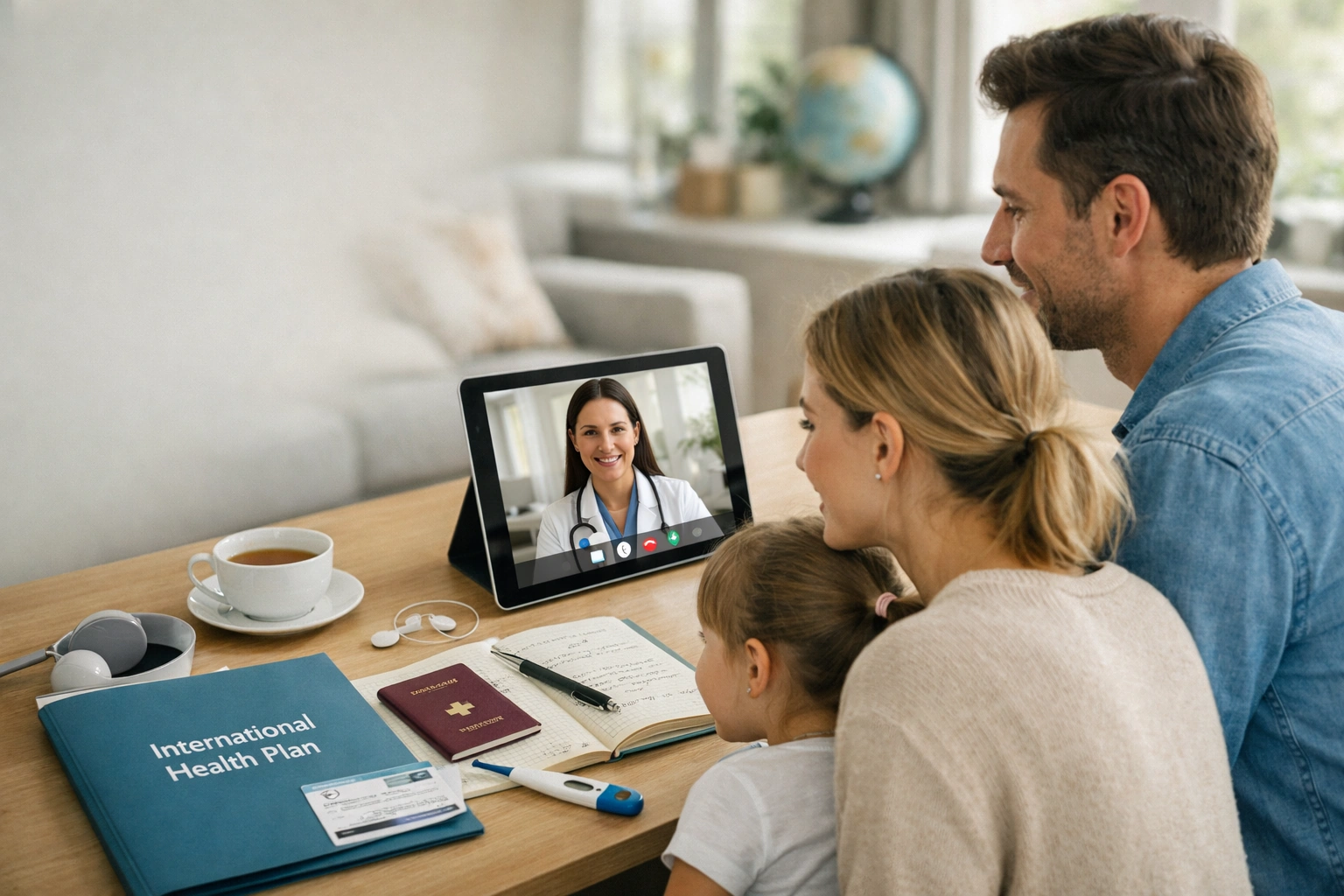

Living abroad can make even straightforward healthcare feel more complicated. You may be dealing with different time zones, unfamiliar healthcare systems, language barriers, or a child becoming unwell when your usual doctor is far away. Telemedicine can make access easier by helping you speak to a clinician remotely, but that convenience only helps if you understand what your international private medical insurance (IPMI) plan actually covers, how to use approved channels, and when remote care is not the right option.
This guide explains how IPMI telemedicine can work in practice for individuals and families. We cover what telemedicine is, the types of service that may be available, common limitations, privacy and data security considerations, and the practical steps that can help you make good use of virtual health consultations. We do not provide medical advice, and we do not assume telemedicine is included in every international health plan. Availability and scope can vary by insurer, policy, country, licensing rules, provider network, and service platform.
- What telemedicine is and how it works with IPMI
- Types of services available (GP, mental health, chronic disease management)
- Benefits and limitations of virtual care
- Accessing telemedicine through insurers
- Privacy and data security considerations
- When to seek in-person care
- Tips for maximising telehealth
- Broker support
What telemedicine is and how it works with IPMI
Health authorities often use telehealth as the broader term for delivering health-related services by electronic means. The CDC describes telehealth as the use of electronic information and telecommunications technologies to support long-distance clinical care, health education, public health, and administration.[1] Within that broader category, telemedicine more commonly refers to remote clinical care between a patient and a healthcare professional.[1]
In practical IPMI terms, this means your insurer may offer access to telehealth, remote healthcare, or app-based medical services through a member portal, mobile app, or an approved provider arrangement. Depending on the plan, you may be able to book a virtual GP appointment, message a clinician securely, request a referral, arrange mental health support, or manage some follow-up care without attending a clinic in person.
The key point is that telemedicine in international private medical insurance is rarely a simple yes-or-no feature. It can depend on:
- the insurer and product design;
- whether your plan includes outpatient cover or a separate digital care module;
- the country where you are physically located at the time of the consultation;
- the provider’s licensing rules and network arrangements;
- the platform used for the consultation; and
- the type of service you are trying to access.
That is why a plan may refer to global access or digital convenience, while the actual availability of telemedicine still varies by jurisdiction, language, consultation type, and claims process. It may be included as a direct-billed member benefit, treated as an eligible outpatient expense on a reimbursement basis, restricted to specific clinicians, or excluded altogether. Using telemedicine well starts with understanding that distinction.
Remote clinical care delivered by video, telephone, or secure digital communication.[1]
A broader category that can include clinical care, education, administration, monitoring, and care co-ordination delivered remotely.[1]
A remote consultation with a general practitioner, often used for triage, everyday illnesses, follow-up, or referrals.
An initial assessment that helps direct you towards self-care, a consultation, a referral, or urgent in-person treatment.
Ongoing support for a condition or treatment pathway, sometimes including remote follow-up and co-ordination between providers.
Either the service is paid for directly by the insurer through an approved route, or you pay first and then submit a claim, subject to policy terms.
An insurer or provider platform used to book appointments, upload documents, receive summaries, and communicate more securely than standard messaging apps.
An electronic prescription arrangement that may or may not be available, and whose validity depends on local law, provider rules, and pharmacy practice.
How telemedicine usually fits into an international plan
For many families, the value of telemedicine is not that it replaces local healthcare. It is that it can provide a useful first point of contact when you need guidance, documentation, or a quick next step. That can be especially helpful if you are newly arrived abroad, travelling between countries, waiting for a local appointment, or trying to co-ordinate care for children, elderly dependants, or a chronic condition.
In some cases, the insurer’s telemedicine pathway is designed to reduce friction. You log in, confirm your location, choose a language, answer a short symptom questionnaire, and then join a video or telephone consultation. In other cases, telemedicine sits outside the insurer’s own platform and works more like a standard outpatient claim. You arrange the consultation through an approved provider, pay if required, and submit the receipt afterwards.
Either way, telemedicine works best when you see it as one part of a wider care pathway. It can help with access and co-ordination, but it does not remove the need to understand your cover, follow platform instructions, keep records, or escalate appropriately when in-person care is needed.
Symptom / question
      ↓
Telemedicine triage through insurer portal / app / approved platform
      ↓
Initial outcome may be one of the following:
  • Self-care guidance
  • Referral to a virtual GP or another clinician
  • Prescription / administrative support
  • Recommendation for tests, imaging, or local in-person review
  • Urgent in-person escalation
      ↓
If suitable for remote care → consultation summary / next steps / follow-up
If not suitable for remote care → local clinic, urgent care, or emergency services
Telemedicine availability and scope vary by insurer, policy, country, licensing rules, provider network, and service platform. Always rely on your policy wording, member portal guidance, and insurer instructions for the exact position.
Types of services available (GP, mental health, chronic disease management)
Telemedicine can cover more than a simple doctor-on-demand model. Depending on the plan and platform, virtual health consultations may be available across primary care, behavioural health, follow-up support, and some specialist pathways. At the same time, service design varies widely, so the better question is not “Does my plan have telemedicine?” but “Which remote services are available to me, under what conditions, in which country, and through which route?”
| Service type | What it may help with | Typical limitations | When in-person care may be better | What to verify in your policy/app |
|---|---|---|---|---|
| Virtual GP | Minor illnesses, initial assessment, triage, follow-up questions, referrals, discussion of test results, and routine administrative requests. | Cannot provide a hands-on examination; may not be suitable for unclear, severe, or rapidly changing symptoms; medication rules vary. | Where examination, testing, imaging, or urgent treatment is needed. | Whether GP telemedicine is included, whether it is direct billed or reimbursable, language options, consultation hours, and country availability. |
| Mental health support | Counselling, therapy sessions, wellbeing support, and follow-up care where telehealth is permitted and clinically appropriate. | Session limits, provider-type restrictions, separate benefit modules, pre-authorisation requirements, and licensing restrictions may apply. | Where there is immediate risk, a severe crisis, or a need for in-person assessment. | Whether remote mental health support is covered, the type of practitioner available, any session limits, and the confidentiality / privacy settings. |
| Chronic disease management | Routine check-ins, medication reviews, monitoring discussions, care co-ordination, and follow-up between in-person appointments. | Often depends on an existing diagnosis, continuity with the same provider, and access to records or test results. | Where symptoms worsen, an examination is needed, or new tests are required. | Whether remote follow-up is covered, whether records can be shared, and whether remote monitoring or care co-ordination is included. |
| Specialist opinion / referral support | Initial guidance, second-opinion pathways, referral letters, and support in deciding the next step. | Not all specialties are available remotely; the service may lead only to a referral rather than definitive treatment. | Where physical examination, procedure planning, or imaging is central to the next step. | Referral rules, approved specialties, billing arrangements, and whether records transfer into the insurer’s network. |
| Administrative / prescription support | Consultation summaries, repeat medication discussions, referrals, fit notes or medical certificates where permitted, and general documentation. | Prescription rights and document validity vary by country, platform, pharmacy, and local law. | Where you need immediate dispensing, controlled medication, or a document recognised only in local paper form. | Prescription validity, pharmacy rules, document sharing, and whether additional verification is required. |
Virtual GP support
For many expat families, the most common use of telemedicine is a virtual GP consultation. This can be a practical first step when you want guidance on whether an issue looks minor, whether a referral is appropriate, or whether a child’s symptoms need prompt local review. It can also be useful for discussing next steps after test results, routine follow-up on an existing care plan, or straightforward administration.
The value here is often speed and access rather than completeness. Remote GP care can be very helpful, but it may still end with “please arrange a same-day local appointment” or “you need a physical examination”. That does not mean the consultation has failed. It means the triage process has done its job.
Mental health as a common telehealth use case
Mental health support is one of the better-known uses of telehealth. Remote sessions can make it easier to maintain continuity if you move country, travel regularly, or live somewhere with limited local access to English-speaking providers. Telehealth.HHS notes that telehealth can expand access to behavioural health services.[2]
Within IPMI, however, mental health benefits can sit in different parts of the policy. Some plans include them within outpatient cover, some treat them as a separate category, and some limit remote sessions by provider type, platform, or number of consultations. For a fuller explanation, see our article on mental health and wellbeing in IPMI: coverage options and best practices.
Chronic disease management and follow-up
Remote care can also support chronic condition management. Telehealth.HHS includes chronic disease prevention and management among established telehealth use cases, and common digital pathways often support follow-up for conditions that need steady monitoring rather than repeated urgent appointments.[2]
In insurance terms, this may mean routine follow-up appointments, care-plan discussions, medication review, or case-management support rather than a wholly separate benefit. The key point is continuity. Remote care often works best when it supports an existing diagnosis and treatment pathway, rather than trying to replace a full initial work-up.
Benefits and limitations of virtual care
The appeal of telemedicine is clear: it can make access easier. However, international families usually get the best results when they combine convenience with realistic expectations. The same features that make telehealth useful also explain its limits.
Remote care can reduce the delay between “I need to ask someone” and actually speaking to a clinician. This can matter when you are abroad, travelling, or outside normal local surgery hours.
A remote consultation can be easier to fit around school runs, work, travel, or caring responsibilities. It may also help where only one parent is available, or when a child feels unwell and travel would be difficult.
Telemedicine may work well for reviewing progress, checking in after treatment, discussing results, or co-ordinating the next step in a wider care pathway.
Public-health sources note that telehealth can improve access to care, especially where geography or local service availability would otherwise create friction.[1]
Telehealth is generally intended for non-emergency needs. If the situation may require examination, testing, or urgent intervention, in-person care may be more appropriate.[5][6]
A provider may only be able to consult where you are physically located in certain countries or regions. This can affect availability even where the policy otherwise provides cover.
Where the main advantages lie
For most IPMI members, the main telemedicine benefits are quicker early guidance and greater administrative clarity. A useful remote consultation may help you avoid unnecessary travel, reach the right care setting more quickly, or obtain the referral or records you need for the next step. It can also support families who are still learning how local healthcare works after a move abroad.
There is also a practical emotional benefit. When you are overseas, uncertainty can itself be stressful. Speaking to a clinician remotely may give you a clearer sense of whether the next step is self-care, a local outpatient appointment, urgent same-day treatment, or something more formal through the insurer’s network.
Where the limits usually arise
Remote care cannot replace everything that happens in a consulting room. Physical examination, imaging, blood tests, vaccinations, and many procedures still require local hands-on care. Even where a clinician can see or hear important clues over video, the consultation may still end with a recommendation for tests or an in-person appointment.
Insurance limits can also be just as important as technical ones. A platform may exist, but your plan may not include access. Or the plan may only provide access in certain countries, in certain languages, or for certain service types. Billing arrangements can vary too. This is one reason telemedicine should be treated as a policy feature to verify, not as something to assume.
- Assuming every country allows the same remote services: country rules, provider licensing, and pharmacy practice can all differ.
- Oversharing through insecure apps: sending sensitive medical details over standard messaging platforms or personal email can create unnecessary privacy risk.
- Expecting prescriptions to transfer neatly across borders: prescription validity and dispensing rules can vary by jurisdiction and by pharmacy.
- Relying on telemedicine for urgent situations: remote care is not a substitute for emergency assessment where symptoms are severe or worsening.[5][6]
- Not keeping records: consultation summaries, invoices, receipts, referral letters, and follow-up instructions should be kept for claims purposes and continuity of care.
Accessing telemedicine through insurers
In practical terms, this is usually the most important section. Knowing that telemedicine exists is less useful than knowing exactly where to look, what to click, which documents to have ready, and what happens if your plan does not include the service.
Where to check first
- Your policy wording and benefit schedule: look for references to telemedicine, telehealth, virtual consultations, digital care, outpatient cover, behavioural health, or approved service platforms.
- Your member portal or insurer app: this is often where approved access routes, appointment booking, service availability, and consultation history are shown.
- Your welcome pack or membership documents: some insurers explain digital services separately from the main policy wording.
- Customer support or broker support: if the wording is unclear, ask directly whether telemedicine is included, reimbursable, direct billed, limited to certain providers, or restricted by country.
A practical “how to access” walkthrough
The process varies by insurer, but a careful step-by-step approach usually helps:
- Confirm eligibility. Check that telemedicine is included in your plan and available in the country where you are physically located.
- Use the official route. Access the consultation through the insurer’s member portal, app, or a clearly approved platform. Avoid finding a random third-party service and assuming it will be covered.
- Verify your identity and location. Many systems ask for your policy number, membership ID, date of birth, and current country because location can affect provider eligibility and prescription rules.
- Choose the service type. You may need to select between GP, mental health, follow-up, or another category before booking.
- Complete a short triage or intake form. This may include symptoms, duration, current medication, allergies, or preferred language.
- Prepare your documents. Have your policy number, identification, a list of medicines, recent reports or test results, and any referral letter ready if relevant.
- Attend the consultation in a private setting. Make sure your connection is stable, your device works properly, and you can speak without being overheard.
- Keep the outcome. Download or retain the consultation summary, referral, prescription information, invoice, or follow-up instructions.
- Check the billing route. If the service is not direct billed, ask what documentation is needed for reimbursement and submit it promptly.
If telemedicine is not included
Some members only discover that telemedicine is not included when they try to book. If that happens, you still have options, but the route changes. You may choose to arrange a private virtual consultation yourself and then check whether any part of the cost is eligible for reimbursement under your outpatient cover. That will depend on the policy wording, provider eligibility, and country-specific rules. In other cases, the better route may simply be a local in-person appointment.
This is one reason it helps to review digital care access before you need it. If telemedicine matters to your family, it is better to know where it sits within the policy now than when you are unwell and trying to solve two problems at once.
- Availability by country: Is the service available where you are physically located today?
- Language support: Can you book in your preferred language, and can dependent family members do the same?
- 24/7 access or set hours: Is the service on demand, scheduled, or limited to certain times?
- Records sharing: Can consultation notes, referrals, and summaries be downloaded or shared with your local doctor?
- Prescription rules: Can the service issue prescriptions, and will they be accepted where you intend to have them dispensed?
- Follow-up options: Can you rebook the same clinician, or is follow-up routed through local care?
- Reimbursement / direct billing: Is the consultation included and billed directly, or do you need to pay first and submit a claim?
- Privacy controls: Is communication secure, is data storage explained clearly, and is there a clear consent and privacy notice?
Privacy and data security considerations
Health information is sensitive. Telemedicine can be highly practical, but it also relies on personal data moving through digital systems. That means privacy and data security are not side issues. They are part of using the service properly.
Telehealth.HHS notes that protecting the privacy and security of patient health information is essential to maintaining trust in telehealth services.[2] The same source also highlights the need for clear policies, lawful processing, and patient awareness of digital privacy risks.[2][3]
Why this matters for IPMI members
International insurance adds extra layers. You may be in one country, using a platform administered in another, speaking to a provider licensed in a third, and storing records that later need to be shared with a local clinic or claims team. That does not automatically create a problem, but it does make it especially important to use official channels and understand who is handling your information.
In the United States, telehealth-related health and billing information is generally protected under HIPAA, and providers are expected to use secure communication and storage arrangements.[3] In UK and EU data protection frameworks, health data is treated as special category or sensitive personal data and is subject to stricter handling requirements.[4] From the member’s perspective, the practical point is simple: do not assume that any messaging app or email thread is an appropriate place for detailed medical information.
Book and communicate through the insurer’s member portal, approved app, or provider system rather than through informal personal messaging.
Check how your data is stored, who can access it, whether it may be shared for billing or clinical purposes, and how long it will be retained.
Provide the information required for the consultation, referral, or claim, but avoid sending unnecessary documents across multiple channels.
Use a secure connection, keep your device updated, and avoid taking calls on public Wi-Fi where possible.
Practical privacy steps before a consultation
- Use a private room where you can speak freely and where family members or colleagues cannot overhear sensitive details.
- Check whether the app or platform requests permissions you do not understand.
- Keep copies of consent screens, privacy notices, and downloaded consultation summaries where relevant.
- Take care when forwarding records to local providers or claims teams: use secure upload functions where available rather than standard email attachments.
- If you are arranging care for a child, check how parental consent, identity verification, and record access work on the platform.
Good privacy practice does not need to be technical. In most cases, it is about using the intended route, reading the notices provided, and treating medical information with appropriate care.
When to seek in-person care
Telemedicine can be useful, but it is not designed for every scenario. General guidance from healthcare providers is consistent on one key point: virtual care is best suited to non-emergency needs, and severe or time-critical symptoms should be assessed in person.[5][6]
For emergencies or urgent red-flag symptoms, seek in-person emergency care or contact local emergency services rather than relying on telemedicine.
Situations where in-person care may be better from the outset
- severe chest pain;
- difficulty breathing or significant shortness of breath;
- possible stroke symptoms, such as sudden weakness, numbness, or speech changes;
- severe abdominal pain;
- sudden loss of vision or hearing;
- major injury, suspected fracture, serious bleeding, or significant trauma;
- rapidly worsening symptoms, or symptoms that seem out of proportion to a minor illness;[5][6]
- an acute mental health crisis or immediate risk of harm.
Even where a telemedicine platform offers a symptom checker or rapid access, it should not be used as a substitute for emergency assessment. If a remote clinician or triage tool advises urgent in-person care, it is sensible to follow that advice without delay.
Why remote care may still direct you to local care
Many successful telemedicine interactions end with an in-person next step. That may happen because the clinician needs a physical examination, because diagnostic testing is required, or because the safest route is to move quickly into local urgent care. This is not a failure of remote healthcare. It is one of its key functions: helping direct you to the right level of care more quickly.
Tips for maximising telehealth
Families usually get more value from telemedicine when they treat it like any other important health service: prepare a little, keep documents organised, and use it within its proper limits.
- Test the technology in advance: make sure your camera, microphone, battery, and connection are working before the consultation.[5]
- Choose a private, well-lit place: good lighting helps if the clinician needs to see visible symptoms, and privacy matters for sensitive discussions.[5]
- Prepare a short summary: note the symptoms, when they started, current medication, allergies, and relevant medical history.
- Keep policy details nearby: have your policy number, member ID, and app login to hand, especially if you may need follow-up administration or a claim.
- Ask how records will be handled: find out whether you can download the summary, how it will be shared, and what you need for reimbursement if applicable.
- Clarify the next step before the call ends: ask whether you need follow-up, local tests, a referral, or urgent review.
- Save the documentation straight away: keep summaries, receipts, referrals, and instructions together for future reference.
- Review dependant access: if you are managing cover for children or a partner, confirm who can book, who needs to be present, and how consent works.
Tips that matter particularly for expat families
If your family is mobile, a little structure goes a long way. Keep a simple folder with policy documents, identification details, child health records, medication lists, and recent reports. Save the insurer app on both parents’ phones where appropriate, and make sure at least one other trusted adult knows where membership details are kept in case you need help quickly.
It also helps to think ahead about local back-up options. Telemedicine works better when you already know the nearest clinic, hospital, or paediatric service in your area. That way, if a remote consultation ends with “please be seen today”, you do not have to start your local search from scratch.
Before the appointment: a simple five-minute check
Confirm location eligibility, log in early, check the consultation language, gather any recent reports or medication details, and make sure you can take the call in private.
After the appointment: the administrative step people often miss
Download the consultation summary, save the receipt if there is one, check whether the visit was direct billed or needs to be claimed on a reimbursement basis, and keep any referral or prescription information with your policy records.
Broker support
Telemedicine is one of those features that sounds straightforward until you need to use it across borders. That is where broker support can make a real difference. We do not provide medical advice, but we can help you understand the administrative and policy side of access.
In practice, that may mean helping you check whether telemedicine is included, whether it sits within outpatient cover or a separate service pathway, whether it is limited to approved platforms, and whether direct billing or reimbursement applies. We can also help you interpret service wording that might otherwise sound broader than it really is.
If telemedicine matters to your family, broker support is often most valuable before there is an urgent need. We can help you compare how different plans approach digital access, language options, service geography, and the practical balance between convenience and local care. For existing members, we can also help you work through what needs to be verified in your current policy if the digital care arrangement is unclear.
More broadly, telemedicine should sit within a wider international health insurance strategy. If you are still planning your move or reviewing your cover, our guide to IPMI Abroad: The Guide to Getting Health Cover Right Before You Move is a useful starting point for understanding how policy design, country choice, and family needs fit together.
Get Started
If you want to understand how telemedicine may fit within your own international cover, start with the policy details rather than assumptions. Our Individual & Families page explains how we support expats and internationally mobile households, and our FAQ answers common questions about IPMI structure, access, and day-to-day use.
For further reading, you may also find these guides helpful:
Points to verify
Before relying on telemedicine under your international health plan, check the following points in your policy wording, member portal, and insurer guidance:
- Whether telemedicine is included, optional, or restricted: some plans include it as standard, some offer it as an add-on, and some restrict access to certain platforms or providers only.
- Countries and languages in which the service is available: availability can depend on your physical location at the time of the consultation.
- Whether consultations are direct billed or reimbursable: the billing route may differ by service type and platform.
- Which services are included: GP support, mental health consultations, chronic condition follow-up, prescriptions, referrals, second opinions, or administrative support may all be handled differently.
- Prescription validity and pharmacy rules across borders: electronic prescriptions and repeat medication arrangements are not handled in the same way everywhere.
- Data privacy settings, consent, and document storage rules: check how health data is handled, who can access it, and how records can be shared.
- Emergency escalation instructions and follow-up options: know what the platform says to do if urgent symptoms arise during or after a consultation.
These are the points that most often determine whether telemedicine feels straightforward and useful, or frustrating and uncertain.