
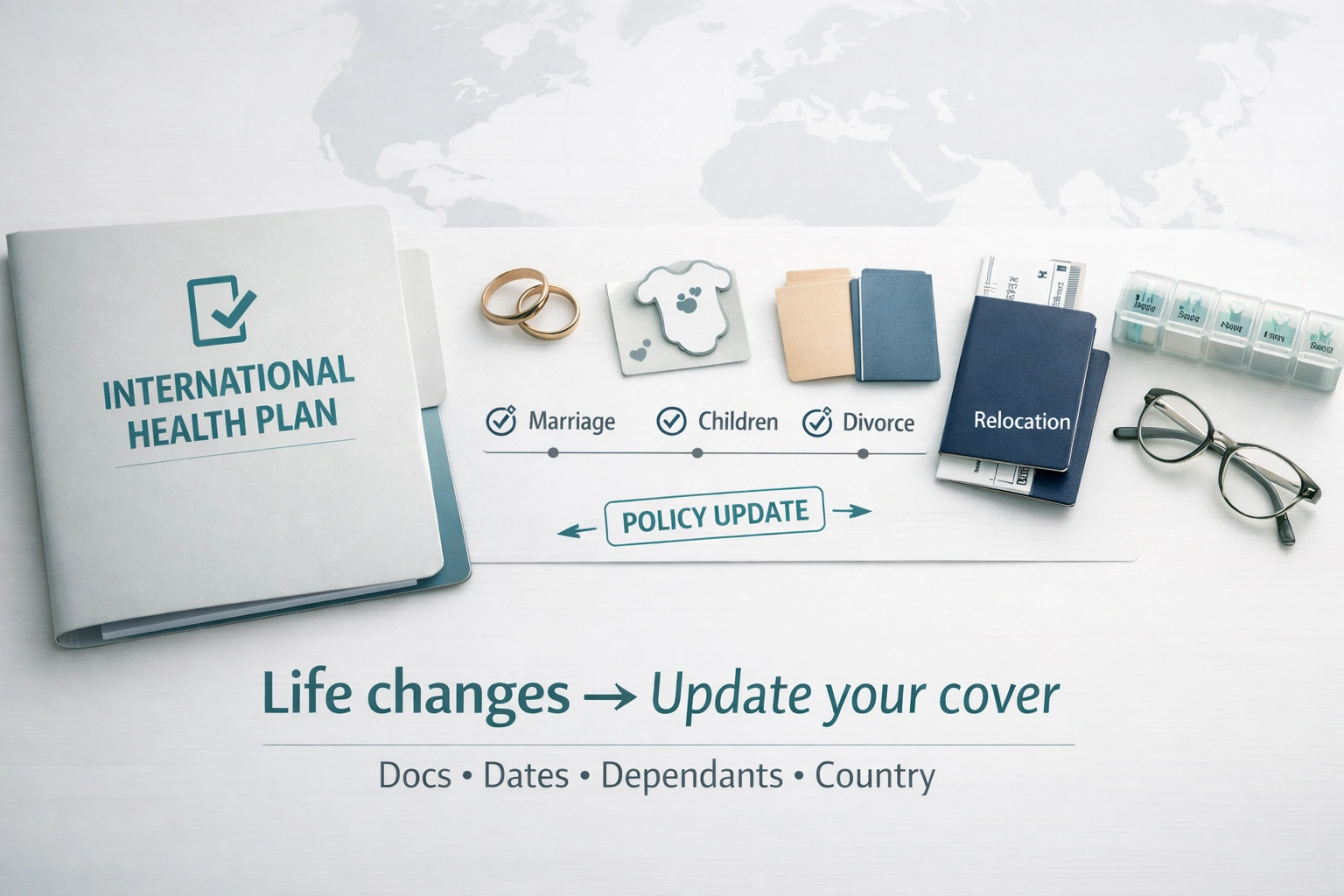

International private medical insurance tends to work best when your policy reflects your real life: who is covered, where you live, and which documents you can produce quickly when asked. Life changes are normal. The difficulty is usually not the event itself, but the timing and administration around it — the right form, the right certificate, consistent names, and written confirmation that your insurer has processed the change. This guide explains how common life changes can affect an international health plan, what usually needs updating, which documents are commonly requested, what can trigger underwriting or revised terms, and how to reduce the risk of gaps in cover.
- Notify your insurer early, then get confirmation in writing
- Expect document checks for names, dates, translations and proof of relationship
- Adding a person can trigger underwriting or revised terms
- Newborn cover is not automatic — treat enrolment as urgent
- Relocation can affect area of cover, premium and eligibility
- Do not cancel too early when restructuring cover after separation or career changes
- A simple family admin system can reduce delays
Overview of life events that trigger policy changes
Most problems policyholders face after a major life change usually come down to one of three things. Your policy details are out of date. A change was requested but not completed. Or the change was completed, but your family is still relying on outdated documents.
At a high level, insurers often deal with life-event changes by issuing a policy amendment, commonly called an endorsement. An endorsement changes the terms of an existing insurance contract and becomes part of that contract, so it should be kept with your main policy documents.[4][6]
Many insurers also treat a life-event update as a mid-term adjustment: you provide new information, the insurer reviews it, and the premium, terms or eligibility may change depending on the policy and the underwriting criteria.[5] That is why even a change that appears straightforward — such as adding a spouse, updating your country of residence, or moving from a group scheme to an individual policy — should be handled carefully.
A person covered under your policy as part of your household, subject to the insurer’s eligibility rules.
A written amendment to your insurance contract which changes the original policy terms.[4][6]
The insurer’s risk assessment process when deciding whether to offer cover and on what terms.
A defined period during which certain benefits may be limited or unavailable, depending on the policy wording.
The insurer’s rules on who can be covered, often based on relationship, age, residency or student status.
The geographical scope of your policy, often linked to premium and provider access.
The point at which your policy continues for a further term and may be re-rated or amended under the policy rules.
The ability to move between plans, insurers or policy structures while managing continuity, where available.
Why documentation matters more than you might expect
Life-event updates often involve identity documents, relationship documents and, in some cases, medical information. Health data is treated as sensitive personal data under data protection rules and requires additional protection.[1][2][3]
The practical point is simple: build a process that is secure, repeatable and quick. That way, you are not rushing to send passports, certificates and medical forms under pressure.
| Life event | What typically changes | Documents commonly requested | Timing risk | Underwriting risk | What to verify |
|---|---|---|---|---|---|
| Marriage / registered partnership | Household status, possible addition of spouse/partner, billing details | Marriage or partnership certificate, passports/ID, sometimes proof of address | Medium | Medium | Partner eligibility, effective date, whether underwriting applies, translation requirements |
| Cohabiting partner | Possible addition if the policy allows it | Proof of relationship, proof of shared address, ID | Medium | Medium to high | Whether partners are eligible, what evidence is accepted, any minimum cohabitation requirements |
| Divorce / separation | Removal of spouse/partner, policyholder changes, child administration changes | Separation or divorce documents where relevant, custody documents where relevant, ID, updated contact details | High | Medium to high | Split-policy process, continuation options, effective dates, who remains the policyholder |
| Newborn enrolment | Add newborn, update family composition, possibly maternity/newborn conditions | Birth certificate or interim hospital confirmation, newborn details, application form | High | Medium to high | Time-limited enrolment window, inception date of cover, underwriting triggers, newborn care terms |
| Adoption / surrogacy | Add child and confirm legal or administrative status | Adoption or placement documents, ID, application form | High | Medium to high | Eligibility definition, effective date, underwriting triggers, required document format |
| Child becomes an adult / leaves the household | Remove dependant or update student status | Proof of study where relevant, ID, age evidence | Medium | Low | Maximum dependant age, student rules, separate policy options |
| Aging parent | Possible request to add a parent or arrange separate cover | Proof of relationship, ID, medical questionnaire or medical history | Medium | High | Whether parents are eligible at all, age limits, treatment of pre-existing medical conditions |
| Relocation | Address, country of residence, area of cover, premium | Proof of address, sometimes visa or residency evidence, travel pattern summary | High | Low to medium | Area of cover, “home country” rules, network suitability, premium impact |
| Career change | Policyholder/payer details, plan structure, group-to-individual transition | Termination or continuation documents where relevant, new billing details, application forms | High | Medium to high | Continuation options, underwriting, effective date, premium payment frequency |
| Name change | Member records and claims matching | Legal name-change document, updated passport/ID | Medium | Low | How all records should be updated so provider invoices match the policy |
Life event occurs
    ↓
Notify insurer and/or broker
    ↓
Confirm eligibility and timing rules
    ├─ If not eligible → discuss alternatives
    └─ If eligible → continue
           ↓
Collect documents and complete forms
           ↓
Submit request and ask for written confirmation
           ↓
Is underwriting required?
    ├─ No → endorsement / updated certificate issued
    └─ Yes → underwriting review → terms offered (if any) → accept / decline
           ↓
Verify: member list, dates, area of cover, benefits, premium, cards / portal
           ↓
Store updated documents and share the current version with the family
Family admin system
Small administrative actions now can prevent major difficulties later. This is where the same principle from BIG’s guide on living with your international health plan becomes useful in practice: keep one clear family admin system, rather than letting policy documents sit across inboxes, phones and old downloads.
A simple structure is usually enough:
- One secure digital folder for current policy wording, schedule of benefits, endorsements, certificates, ID and relationship documents.
- One slim physical folder containing current member cards, insurer assistance numbers, and essential copies of ID and certificates.
- Controlled access so only the right adults can view medical and personal documents, especially for children and aging parents.[1][2]
- Consistent file names such as YYYY-MM-DD – Person – Document – Country.
General guidance on moving abroad also supports this approach: keep originals with you, make digital and paper copies, and be ready for translation requirements where needed.[10][11]
- Late notification: the change is only raised when you already need to make a claim.
- Assuming automatic cover: especially for newborns, spouses or partners.
- Cancelling too early: ending one arrangement before the replacement is active and confirmed.
- Moving countries without updating area of cover: creating a mismatch between the policy and your actual circumstances.
- Document mismatches: different spellings, missing pages, untranslated certificates, or inconsistent dates.
- Gaps during divorce transitions: one party or the children fall between two policy arrangements.
How to add or remove dependants
Adding dependants sounds like a single administrative step. In practice, it is a small project: confirm eligibility, gather documents, submit forms, clarify any underwriting requirements, and check the updated documents once the change has been accepted.
Adding a dependant
You are usually updating the member list, the premium, the policy documents, and often the member portal or cards as well. Some insurers state explicitly that adding a new beneficiary requires an application and that cover starts only after acceptance and once any offered terms have been agreed.[7][9]
That does not mean every addition will be difficult. It does mean you should avoid assumptions, especially when adding an adult dependant, a partner, or anyone with more complex circumstances.
Check who is being added, where they live, whether the policy allows that relationship category, and whether you are changing the policy mid-term or at renewal.
Usually ID, proof of relationship, proof of address if requested, and any insurer application or health forms.
Does underwriting apply, what is the proposed effective date, and what naming or translation standards will apply?
Check the updated certificate, member list, premium, effective date and portal access once the insurer has issued the change.
Removing a dependant
Removal often appears simpler because it may not trigger underwriting. The real risk is continuity: does removal end cover immediately, is there a continuation option, and is anyone mid-treatment or waiting for authorised treatment?
Some insurer rules specifically warn that authorised treatment may be affected if a beneficiary leaves the policy before the treatment takes place.[9] That is why removal should be treated as a cover issue, not just an administrative tidy-up.
A note on consent and older children
As children get older, access to their information may become more restricted. Some insurers note that once dependants reach a certain age, they may need to give their own consent before you can view or change their information.[8]
That makes it worth planning early for who manages administration within the family and who is authorised to speak to the insurer.
Marriage and legal partners: documentation
Marriage abroad often seems straightforward until the paperwork starts moving across borders. Your marriage may be legally valid, but the insurer still needs documents it can read, match to your ID, and process under its own administration rules.
What typically changes after marriage
- Adding a spouse as a dependant or moving to a family policy structure
- Updating your surname or identity records
- Updating billing, beneficiary and contact details
- Sometimes updating your country of residence if the marriage also involves relocation
Documents commonly requested
In many cases, the insurer will ask for a marriage or registered partnership certificate, ID or passports for both people, and sometimes proof of address. If the document was issued in another country or language, translations or additional verification may be requested.
EU guidance on public documents is useful at a high level here. It explains that some public documents can be accepted across EU countries without an apostille for authenticity purposes, while their legal effect still depends on national law, and translations may or may not be required depending on the document and the language.[10]
For IPMI purposes, the practical point is straightforward: if the insurer cannot clearly match the certificate to the insured person, delays are more likely.
- Use the same name format as appears on passports and policy records.
- Keep both the original certificate and any official translation.
- Label different versions clearly so you do not submit the wrong scan.
- Ask the insurer to confirm in writing whether extra authentication is required for the document submitted.
If you are not married
Partner eligibility is insurer-specific. Some policies allow partners, some only allow spouses, and some require proof of cohabitation or financial interdependence.
Treat this as a point to verify, not an assumption. Confirm what counts as a legal partner or eligible partner under your policy, what evidence is accepted, and whether underwriting applies.
Divorce or separation: splitting policies
Divorce or separation is one of the highest-risk transitions for cover because several things can change at once. A dependant may be removed, the policyholder may change, the premium payer may change, and children’s living arrangements may affect who manages the policy.
This section is not legal advice. Think of it as an insurance administration checklist designed to reduce the risk of gaps in cover or accidental termination.
Common assumptions that can cause problems
- “We will just remove them and they can arrange their own cover later.”
- “The policy will automatically split into two.”
- “The children will remain covered exactly as before.”
- “Nothing changes until the divorce is legally final.”
In practice, policies vary. Some insurers may require formal instructions and supporting documents and may treat the change as a mid-term adjustment requiring review.[5]
A safer way to manage the transition
Break the situation down into four questions. Who is the current policyholder? Who needs to remain insured under the existing contract? Who needs separate cover, and from what date? And what happens to any pending claims, pre-authorisations or treatment plans?
- Do not cancel first. Keep cover in force until the replacement arrangement is active and confirmed in writing.
- Ask for the insurer’s written process. This reduces the risk of acting on assumptions.
- Deal with children explicitly. Make sure the insurer’s records show who can manage claims and receive communications.
- Check effective dates carefully. The main risk is that one side of the transition moves faster than the other.
Documents commonly requested
Depending on the insurer and the circumstances, this may include separation or divorce documents, updated ID and contact details, custody or parental responsibility documents where relevant, and written instructions from the policyholder.
Even where formal legal documents are not strictly required for policy administration, insurers will usually still need clear and consistent instructions to avoid processing errors.
High-risk point: changing the policyholder
Some policies are built around a principal applicant or main policyholder. If that person leaves the household, you need written confirmation of whether another insured person can take over the contract or whether a new policy must be issued. This is highly insurer-specific and should be confirmed before anyone is removed.
Newborn enrolment
Newborn enrolment is usually the most time-sensitive life-event update. Parents are busy, documents may arrive in stages, and many insurers operate time-limited enrolment windows or different underwriting outcomes depending on when the baby is added.
The safest assumption is that a newborn is not automatically added to most IPMI plans. Treat enrolment as a formal request to amend the policy and start the process promptly.
Separate the parent’s cover from the baby’s cover
Your plan may include maternity benefits for the birth parent, depending on the benefits selected and any waiting periods. That is not the same as the baby being enrolled as a covered member.
Newborn care benefits can also have their own conditions. In other words, a childbirth claim and a newborn enrolment are related, but they are not the same administrative step.
What insurers commonly ask for
- A newborn addition request or application form
- Birth certificate, or interim hospital confirmation pending the certificate
- The newborn’s name and date of birth, recorded consistently across documents
- Sometimes additional information, depending on the insurer’s rules and the policy structure
Insurer examples show why timing matters. Some policy rules state that where a newborn is added within a specified early window, medical information may not be required, whereas later applications can trigger medical underwriting.[7][9] These examples are not universal deadlines, but they do illustrate the pattern.
- Notify the insurer or broker that the birth has taken place, even if the final certificate is not yet available.
- Ask what interim document the insurer will accept while the certificate is being issued.
- Confirm whether an application form is required and whether late notification changes the underwriting process.
- Confirm the effective date in writing rather than assuming cover starts automatically.
- Submit the certificate in the format requested by the insurer as soon as it is available.
Situations to flag early
Some family situations can affect the documents required, the eligibility review or the underwriting process. It is sensible to raise them early rather than wait for the insurer to identify them later.
- Multiple births
- Adoption or surrogacy arrangements
- Parents who recently joined the policy
- Early treatment needs or specialist neonatal care
Aging parents and elder care
Aging parents are a common practical issue for internationally mobile families. The main challenge is that many IPMI plans are designed around policyholders, spouses or partners, and children — not necessarily parents.
The first question is not “what documents do I need?” It is “are parents eligible for cover under this plan at all?”
Start with eligibility
- Does the policy allow parents to be added as dependants?
- Are there age limits?
- Does the parent need to live with you or in the same country of residence?
- Will underwriting apply and, if so, how?
Where parents can be added, the underwriting risk is often higher because medical history is more likely to be relevant. In many cases, a separate policy may be more realistic than adding a parent to an existing family policy.
Elder care and IPMI
International medical plans are usually structured around acute medical treatment, specialist access, provider networks and international claims support. Long-term social care, non-medical support, or ongoing personal assistance may be restricted or fall outside standard medical benefit categories, depending on the policy wording.
That means elder care should be treated as a broader planning issue rather than simply a dependant addition request. Residency, access to providers, realistic care needs, and the portability of medical records all matter.
General relocation guidance also supports keeping core medical records ready when someone moves country or needs continuity between providers.[11]
Data protection in caregiving
When you manage a parent’s medical information, you are handling sensitive personal data. Health data requires additional protection under data protection rules.[1][2][3]
- Keep a parent’s medical documents in a restricted folder.
- Share secure links rather than open email attachments where possible.
- Use a short care summary for emergencies instead of sending full medical files every time.
Career or residency changes
Relocation and career change are two of the most common causes of policy drift. The policy remains the same while real life moves on.
Relocation
Changing country of residence can affect your address details, area of cover, provider network suitability, premium levels, and the practical way you access treatment. In some cases, it can also affect eligibility or how the insurer interprets your residency status.
High-level guidance on insurance policy changes supports the point that when a customer’s circumstances change mid-term, the insurer may review the position and amend the contract accordingly.[5] That is why it is important to notify the insurer promptly rather than assume the policy can continue unchanged.
A useful relocation update pack will usually include:
- Your new address and country of residence
- A summary of your expected travel patterns
- Any linked family changes, such as dependants moving later
- Any insurance evidence needed for local residency or visa administration
Keep your paperwork ready for the move: originals with you, digital and paper copies, and a note of any translation requirements.[10][11]
Career change
Career changes can affect not only who pays the premium, but also who owns the policy and whether you are moving from a group arrangement to an individual one. Common examples include employer-sponsored cover ending, self-employment, contract changes, or moving country for work.
- Confirm who owns the policy: the company or the individual.
- Confirm whether there is a continuation or conversion option.
- Confirm what happens to dependants during the transition.
- Confirm effective dates so you do not create a gap, or an unnecessary overlap.
These arrangements vary significantly by insurer and by scheme. Get the process and dates confirmed in writing before relying on them.
Checklist for updating cover
This section is the consolidated quick-reference version of the article. Save it in your policy folder and use it whenever a life event occurs.
- Policy number and current certificate or schedule
- Current area of cover
- List of everyone currently insured
- A short summary of the life event: what changed, when and where
- The target outcome: add spouse, add newborn, update country of residence, split policy, remove dependant
| Event | Documents to prepare |
|---|---|
| Marriage / registered partnership | Marriage or partnership certificate, passports/ID, proof of address if requested, insurer application form, translations if needed[10] |
| Cohabiting partner | ID, insurer-specific proof of relationship, proof of shared address or financial interdependence, any required application or health form |
| Divorce / separation | Written instruction setting out the desired policy change, ID, updated contact details, separation or divorce documents if requested, custody documents if relevant |
| Newborn enrolment | Birth certificate or interim proof, newborn details, application form, confirmation of any enrolment window or underwriting implications[7][9] |
| Adoption / surrogacy | Relevant legal or administrative documents, ID, application form, confirmation of effective date and underwriting approach |
| Adding / removing a child | Birth certificate or adoption papers, ID copy if required, application form, written confirmation of the removal date if leaving the policy |
| Student-age dependant | Proof of education enrolment, ID, confirmation of age limits and renewal handling |
| Aging parent | Proof of relationship, ID, medical questionnaire or medical history where requested, confirmation of age and eligibility limits |
| Relocation | Proof of new address, country of residence update, travel pattern summary, translations or supporting relocation documents where needed[11] |
| Career change | Current scheme details, updated billing details, conversion or continuation documents if available, written confirmation of effective dates |
| Name change | Legal name-change document, updated passport/ID, confirmation of how claims and provider invoices should match the new record |
- Updated certificate or schedule issued and saved
- Endorsement issued where applicable and stored with the policy documents[4][6]
- Member list checked for correct names and dates of birth
- Effective dates checked for each person
- Area of cover checked against your current country of residence and travel pattern
- Premium and billing checked and understood
- Member cards and portal updated
- Family admin folder updated so everyone is using the current version
Broker support
If you already have an existing policy in force, broker support is usually less about shopping around and more about keeping the arrangement aligned with your circumstances. That can help reduce administrative friction when you need to use the plan.
We can help you identify what actually needs updating, what might reasonably wait until renewal, and which questions matter most before you submit a change. We can also help you assemble the right document pack, sense-check common issues such as name mismatches, and ask the insurer to confirm eligibility, underwriting triggers and effective dates in writing.
We do not make promises about acceptance or policy terms. What we can do is help you manage the process in a more organised way so that avoidable errors are less likely.
Get Started
If you would like help reviewing how your current plan would respond to a life change, start with Already Covered (Review my existing policy). If your question is process-based — such as what counts as a dependant, how to update details, or which documents are usually required — the FAQ is a useful place to begin.
For further reading, see Renewal strategies: managing premium increases and improving your cover and Living with your international health plan: 10 best practices for expatriate families.
Points to verify
- Dependant eligibility rules: spouse or partner definitions, stepchildren, students, and whether parents can be added.
- Enrolment windows and documentation requirements: especially for newborns and new adult dependants.
- Whether and when underwriting applies: to additions, structural changes, or continuation arrangements.
- How divorce or separation is handled: split policies, effective dates, and whether continuation is possible.
- Residency and country changes: how they affect area of cover, network access and premium.
- Required evidence: marriage certificates, birth certificates, custody documents, translations, multilingual forms or apostilles where relevant.
- Waiting periods: whether they apply to new members, added benefits or changed policy structures.