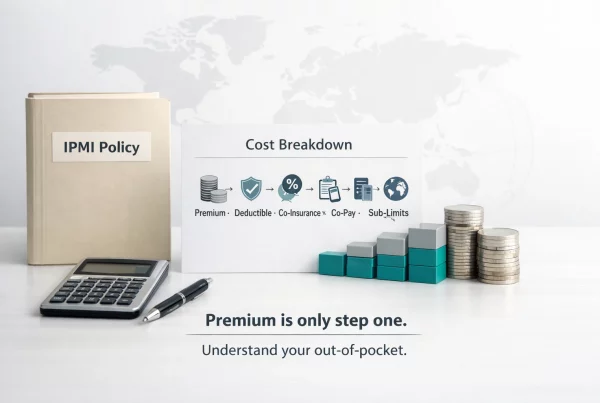




Moving to France is a lifestyle choice. Getting health coverage right is a residency decision. This guide walks you through the process from start to finish, explains what’s typically expected across the main long-stay visa pathways, and helps you choose between French public coverage, local private options, and International Private Medical Insurance (IPMI)—without backing you into a solution you’ll regret later.
- Why health insurance is a migration tool, not an admin task
- The A–Z process: what to do before you fly, on arrival, and after month 3
- France visa pathways: what insurance is typically expected (by visa)
- French public healthcare (Assurance Maladie / PUMa): who qualifies, when, and how
- Your insurance options in France: bridge cover, local private, IPMI
- Before you cancel your US plan: the 3–5–10 year view
- Clear comparison: public system vs local private vs IPMI
- Which route fits your situation: 6 common relocation profiles
- Where a specialist broker helps, and why it’s often more cost-effective
- Checklists: visa file, arrival week, and the “first 90 days”
- FAQ (the questions people ask too late)
- Bottom line
Why health insurance is a migration tool, not an admin task
When you relocate from the US to France, health insurance isn’t just “a benefit.” It’s part of your legal and financial setup: it may be required for your visa, it can prevent costly coverage gaps before public benefits begin, and it can shape how easily you move again later.
The most common mistake we see is treating insurance as a one-year box to check—then being surprised later by what isn’t portable, what can’t be upgraded, or what becomes significantly more expensive after a new medical condition arises.
You’re not just choosing a plan for France. You’re choosing a 3–10 year coverage strategy: whether you may return to the US, relocate again, apply for longer-term residency, or cover dependents across borders. The “best” option is the one that still fits as your life changes—not just the one that satisfies today’s visa paperwork.
The A–Z process: what to do before you fly, on arrival, and after month 3
Phase 1, 60–120 days before departure (design the plan—don’t improvise)
- Choose your visa pathway first. Your visa type drives the insurance approach (visitor vs work vs student vs family).
- Map your “care reality.” Decide where you would prefer treatment for (a) routine care, (b) specialist diagnostics, and (c) hospital admissions. France has excellent public care and strong private facilities, but access, timelines, and reimbursement work differently depending on how you’re set up.
- Define what “continuity” means for your household. Are you likely to move again in 2–3 years, stay 5–10 years, or keep ties and time in the US?
- Build your document package early. For many visa and healthcare steps, you’ll likely need: birth certificates, marriage certificates, apostilles (when required), certified translations, and a plan for proof of address.
- Do a “don’t cancel yet” review of your US coverage. Before dropping US health insurance, confirm whether you can keep it, extend it (for example, via continuation), or transition to an international arrangement on better terms than starting fresh. This can be especially important if you have medical history.
Phase 2, Arrival week (get legally and practically set up)
- Secure a French address and proof of accommodation. Many downstream steps require it: mobile service, banking, and eventually CPAM registration.
- Validate your long-stay visa if required. Many long-stay visas that function as a residence permit (VLS-TS) must be validated online within the required window after arrival.
- Put “bridge” coverage in place if public coverage won’t start immediately. This is where many Americans unintentionally end up underinsured—or buy the wrong type of coverage.
Phase 3, The first 90 days (bridge coverage + public/private setup)
- If you’re employed in France: entry into the public system is typically quicker and more structured through employment.
- If you’re a student: you’ll typically enroll through the student platform for Assurance Maladie, then add a “mutuelle” (complementary coverage) if you want stronger protection against out-of-pocket costs.
- If you’re not working (for example, on a visitor visa): you may need to show stable, lawful residence before you can apply for public coverage. Plan your bridge coverage accordingly.
Phase 4, Month 3 and beyond (optimize—don’t just renew)
This is where planning pays off. Once you have clarity on residency, work status, and your timeline, you can choose the long-term structure: a public base plus a mutuelle, a France-focused private option, IPMI, or a carefully designed combination that avoids paying twice while preserving mobility.
Visas and insurance intersect in nuanced ways—especially for mixed-status households, remote work, or non-traditional income. If you need legal guidance, we can refer you to vetted immigration attorneys who focus on France, and we can coordinate on insurance documentation so your application package is consistent.
France visa pathways: what insurance is typically expected (by visa)
France has several long-stay visa pathways. The practical insurance question is: Are you expected to arrive with comprehensive private medical coverage for the full visa period, or are you likely to enter French public coverage quickly through work, study, or family status?
| Visa pathway (common for US citizens) | Can you work? | Public healthcare access timing (typical) | Insurance approach that usually fits |
|---|---|---|---|
| Long-stay “Visitor” (VLS-TS Visiteur) Often used for retirees, financially independent individuals, or those not employed in France |
No | Not immediate; plan for a private “bridge” period | Comprehensive private medical insurance suitable for long-stay residents (not emergency-only travel coverage). Medical repatriation is commonly expected. |
| Work visa / salaried employment | Yes (authorized) | Often faster once employment is active | Short bridge coverage (if needed) + transition into public coverage; add a mutuelle based on budget and preferences. |
| Passeport Talent For qualified profiles, founders, and certain high-skill categories |
Yes (authorized) | Typically structured; depends on the specific category | Bridge coverage on arrival + public pathway; consider IPMI if you need multi-country portability. |
| Student visa (VLS-TS Étudiant) | Limited (authorized hours under applicable rules) | Student enrollment route | Student enrollment + optional mutuelle; consider IPMI only if mobility is high and the budget supports it. |
| Family pathway Spouse/partner of a French or EU resident, family reunification, etc. |
Depends on status | Often faster, but varies | Bridge coverage until residency status and public enrollment are confirmed; choose a structure that supports the whole household. |
| Short stays (under 90 days) US citizens may be visa-exempt for tourism/business for limited stays |
No (as a visitor) | Not applicable | Travel medical insurance (emergency-focused) can be appropriate for short stays; it is not a long-stay solution. |
For many long-stay scenarios—especially visitor-style residency without immediate public eligibility—the practical expectation is comprehensive health coverage (including medical care and repatriation) for the full visa period. This is where policy terms and the insurance certificate language matter—not just the product’s marketing name.
If you’d like, we can review your visa category and confirm which insurance certificates and wording are typically accepted. If your case is legally sensitive, we can coordinate with an immigration attorney partner.
French public healthcare (Assurance Maladie / PUMa): who qualifies, when, and how
France’s public system is among the strongest in the world—but it helps to understand how it works in practice: for newly arrived non-EU residents who aren’t affiliated through work or a defined enrollment route, coverage is not automatic on day one.
The structure in one minute
The public system reimburses a defined portion of eligible medical costs. Your local office is typically CPAM.
The card that streamlines access and reimbursement once your rights are opened.
Optional (but very common) supplementary coverage that can reduce out-of-pocket costs, depending on the level you choose.
When can a US citizen access public coverage?
The general principle is that public coverage applies if you work in France or reside in France on a stable, lawful basis. Timing varies by situation (employee vs student vs non-working resident).
- If you work in France: eligibility is typically linked to employment and can begin once your employment is active.
- If you are a student: there is a defined enrollment pathway.
- If you are not working: you may need to demonstrate stable, lawful residence before you can apply. In practice, that often means planning a bridge period.
How to register (high-level, practical)
- Confirm your status and proof of address. Your visa/residence status and proof of accommodation matter.
- Prepare documentation. Expect civil status documents, proof of address, and status-related documentation.
- Apply to open your rights. The process typically involves requesting “opening of rights,” then receiving an identifying number and, later, the Carte Vitale.
- Decide whether you need a mutuelle. Many residents choose one to manage out-of-pocket costs and improve reimbursement for items like dental and vision.
If there’s any delay before your public coverage is active, you need a policy that functions like real health insurance—not emergency-only travel coverage. This is also when households are most exposed to unexpected costs, because you’re setting up housing, schools, and banking without the protection of an established public-benefits framework.
Important: eligibility rules and processing timelines can vary by individual circumstances and local administration. Build time buffers into your plan and keep coverage continuous.
Your insurance options in France: bridge cover, local private, IPMI
Most US citizens moving to France choose one of three structures. The right fit depends on your timeline, mobility, and risk tolerance.
Option 1, Bridge coverage (arrival and the first months)
Bridge coverage is intended to prevent a gap while your long-stay status is validated and your public enrollment is pending. The key decision isn’t simply “cheap vs expensive.” It’s whether the coverage is truly designed for residents: outpatient and inpatient benefits, workable claims support, and clear certificate wording for visa files when needed.
Option 2, French local private options (often paired with public coverage)
Many residents rely on the public system as a base and add a mutuelle for predictable out-of-pocket costs. Depending on status and preferences, there may also be France-focused private options. Strategically, the key point is: local solutions are usually built for life in one country. They often lose value if you relocate again.
Option 3, IPMI (International Private Medical Insurance)
IPMI is designed for multi-country living: internationally mobile households, executives, and people who want continuity if they move again. The value isn’t just broader access—it’s portability, claims administration across borders, and how underwriting is handled over time.
If you choose a France-only structure and later relocate, you may need to apply again in a new market. If a medical condition develops in the meantime, it can affect not just premium, but whether certain benefits are offered—or whether exclusions apply.
Before you cancel your US plan: the 3–5–10 year view
Many Americans drop US coverage as soon as they arrive in Europe—and sometimes that’s reasonable. But it’s often worth pressure-testing the decision before you cancel.
Why “cancel immediately” can cost more later
- Some US coverage can be extended or converted in ways that preserve continuity, reduce future underwriting friction, or maintain access for US visits.
- If you develop medical history after cancellation, your future international options can narrow—especially if you later need a portable solution.
- Family needs change. Children’s needs evolve, adults age into higher-risk years, and a “cheaper today” plan can become costly at renewal.
Before canceling a US private health plan (or any continuation option you may be eligible for), do a structured review. In some cases, keeping some form of US coverage for a defined period—while you establish your France structure—can be the most cost-effective outcome over 3–5 years.
This is exactly the kind of decision a broker can help you model: not “what’s cheapest this month,” but what’s most resilient over the next chapter.
A practical way to decide (a 3–5–10 year framework)
You may return to the US or move again. Prioritize flexibility: bridge coverage plus an arrangement that doesn’t lock you into non-portable benefits.
Public coverage plus a mutuelle often fits well, but consider whether one adult’s work or family ties create a meaningful likelihood of another move.
Optimize for stability and predictable costs. This is where reimbursement structure and outpatient exposure matter more than brand names.
Clear comparison: public system vs local private vs IPMI
| Feature | French public system (often + mutuelle) | Local private option (France-focused) | IPMI (international private medical insurance) |
|---|---|---|---|
| Designed for | Residents living primarily in France | Residents seeking a private-style experience in France | Internationally mobile individuals and families |
| Visa usefulness | Generally not a pre-arrival solution; applies after eligibility and enrollment | May work as bridge coverage or resident coverage depending on terms | Often used for visa files when comprehensive private coverage is expected |
| Portability if you move again | Low (country-specific) | Low to moderate (often France-centric) | High (built for multi-country living) |
| Claims model | Reimbursement-based; a mutuelle can reduce out-of-pocket costs | Varies by plan; typically France-based workflows | International claims administration; may support direct billing/direct settlement depending on networks and rules |
| Underwriting impact over time | Not the same underwriting model as private international markets | Varies; generally built for local risk pools | Underwriting and continuity are core features of the product |
| Best for | People settling in France with stable status | France-first lifestyles who want more private-style comfort locally | Households who want continuity across countries under one policy structure |
| Primary watch-outs | Eligibility timing; administrative setup; understanding reimbursement | Limited portability; restricted benefits outside France | Premium cost; choosing the right area of coverage; managing exclusions and underwriting disclosures correctly |
Picking a solution that’s “perfect for France” only if you stay forever—when your real plan is uncertain. The right structure is the one that fits your timeline, mobility risk, and medical profile.
Which route fits your situation: 6 common relocation profiles
Prioritize comprehensive private coverage that clearly supports long-stay residency and protects you during the bridge period while you establish stable, lawful residence. If another move is likely, consider portability from day one.
Public coverage often becomes your base. The strategy is managing out-of-pocket exposure and deciding whether you need international continuity for travel or a future relocation.
If your work is inherently multi-country, a France-only solution can create friction later. IPMI—or a hybrid approach—can be more efficient over 3–5 years.
Families benefit from predictability: outpatient care, diagnostics, mental health support, and day-to-day claims administration. Cost-effective planning often means a base + top-up structure rather than buying the richest benefits across the board.
This is where timing and continuity matter most. Don’t cancel US coverage until you’ve confirmed your France pathway and any international underwriting implications. A broker review can help you avoid a future “no options” outcome.
Plan for flexibility. Local solutions are often not transferable. If a medical condition develops, future options can narrow. Choosing the right structure now can protect mobility later.
Where a specialist broker helps, and why it’s often more cost-effective
A broker’s value isn’t “finding a brand.” It’s helping you build a coverage strategy aligned with your visa pathway, timeline, and risk profile—then turning that into clean documentation and a policy that performs well when you actually need it.
What we do in practice (what clients actually notice)
- Visa-aligned documentation: we confirm appropriate certificate language and supporting documents for your visa file, based on your situation.
- Bridge planning: we help prevent gaps between arrival and public coverage, especially for visitor-style relocations.
- Cost-efficiency modeling: we help you avoid paying for benefits you won’t use—and avoid gaps in benefits you will need.
- Continuity strategy: we assess whether maintaining US coverage temporarily (or preserving an eligibility pathway) protects your longer-term options.
- Underwriting hygiene: for international plans, accurate disclosure is essential. Good documentation now helps prevent claim disputes later.
- Coordination with immigration attorneys: when legal nuance matters, we can introduce specialized partners and ensure the insurance documentation aligns with the legal application.
The best insurance decision is the one you don’t have to revisit because it keeps working as your situation changes. That usually means a little more planning upfront—and often less cost and friction over time.
If you’d like, we can review your visa category, timeline (3/5/10 years), and medical profile at a high level and propose a short list of coverage structures (not just products) that are genuinely cost-effective for your situation.
Checklists: visa file, arrival week, and the first 90 days
Checklist A, Visa file (insurance-focused)
- I know my visa pathway and whether I’m expected to show comprehensive private medical coverage.
- I have an insurance certificate that clearly states coverage territory, effective dates (matching the visa period), and medical repatriation where expected.
- I understand whether my policy is emergency-only travel medical coverage or resident-style medical insurance.
- I have bridge coverage in place if public coverage won’t begin immediately.
- I have reviewed whether I should keep any US coverage temporarily (or preserve a continuation option) before canceling.
- If my case is nuanced, I’ve spoken with an immigration attorney (we can introduce vetted partners).
Checklist B, Arrival week
- I have proof of accommodation and a French address plan.
- I have validated my long-stay status if required and saved the confirmation.
- I have bridge coverage active from day one (no gaps).
- I know how to access urgent care and which hospitals/clinics I would use locally.
Checklist C, First 90 days
- I’ve mapped my path into the French system (work/study/residence-based) and know when to apply/enroll.
- I have my documents ready (civil status documents, translations if needed, proof of continuous address).
- I’ve decided whether to add a mutuelle (and at what level) to manage out-of-pocket costs.
- I have a long-term plan: public + mutuelle, France-focused private, IPMI, or a hybrid strategy aligned with 3–10 year mobility.
FAQ (the questions people ask too late)
Is travel insurance enough for moving to France?
For a short trip, travel medical insurance can be appropriate. For a long-stay relocation, it’s usually the wrong tool. Long-stay residency typically calls for resident-style medical coverage—especially if you won’t enter the French public system immediately.
If France has public healthcare, why do I need private insurance at all?
Because public coverage depends on eligibility and enrollment, and it may not start right away depending on your status. Private coverage can also be a strategic choice—for faster access preferences, portability, and continuity if you relocate again.
Should I cancel my US plan before I leave?
Not automatically. In many cases, a short overlap is smart—especially if you have medical history, expect US visits, or want to preserve continuity. The right decision depends on your timeline and what your US insurer allows.
What’s the “best” choice: public + mutuelle, local private, or IPMI?
The best choice is the one aligned with your real situation: visa category, timeline, mobility, and medical profile. We often see “perfect on paper” choices fall apart because they were built for a life the client wasn’t actually living.
Bottom line
- Start with the visa pathway. Coverage follows residency rules—not the other way around.
- Protect the bridge period. Coverage gaps and the wrong type of policy are the most common (and avoidable) errors.
- Think in 3–5–10 years. Local solutions optimize for one country; IPMI optimizes for mobility and continuity.
- Don’t cancel US coverage blindly. Some households preserve better terms by planning continuity carefully.
- Use a broker for strategy, not just shopping. The most cost-effective answer is usually a structure—not a single “best plan.”
Share your visa pathway, planned move date, household details, and a simple “3–5–10 year” plan. We’ll respond with a cost-effective structure (bridge + long-term) and explain the trade-offs in plain English. If legal nuance is involved, we can connect you with specialized immigration attorneys and coordinate the insurance documentation with the legal application.