
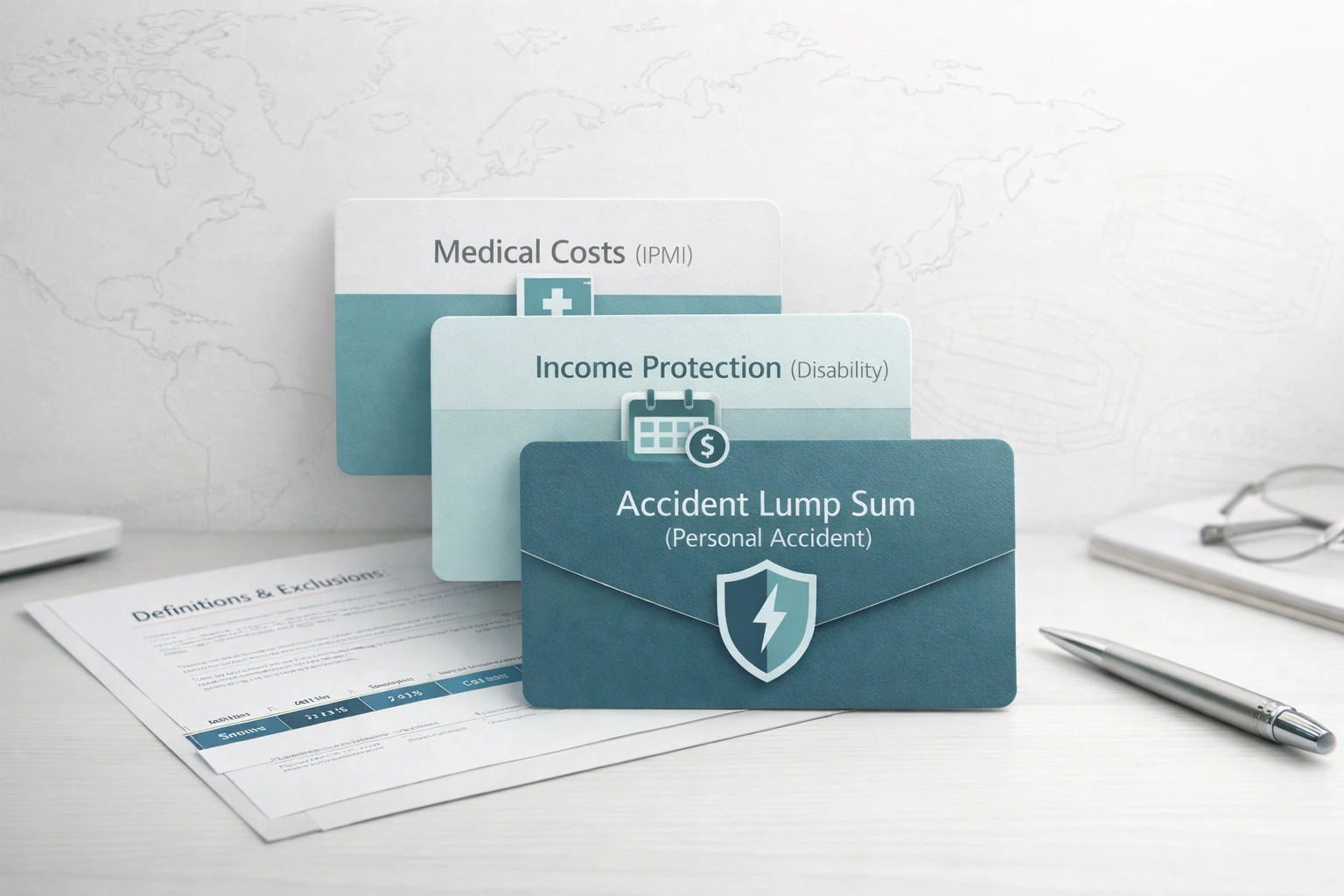

International private medical insurance (IPMI) helps with eligible treatment costs while you are living abroad, but it will not usually replace your income or provide a cash buffer if an accident or disabling illness affects your ability to work and manage day-to-day life. That is where expatriate accident and disability insurance may have a role. It sits alongside health cover rather than replacing it, and can help you think more clearly about income interruption, rehabilitation, family commitments, and the wider financial impact of being unable to work.
This guide explains what expat accident and disability insurance is, how it differs from IPMI and life insurance, why definitions and exclusions matter, and how buyers often compare lump-sum benefits with disability income arrangements. The aim is not to recommend any insurer or suggest what level of cover you should buy. It is to provide a practical decision-making framework so you can review policy wording carefully and make a more informed choice.
- IPMI pays medical bills; accident and disability cover addresses different financial needs.[1][2]
- Personal accident insurance usually pays cash benefits following covered accidental injury or accidental death, often as lump-sum benefits.[1][3]
- Disability income is generally intended to replace part of your earnings if illness or injury prevents you from working, subject to the policy wording and supporting evidence.[2]
- Definitions matter: own occupation, any occupation, waiting periods, benefit periods, and residual disability wording can all materially affect a claim outcome.[2][6]
- Exclusions matter just as much: hazardous activities, substance misuse, travel restrictions, pre-existing conditions, and other exclusions can affect whether a claim is payable.[4][3]
- Accident and disability cover complements IPMI and life insurance; it does not replace either of them.[1][3]
- Careful comparison helps: check portability, currency, employer overlap, disclosure obligations, and claims evidence before arranging cover.[7]
What accident and disability insurance covers
The broad concept is straightforward. Personal accident insurance usually pays a fixed cash benefit if a covered accident causes a specified injury or death, while disability insurance is generally designed to pay an income benefit if illness or injury leaves you unable to work under the policy definition.[1][2]
These benefits are different from health insurance reimbursements. They are usually paid to you or your beneficiaries rather than to a hospital or clinic. That distinction matters because medical treatment is only one part of the issue when a serious accident or disability disrupts life abroad.[1]
- Personal accident: cover that typically pays fixed benefits following a covered accidental injury and, in some cases, accidental death.[1]
- Accidental death: death resulting from a covered accident rather than illness or natural causes; often referred to in AD&D wording.[3]
- Permanent total disability (PTD): a severe disability expected to be permanent or irreversible, as defined in the policy.
- Temporary total disability (TTD): a complete inability to work for a limited period.
- Residual/partial disability: a reduced capacity to work, which may lead to a proportionate benefit rather than a full one.
- Disability income benefit: a regular payment intended to replace part of your earnings when you meet the policy’s definition of disability.[2]
- Elimination/waiting period: the period between a disabling event and the point at which benefits begin.[6]
- Definition of disability: the test the policy uses to decide whether you qualify, often framed as own occupation or any occupation.[2]
- Own occupation: a generic concept under which you may qualify if you cannot carry out the duties of your own occupation, even if you could still do some other work.[2]
- Any occupation: a generic concept under which you usually need to be unable to work in any occupation for which you are suited by training or experience.[2]
- Exclusions: situations, causes, activities, or conditions the policy does not cover.[4]
- Hazardous activities: higher-risk sports, hobbies, or occupations that may be excluded or subject to restrictions.[4]
- Rehabilitation benefit: a benefit or support feature linked to rehabilitation or return to work, where included.
- Critical illness: a separate type of cover that usually pays a lump sum if the insured is diagnosed with a listed serious illness; it is not the same as accident or disability cover.[5]
- IPMI: international private medical insurance, designed to pay eligible healthcare costs while you are living abroad.[8]
What personal accident insurance is typically designed to address
A personal accident policy usually responds to a sudden accidental event rather than an illness that develops over time. Benefits may be structured as fixed amounts for specified injuries, hospital cash, accidental death, or permanent disability. In practical terms, this type of cover is often used to provide immediate liquidity after an accident: transport, household costs, school fees, temporary care support, or other expenses that continue while your IPMI claim is being processed.[1][3]
What disability income is typically designed to address
Disability income is usually about earnings rather than treatment costs. If illness or injury prevents you from working, the policy may pay a monthly benefit for a stated period, subject to the waiting period, evidence requirements, offset provisions, and the policy definition of disability.[2][6]
This can be particularly relevant for expatriates because income interruption may be more destabilising abroad. Rent, international school fees, visa costs, debt repayments, travel commitments, and family support obligations do not usually stop simply because a disabling event occurs.
More common in personal accident or accidental death arrangements. They can provide immediate capital after a covered event, but the policy wording determines exactly when and how they are paid.
More common in income protection-style policies. It is intended to address an ongoing loss of earnings rather than one-off shock costs.
Some policies include rehabilitation or return-to-work support. That may be just as important as the cash benefit if recovery is prolonged.
A policy may be accident-only, disability cover for illness and injury, or a package combining both elements. The product label matters less than the definitions, triggers, limits, and exclusions in the full policy wording.
Differences from IPMI
The simplest way to distinguish these products is by the problem each one is intended to solve. IPMI is about access to healthcare and eligible medical costs abroad. Accident and disability insurance is about cash support following a covered event, often for income disruption or non-medical knock-on costs.[1][8]
| Feature | IPMI | Accident / disability insurance | Life insurance |
|---|---|---|---|
| Purpose | Pay eligible medical costs and provide access to private healthcare abroad.[8] | Provide cash support following covered accidental injury, disability, or loss of earnings. | Provide a death benefit to beneficiaries. |
| How it pays | Usually pays providers directly or reimburses eligible medical costs. | Usually pays lump-sum benefits, scheduled accident benefits, or disability income to the insured. | Usually pays a lump sum on death. |
| Typical triggers | Eligible illness or injury requiring treatment. | Covered accident, covered accidental death, or disability meeting the policy definition.[1][2] | Death, subject to the policy terms and exclusions. |
| Typical exclusions / limitations | Policy limits, provider networks, rules on pre-existing conditions, territorial limits, waiting periods, and other standard medical plan restrictions. | Definitions of disability, waiting periods, hazardous activities, alcohol/drug exclusions, pre-existing conditions, war/terrorism limitations, and other exclusions.[3][4] | Cause-of-death exclusions in early policy years, fraud, war/terrorism wording, and other policy conditions. |
| Who it suits | Expats who need ongoing access to healthcare. | People who want a financial buffer for serious accidents or who rely on their income continuing. | People with dependants, debts, or estate-planning needs. |
| What to verify | Hospital network, outpatient limits, treatment of chronic conditions, portability, and the claims process. | Definition of disability, elimination period, benefit period, exclusions, offsets, portability, currency, and evidence requirements. | Beneficiary arrangements, policy term, exclusions, and how it fits into wider family protection planning. |
This distinction matters because buyers sometimes expect one product to do the job of another. An IPMI plan may be excellent and still leave a sizeable gap in relation to lost earnings. A life insurance policy may protect dependants after death and still provide no support at all if you survive but are unable to work.
That is why the more useful question is not “Which is better?” It is “Which problem am I trying to solve?” Medical costs, income interruption, and death protection are related risks, but they are not the same risk.
Why expats may need it (work & leisure risks abroad)
Expatriates are not one uniform group. Some are on formal assignments with strong employer benefits. Others are freelancers, business owners, contractors, remote workers, retirees supporting family members, or parents managing a household that depends mainly on one income across borders.
What they often have in common is that living abroad can make financial disruption more complex. The same injury may be manageable from a medical perspective under a good IPMI plan, yet still create weeks or months of pressure on income, caregiving, mobility, housing, and family arrangements.
Work-related reasons
- Employer cover may be limited: many group schemes are basic, local-only, or tied strictly to employment status.
- Self-employed expats may have no fallback: if you cannot work, income may stop immediately.
- Cross-border statutory systems vary: access to state disability benefits may depend on residency, social security contributions, immigration status, or local employment classification.
- Physical presence matters: an expat who travels frequently may face a gap between where medical cover applies and where income protection remains valid.
Leisure and lifestyle reasons
- Travel and active hobbies: hiking, skiing, diving, motorcycling, cycling, or boating may increase the relevance of accident benefits, but these same activities may also trigger exclusions or special terms.[4]
- Different transport environments: driving or commuting patterns abroad may change your exposure to accident risk.
- Family logistics abroad: if one adult becomes disabled, the other may need to reduce work, relocate temporarily, or arrange additional support.
She already has IPMI and healthy emergency savings, but her income depends on being able to travel and deliver projects. She looks first at disability income because the bigger risk for her is not hospital bills; it is a multi-month interruption to earnings.
One parent provides most of the household income, and the family takes adventure holidays. They review both accident benefits and disability income because they are thinking about immediate shock costs as well as a longer interruption to earnings.
His employer already provides some disability protection. Rather than assuming that is enough, he compares waiting periods, territorial restrictions, and whether cover ends if the assignment or employment ends.
These are anonymised examples showing decision logic, not guaranteed outcomes or recommendations.
Key features (benefit amounts, definitions of disability, exclusions)
When buyers compare expatriate accident and disability insurance, the headline premium is rarely the most important factor. The key questions sit in the policy wording: what is being insured, how a claim is assessed, how long benefits last, and what the insurer does not cover.
Benefit amounts and structures
Accident cover commonly uses lump-sum benefits or scheduled accident benefits. Disability income usually uses a monthly benefit linked in some way to earnings, often up to a stated percentage or cap. Neither structure is inherently better; they address different needs.
- Lump-sum structures may help with immediate adaptation costs, debt reduction, domestic support, emergency travel, or creating time to reorganise your finances.
- Income structures may be better aligned with recurring commitments such as rent, education costs, or general household cash flow.
- Combined structures may exist, but you still need to check the separate triggers, limits, and evidence requirements for each benefit.
Definition of disability
This is one of the most important concepts in the article. Disability is not simply a medical statement. In insurance, it is usually a contractual definition, and that definition may determine whether a claim is payable at all.[2]
Own occupation vs any occupation
In generic terms, an own occupation definition may treat you as disabled if you cannot carry out the duties of your own job, even if you might still be capable of doing other work. An any occupation definition is usually narrower: you may need to show that you are unable to work in any suitable occupation based on your training or experience.[2]
Some policies use one definition at the start of a claim and then switch later. That is why relying only on a marketing summary can be misleading.
Residual or partial disability
Not every disabling event results in a simple “can work / cannot work” outcome. Some people return gradually, work part-time, or move into lower-paid duties. If partial or residual disability benefits are included, check how the loss is measured and whether the formula is practical for your circumstances.
Elimination / waiting period and benefit period
The waiting period is the gap between the disabling event and the start of benefit payments.[6] A shorter waiting period may reduce the amount you need to fund from savings, while a longer one may reduce the premium but increase the period you must manage yourself financially.
The benefit period matters just as much. Some policies pay for a limited period, while others may run to a stated age or another contractual end point. A plan with a shorter benefit period may still be useful, but only if that timeframe matches the financial risk you are trying to cover.
Exclusions and limitations
Exclusions are not a side issue. They are central to understanding how broad or narrow a policy really is. Consumer guidance repeatedly warns policyholders not to assume broad cover without checking what the contract excludes.[4]
- Hazardous sports or activities, including certain motor sports, climbing, diving, or other higher-risk pursuits.[4]
- Alcohol or drug-related events, intentional self-injury, or criminal acts.[3][4]
- War, terrorism, civil unrest, or travel to restricted areas.
- Pre-existing conditions or symptoms arising before cover starts.
- Specific occupational risks or territorial restrictions.
- Mental health limitations, pregnancy-related wording, or chronic condition carve-outs, depending on the policy.
Critical illness cover in context
Critical illness cover is often mentioned in the same conversation, but it is a separate type of insurance. It typically pays a lump sum on diagnosis of a specified serious illness listed in the policy, not simply because you have had an accident or cannot work.[5]
It can therefore sit alongside personal accident insurance and disability income, but it does not remove the need to understand either of those properly. Keeping these categories separate usually leads to clearer decisions.
Common pitfalls
- Assuming employer cover is enough: employer schemes may be limited, not portable, or tied to ongoing employment.
- Misunderstanding own occupation wording: generic labels can conceal narrower claims tests in the full policy wording.[2]
- Ignoring exclusions for hazardous sports or travel: lifestyle and geography matter.[4]
- Choosing the wrong currency or too short a benefit period: a policy may look strong until exchange-rate movements or time limits reduce its practical value.
- Poor disclosure: incomplete disclosure about health, occupation, or activities can create issues at claim stage.
- Gaps in claims evidence: income records, medical reports, or accident documentation may be essential to support a claim.
How it complements IPMI and life insurance
Expat accident and disability insurance is usually best understood as part of a wider protection structure. IPMI covers healthcare costs. Disability income addresses loss of earnings. Life insurance addresses the financial consequences of death. These products are connected, but none of them fully replaces the others.[1][3][8]
Consider a serious cycling accident abroad. Your IPMI plan may help with surgery, scans, rehabilitation, and hospital care if those costs are eligible under the policy. But if you are unable to work for nine months, the medical plan is not usually designed to replace your salary. That is the gap disability income may address.
Now consider a fatal event. Personal accident insurance may pay an accidental death benefit if the cause meets the policy wording, but life insurance is typically designed for the broader purpose of paying on death from covered causes generally, not only accidents.[3]
Designed for eligible treatment costs, hospital networks, consultations, and ongoing access to healthcare abroad.
Designed for accident benefits, lump-sum payments, rehabilitation support, or disability income when work is interrupted.
Designed to support dependants or liabilities after death. It is not a substitute for support while living with a disability.
This is also why the phrase complement IPMI is useful. The point is not to duplicate your medical plan. It is to protect the financial areas your medical plan does not usually cover.
Selecting the right coverage
A sound selection process usually starts with your real-world exposure rather than with product labels. Before thinking about premiums or insurer names, identify the financial problem that would hurt most if a disabling event happened next month.
A practical decision-making framework
- Start with current protection: what do your IPMI, employer benefits, statutory entitlements, savings, and life insurance already do?
- Identify the gap: is the main concern immediate accident costs, medium-term household cash flow, long-term loss of earnings, or a combination?
- Check your lifestyle: does your work, travel pattern, or leisure profile increase the relevance of accident benefits or exclusions?
- Check portability: will the cover remain in force if you change country, residency status, or employer?
- Check evidence requirements: could you prove your occupation, earnings, medical status, and the circumstances of an accident if you needed to claim?
Do you already have strong employer or statutory disability protection abroad?
  ├─ Yes
  │   ├─ Is it portable if you change employer or country?
  │   │   ├─ No → Review private disability income or accident cover to fill the gap.
  │   │   └─ Yes → Move to the next question.
  │   └─ Do you still face meaningful out-of-pocket disruption after an accident?
  │       ├─ Yes → Personal accident insurance may still be relevant.
  │       └─ No → You may need little or no additional cover beyond a careful review.
  │
  └─ No
      ├─ Would loss of earnings hurt more than one-off accident costs?
      │   ├─ Yes → Disability income may be the first area to examine.
      │   └─ No → Move to the next question.
      │
      ├─ Do you travel often, use motorbikes, ski, dive, or take part in other higher-risk activities?
      │   ├─ Yes → Review personal accident insurance and exclusions carefully.
      │   └─ No → Move to the next question.
      │
      └─ Do you want immediate capital for a severe event as well as ongoing income protection?
          ├─ Yes → Review both lump-sum accident structures and disability income.
          └─ No → Focus on the single structure that best matches the main gap.
This decision tree is illustrative only. It is a framework for comparing product types, not personal advice.
How people often compare structures
Buyers often end up comparing four broad outcomes:
- Accident cover only: more relevant where the buyer mainly wants a financial buffer for accidental injury and already has acceptable income protection elsewhere.
- Disability income only: more relevant where the main risk is loss of earnings due to illness or injury, not just accidents.
- Both: more relevant where there is a clear need for immediate lump-sum support and medium-to-longer-term income continuity.
- Neither, or only limited additional cover: sometimes rational if employer or statutory benefits are unusually strong, obligations are low, and the existing protection has been reviewed carefully.
The key is to avoid choosing on instinct alone. A policy that sounds broad in marketing language may be quite narrow once you examine waiting periods, exclusions, partial disability wording, benefit caps, and international portability.
Checklist for buyers
Before arranging expatriate accident and disability insurance, it helps to work through a practical checklist rather than relying on a summary quotation. This is often where avoidable mistakes are identified early.
- Questions to ask
- What exactly triggers the benefit?
- Is disability assessed on an own occupation, any occupation, or staged basis?[2]
- Is the cover accident-only, or does it also include disability resulting from illness?
- How do residual or partial disability claims work?
- What are the waiting period and benefit period?[6]
- Are there offset provisions for employer benefits, state benefits, or other insurance?
- Documents to review
- Full policy wording and schedule, not just a summary.
- Application wording covering health, work, sport, and travel disclosures.
- Benefit definitions, exclusions, and territorial terms.
- Claims guidance and evidence requirements.
- Disclosure
- Disclose your medical history honestly and in full.
- Disclose hazardous hobbies, changes of occupation, and relevant travel patterns.
- Do not assume that a broker or insurer “already knows” something unless it has been recorded in writing.
- Cover coordination
- Check how the policy sits alongside IPMI, employer benefits, and life insurance.
- Confirm whether disability income is reduced by other payments.
- Check whether rehabilitation or return-to-work support overlaps with your medical plan.
- Portability
- Will the policy continue if you relocate again?
- Are there residency or tax residence requirements?
- Will a change of employment affect eligibility?
- Currency
- In what currency are premiums and benefits paid?
- Does that currency match the liabilities you are actually trying to protect?
- Claims evidence
- What medical evidence is required?
- How are earnings evidenced for self-employed applicants or those with variable income?
- Are police reports, hospital reports, or employer forms required after an accident?
- What notification or claims deadlines apply?
Broker’s role
A good broker does more than source quotations. In this area, the broker’s value often lies in translating your circumstances into the right comparison framework: what protection you already have, where the real gap sits, and which wording points need the closest scrutiny.[7]
That can include reviewing how your IPMI plan, employer benefits, and personal accident insurance or disability income options interact. It may also include identifying when an apparently competitive option becomes less attractive once exclusions, portability rules, benefit duration, or claims evidence requirements are taken into account.
We can help you compare definitions, exclusions, waiting periods, benefit periods, and portability rather than focusing only on premiums.
We can help you think about how accident benefits, disability income, IPMI, and life insurance work together without implying that one replaces another.
We can help organise disclosures and highlight what should be verified in writing so there are fewer surprises later.
That said, the final position will always depend on the insurer’s policy wording, underwriting approach, and claims process. A broker can improve clarity and comparison, but cannot guarantee an underwriting or claims outcome.
Get Started
If you are reviewing how accident and disability cover might sit alongside your medical plan, begin with the wider structure of your international protection. Our Individual & Families page explains how we support people and households living internationally, and you can use our Quote page if you want to begin a more structured comparison.
For related reading, our guide on IPMI Abroad: The Guide to Getting Health Cover Right Before You Move explains the medical insurance side of the decision, while Chronic conditions and long-term care abroad: choosing the right health insurance is useful if you are also thinking about longer-term health planning and policy wording in more depth.
Points to verify
- Definition of disability: own occupation vs any occupation, any staged change over time, and how assessment is carried out.[2]
- Benefit period, elimination/waiting period, and offset provisions: how long benefits last, when they start, and whether other income sources reduce them.[6]
- Exclusions: sports, travel advisories, alcohol/drugs, pre-existing conditions, war/terrorism, criminal acts, and any other relevant exclusions.[3][4]
- Portability across countries and residency requirements: whether the policy remains valid after relocation, a visa change, or a change of employment.
- Claims evidence requirements and timelines: medical certificates, earnings records, accident reports, specialist evidence, deadlines, and insurer forms.
- Interaction with employer benefits and statutory systems: overlaps, offsets, conversion options, and the risk of cover ending with employment.