

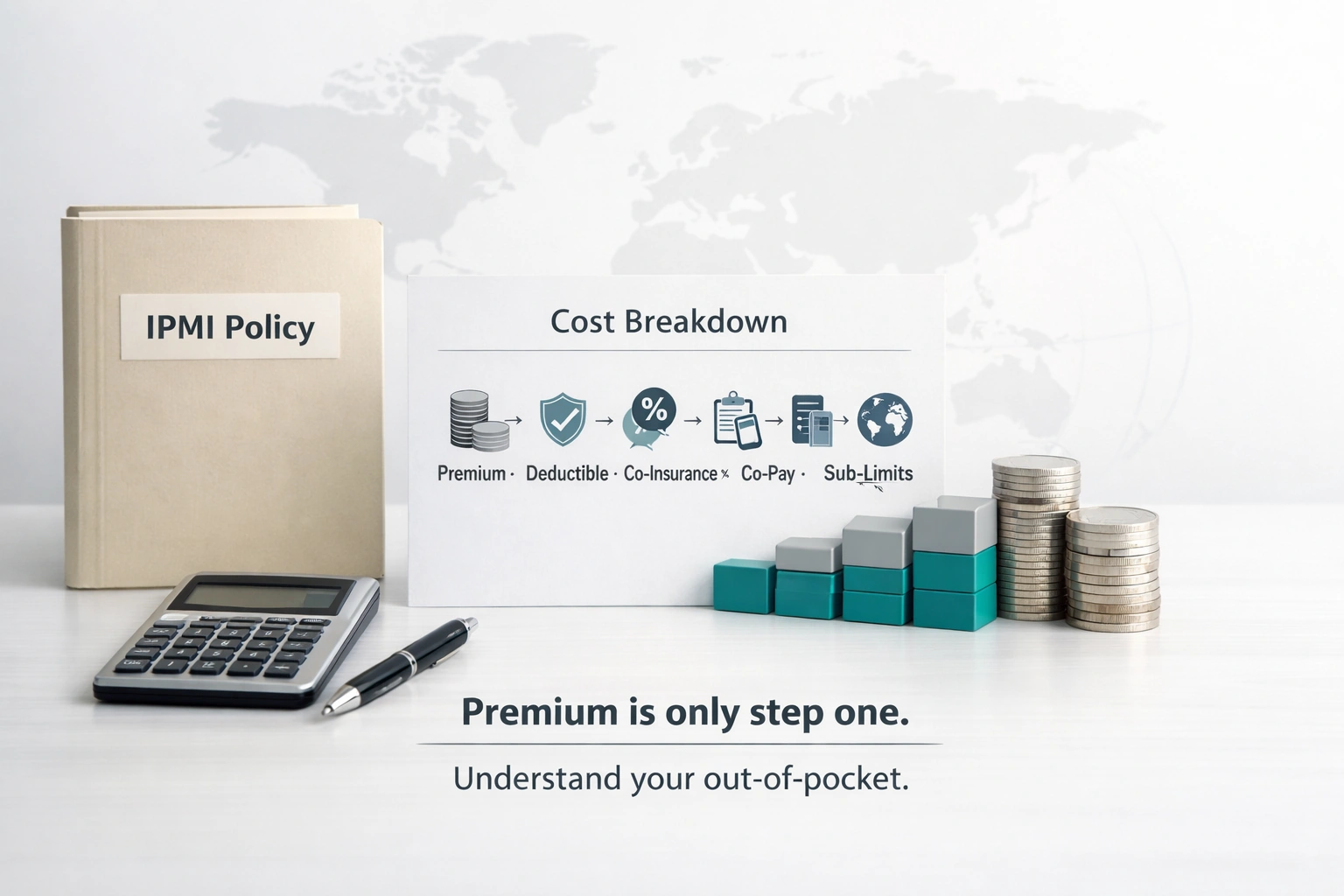

If you are comparing international private medical insurance (IPMI), the premium is only part of the picture. The terms within the policy — deductibles, co-insurance, co-payments, annual limits and sub-limits — can materially affect what you may have to pay when you actually use the plan. This guide explains those cost levers in plain English, shows where they usually appear in the policy wording, and offers practical ways to assess the “real cost” of cover before you commit.
- Cost sharing is not a single lever. In many plans, you may first face a deductible, then a percentage share, sometimes a fixed co-payment, and then benefit limits or caps.[1][2][6]
- The “real cost” of cover is often broader than the premium. It can include expected out-of-pocket costs for covered treatment, plus any shortfalls for excluded care, non-network billing differences, or amounts above sub-limits and annual maxima.[4][8][17]
- Definitions can vary by insurer and by wording. Some IPMI policies use “co-payment” to mean a percentage share rather than a fixed fee, so the contractual definition matters more than the label.[1][6]
- Two checks can prevent many surprises: confirm exactly how your deductible applies, and confirm both the overall annual maximum and any sub-limits within it.[6][8]
- The worked examples in this guide are illustrative only. They are not quotations, pricing guidance or promises as to claims outcomes.
Treat these as plain-English starting points. The decisive wording is always the definition in the policy documents and table of benefits.[1][6]
- Deductible: the amount you pay towards covered services before the plan starts to pay, or before it pays at the stated benefit rate.[1][2]
- Excess: a term often used in UK insurance for the first part of a claim that you pay yourself; it is often similar to a deductible, but you should always check the wording.[14][15]
- Co-insurance: your percentage share of an allowed or eligible cost, often after any deductible has been met.[1][3]
- Co-payment: commonly a fixed charge in consumer glossaries, but some IPMI policies use it to mean a percentage share of cost.[1][6]
- Annual limit / annual maximum: the maximum amount the insurer will pay in total during the policy year.[6][8]
- Sub-limit: a smaller cap on a specific benefit within the wider policy structure.[6][8]
- Out-of-pocket costs: what you pay yourself for covered care, plus the full cost of non-covered care.[1][4]
For broader background, BIG’s guides on understanding international health insurance and how to compare what actually matters provide useful context before you focus on the cost-sharing details.
What these terms mean (plain English)
The safest starting point is to separate the premium from the costs you may face once treatment begins. The premium is what keeps the policy in force. Cost sharing is what you may still have to pay when you use it.[17]
IPMI deductible explained
A deductible is the amount you pay towards covered medical costs before the insurer starts paying, or before it pays at the stated rate.[1][2] In IPMI, that deductible may apply per person, per family, per policy year or, in some wordings, per claim. That is why the amount alone does not tell the full story.[6][7][8]
In practical terms, a higher deductible means more routine spend falls to you. If your annual claims are low, the deductible may be the main reason the insurer pays little or nothing in that year. For people expecting regular outpatient use, that can materially affect the day-to-day value of the policy.
Excess vs deductible
In UK insurance terminology, “excess” usually means the first part of a claim that you pay yourself. In health insurance, it is often conceptually similar to a deductible, but not every policy uses the two terms interchangeably.[14][15][16]
The practical point is straightforward. Do not assume they mean the same thing in your contract. Check the definition, how often it applies, and which benefits it affects.
Co-insurance meaning
Co-insurance is usually your percentage share of the eligible or allowed cost of treatment.[1][3] If a policy says the insurer pays 80% and you pay 20%, that 20% is the co-insurance. The percentage may apply after the deductible has been met, but you should verify the order of application in the policy wording.[7]
Percentages can look modest on paper. The issue is scale. A small percentage applied to a large hospital bill can still create a significant out-of-pocket cost if there is no cap, or if the cap is higher than expected.
Co-payment vs co-insurance
In many consumer glossaries, a co-payment is a fixed amount and co-insurance is a percentage.[1] That distinction is useful as a starting point, but it does not always hold in IPMI policy documents. Some published IPMI wording uses “co-payment” to mean a percentage share of eligible costs, which makes it operate like co-insurance in practice.[6]
Often described as a set fee for a covered service, such as a defined amount per consultation or prescription.[1]
Usually described as a percentage of the eligible cost that you pay after any deductible, subject to the wording and any cap.[3]
Some IPMI policies describe a percentage share as a “co-payment”, so the defined term matters more than the everyday label.[6]
Annual limit and sub-limits
An annual limit, annual maximum or maximum plan benefit is the overall ceiling on what the insurer will pay during the policy year.[6][8] A sub-limit is a smaller ceiling on a particular benefit or category, such as outpatient medicines, maternity, mental health or therapies.
This distinction matters because a policy can have a high overall annual maximum and still apply much smaller caps to the benefits you are more likely to use. That is why a headline annual maximum can feel reassuring but still be incomplete if you do not also review the benefit-level limits.[6][8]
| Term | Plain-English meaning | What to verify in IPMI |
|---|---|---|
| Deductible | The first amount you pay towards covered care before the insurer pays, or before it pays more. | Whether it applies per person or family; per year or per claim; and which benefits it applies to.[6][7] |
| Excess | Often similar to a deductible, especially in UK insurance terminology. | Whether the policy uses it interchangeably with deductible or treats it separately.[14][16] |
| Co-insurance | Your percentage share of the eligible cost. | Whether it applies after the deductible, and whether a cap exists.[3][9] |
| Co-payment | Often fixed, but sometimes percentage-based in IPMI wording. | The exact contractual definition.[1][6] |
| Annual maximum | The overall amount the insurer may pay in a policy year. | Whether it is per person and whether all benefits remain subject to it.[6][8] |
| Sub-limits | Smaller caps within the wider plan. | Which benefits they apply to, and whether they are per year, per event or per lifetime.[6][8] |
Where they appear in the policy wording
Most misunderstandings do not arise from the concept itself. They arise from where people look, or from reading one document without cross-checking the others. In IPMI, the definitions, table of benefits and policy schedule typically work together.[6][8]
Policy wording / terms and conditions
This is usually where the formal definitions sit. It is where you may find the insurer’s exact meaning of deductible, co-payment, eligible expenses, pre-authorisation and similar terms. One published IPMI wording, for example, defines co-payment as a percentage share and explains that deductibles are payable per insured person per insurance year unless stated otherwise.[6]
Table of benefits / schedule of benefits
This is usually where the financial structure becomes visible. The table often shows which benefits are covered, which are paid in full, which are paid at a percentage, and where annual limits or sub-limits apply. Some published tables also show optional percentage co-payments with a maximum cap per person per insurance year.[9]
Policy schedule / certificate
This is often where your chosen options are confirmed. Region of cover, deductible selection, underwriting basis, start date and endorsed changes may all appear here. In practice, this means you should read the general wording and then confirm your specific selections in the schedule or certificate.[7]
Membership guide / claims guide
These documents can explain how the mechanics work in practice. They may show how direct settlement operates, how claim statements display deductible or co-insurance deductions, and how non-network “reasonable and customary” limits can create shortfalls for the member.[8]
- Find the exact definition of deductible or excess.
- Confirm whether co-payment means a fixed fee or a percentage share.
- Locate the overall annual maximum.
- List the sub-limits most relevant to your circumstances.
- Check the basis for eligible expenses or “reasonable and customary” reimbursement.
- Confirm the pre-authorisation rules and any consequences of not following them.[7][8]
If you are comparing options and want a broker-led view focused on wording rather than headline price alone, BIG’s Individuals & Families page is a sensible starting point.
How cost sharing can affect claims behaviour
Cost sharing does more than shift money from insurer to member. It can influence how people use care, whether they claim, and how they approach treatment decisions. The strongest evidence for this comes from broader health policy research rather than IPMI-specific consumer studies, so it is best treated as directional rather than predictive for every private international plan.[10][11]
What the research broadly shows
RAND’s Health Insurance Experiment remains one of the best-known studies on cost sharing. It found that when participants faced a greater share of costs, they used fewer health services overall.[10] The study also found that cost sharing reduced the use of both more effective and less effective care in broadly similar proportions.[10][11]
That matters because cost sharing is not a precision tool. It may reduce smaller or discretionary claims, but it can also make members more hesitant about necessary treatment, especially where costs are difficult to predict in advance.
Why this matters in IPMI
In IPMI, the effects of cost sharing can show up in a few practical ways. Members may decide not to submit smaller outpatient claims if those charges are likely to fall entirely within the deductible. They may also prefer network providers or direct settlement arrangements, where there is less uncertainty around the bill and a lower risk of shortfalls.[7][8]
Affordability is also relevant. WHO Europe continues to treat out-of-pocket spending as a financial protection issue because user charges and co-payments can affect both access to care and household financial strain.[12][13] For families buying IPMI, that is a reminder to test the policy against a difficult month or a difficult year, not just a routine one.
If routine outpatient bills sit below the deductible, members may effectively self-fund these costs and treat the policy as protection against larger events.
Once specialist appointments, imaging or therapies begin to accumulate, co-insurance or percentage co-payments can become the main driver of out-of-pocket costs.
In larger claims, members tend to focus less on the deductible and more on whether cost sharing is capped, whether treatment is within the network, and whether approval steps have been followed.
Worked examples (low/medium/high usage)
The examples below are illustrative only. They are not quotations, insurer pricing or forecasts. Their purpose is to show how the mechanics can work so that you can model your own scenarios using the actual policy wording and a real quotation.
Copy this structure into your own notes and complete it using the table of benefits and policy schedule.
- Policy year dates: ____________________
- Deductible / excess: ____________________
- How it applies (per person / family / year / claim): ____________________
- Co-insurance or percentage co-payment: ____________________
- Any cap on that percentage share: ____________________
- Any fixed co-payments: ____________________
- Overall annual maximum: ____________________
- Key sub-limits relevant to you: ____________________
- Out-of-network reimbursement basis: ____________________
- Pre-authorisation requirements: ____________________
Worked example 1: low-usage year
Assume an illustrative policy with a deductible of 750 currency units per policy year, followed by 20% co-insurance. Assume there are no material fixed co-payments. Assume all treatment is covered and falls within the relevant benefit limits.
In a year where eligible outpatient costs total 600 units, the deductible dominates. Because the total eligible spend does not exceed the deductible, the member would pay the full 600 and the insurer would pay nothing in this illustration. In practical terms, the policy still offers protection for larger events, but the routine-usage year remains largely self-funded.
| Illustrative low-usage scenario | Amount |
|---|---|
| Total eligible bills | 600 |
| Deductible | 750 |
| Member pays | 600 |
| Insurer pays | 0 |
Worked example 2: medium-usage year
Using the same illustrative structure, assume eligible bills total 10,000 units. The first 750 falls to the member as the deductible. The remaining 9,250 is then subject to 20% co-insurance.
On that basis, the co-insurance element would be 1,850 units. Total out-of-pocket cost for covered treatment would therefore be 2,600 units in this illustration. In a medium-usage year, the percentage share becomes more significant than the deductible itself.
| Illustrative medium-usage scenario | Amount |
|---|---|
| Total eligible bills | 10,000 |
| Deductible paid by member | 750 |
| Remaining eligible amount | 9,250 |
| 20% co-insurance on remainder | 1,850 |
| Total member out-of-pocket for covered costs | 2,600 |
Worked example 3: high-usage year
In a severe claims year, the discussion often shifts. The deductible still applies, and the percentage share may still apply, but the more important questions become whether that percentage share is capped, whether the annual maximum is sufficient, and whether key categories are subject to sub-limits.[6][8][9]
Assume the same deductible and 20% percentage share, but also assume a cap on that percentage share and a high overall annual maximum. In a year with 200,000 units of eligible hospital and follow-up costs, the member may still pay the deductible and then their percentage share until the cap is reached. After that, the insurer may pay covered eligible costs, but only within the plan’s overall annual maximum and any relevant sub-limits.
- Low usage: the deductible often dominates.
- Medium usage: co-insurance or a percentage co-payment often dominates.
- High usage: caps, annual limits, sub-limits, network rules and authorisation requirements often become the bigger risk points.
Simple order-of-operations model
1) Apply the deductible / excess first
2) Apply co-insurance or percentage co-payment to the remaining eligible amount
3) Apply any cap on the member's percentage share, if the policy includes one
4) Apply sub-limits to the specific benefit categories involved
5) Apply the overall annual maximum
6) Excluded or non-eligible charges remain outside the insured payment calculation
If any quotation or table of benefits is unclear about that sequence, it is worth asking for written clarification before relying on a cost estimate.
Common traps (caps, sub-limits, exclusions)
This is where many avoidable misunderstandings arise. The policy may still be suitable, but only if the member understands where the limits and conditions actually bite.
- Assuming “co-payment” means a fixed fee. In some IPMI wording it can mean a percentage share instead.[6]
- Not checking whether the deductible applies per year or per claim. That single point can materially alter your modelling.[7][8]
- Missing separate deductibles for different benefit areas. Some plans apply them differently across core, outpatient, maternity or dental modules.[6]
- Reading “paid in full” as “unlimited”. A benefit can still sit within an overall annual maximum or be subject to a related condition elsewhere in the wording.[6]
- Ignoring sub-limits because the annual maximum looks generous. Smaller benefit caps may be more relevant than the headline annual figure.[8]
- Assuming non-network bills will be reimbursed in full. The insurer may reimburse only up to what it considers reasonable, customary or otherwise eligible.[1][8]
- Treating pre-authorisation as optional when it is not. For some treatments, failing to follow the required approval process can affect how the claim is settled.[7][8]
- Forgetting exclusions. Out-of-pocket costs do not arise only from deductibles and percentages; non-covered treatment remains entirely your responsibility.[1]
| Situation | Trap that may matter most | Why |
|---|---|---|
| Mostly routine outpatient use | Deductible structure and outpatient sub-limits | These can determine whether routine claims are effectively self-funded. |
| Ongoing medication or therapy needs | Percentage cost sharing and medicines / therapy caps | Repeated but non-catastrophic spend can accumulate quickly. |
| Concern about major hospital events | Co-insurance cap, annual maximum and authorisation rules | In severe claims, these often matter more than the headline deductible. |
| Cross-border or frequent travel | Network rules and “reasonable and customary” reimbursement | Differences in provider charging can create shortfalls. |
If you want help turning policy wording into a practical comparison, BIG’s quote request page is where you can start a structured review.
Points to verify + checklist
The items below vary by insurer, policy wording, country, provider billing practice and the exact module or option selected. If you cannot verify a point in the policy wording, table of benefits and schedule, treat it as uncertain until it has been confirmed in writing.
- What does the policy mean by co-payment: a fixed amount or a percentage share?
- How does the deductible apply: per person, per family, per year, per claim, or by category?
- Are there separate deductibles for core, outpatient, maternity or dental benefits?
- In what order are deductible and co-insurance applied?
- Is there a cap on co-insurance / percentage co-payment?
- Does the plan include any genuine out-of-pocket maximum for the member, and what counts towards it?
- What is the overall annual maximum?
- Which sub-limits are most likely to affect your own usage?
- How are eligible expenses defined, particularly outside the network?
- Which treatments require pre-authorisation?
- Does the plan support direct settlement, and under what conditions?
- What are the main exclusions relevant to your circumstances?
If you are at the comparison stage, BIG’s Individuals & Families page and quote request page can help you translate the wording into a clearer side-by-side comparison.