


Group international private medical insurance (IPMI) can be simpler to put in place than individual cover — but it is not “underwriting-free”. In practice, insurers still need to understand the risk within your insured population, and medical history can influence terms, onboarding steps, timelines, and the day-to-day employee experience.
If you manage HR or benefits, friction usually shows up in predictable places: what the insurer asks for at onboarding, when evidence of insurability is required, how late enrollees are handled, and how pre-existing-condition rules are applied — not only at inception, but as people join, move country, or add dependants.
This long-form guide explains how group IPMI underwriting and corporate medical underwriting typically work in real-world implementations, using compliance-safe language. It focuses on governance: eligibility, participation, data handling, and communications — so your HR team can reduce avoidable delays without making promises about outcomes that depend on the insurer, the policy terms, and the jurisdiction.
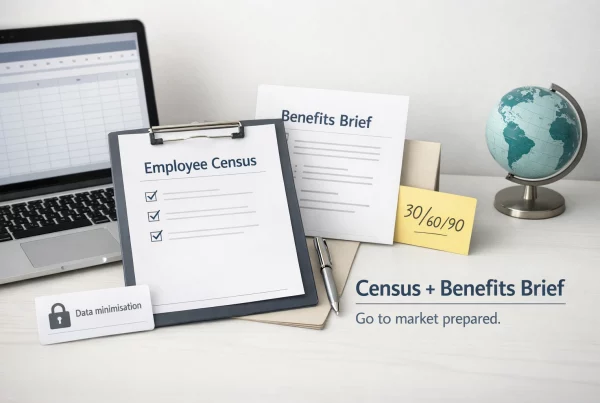
Before you request terms, make sure the basics are ready (exact requirements vary by insurer/country):
- Employee census: date of birth/age, sex (if requested), country of residence, employment category, start dates, and dependants (where applicable).
- Eligibility rules: who is in scope, when cover starts, joiner/leaver rules, and any “actively at work” rule (as defined by the policy).
- Location mix: where employees live/work and expected cross-border movement.
- Participation approach: expected take-up and how opt-outs are handled (to reduce adverse selection risk).[4]
- Benefit design: excess/deductible, cost-sharing, area of cover, and any optional modules.
- Pre-existing condition and waiting-period rules: what applies, where definitions sit, and how you will explain them to employees.
- Data handling: health data is sensitive in UK/EU frameworks; HR should minimise collection and use secure insurer/broker channels.[7]
- Group underwriting is still underwriting: insurers price a pool and rely on eligibility rules, participation, and plan design to manage risk.[1]
- Medical history is collected in different ways: from full medical underwriting to limited declarations to evidence only for some members (often late entrants or above thresholds).[2]
- Pre-existing conditions are handled by policy rules: exclusions, waiting/moratorium-style approaches, continuation terms, or medical-history-disregarded (MHD-style) structures may exist — availability varies.[2]
- Late enrolment is a predictable trigger for EOI: enrolling outside windows, adding dependants late, or increasing cover may require group insurance evidence of insurability.[5]
- Wellness programmes can support governance: they may help engagement and navigation, but cost impacts are not guaranteed and evidence is mixed.[11]
- HR reduces friction through process: clear eligibility definitions, consistent enrolment windows, and privacy-safe data handling are practical levers you control.[7]
- Group underwriting: how the insurer assesses and prices an employer’s insured population as a collective risk, based on eligibility rules and plan design.[1]
- Risk pooling: spreading the financial risk of healthcare costs across a group (rather than leaving it with the individual who becomes ill).[3]
- Experience rating: using a group’s claims experience to inform renewal pricing; more common when the group is large enough for credible data.[12]
- Evidence of insurability (EOI): health information requested so the insurer can decide whether to accept cover or a change (often via a questionnaire).[5]
- Late entrant (late enrollee): someone joining outside the standard eligibility/enrolment window; commonly a trigger for EOI or additional checks (definitions vary).[6]
- Actively at work: a policy-defined concept (often requiring an employee to be carrying out their usual duties) that may affect when cover starts for new joiners or changes (verify your policy wording).
- Pre-existing conditions: a policy-defined concept (often tied to prior symptoms, advice, treatment, medication, or diagnosis within a lookback period). Definitions vary materially.[2]
- MHD (medical history disregarded): an approach seen in some group markets where medical history is not applied in the same way at onboarding; typically subject to criteria and policy definitions (not a blanket guarantee).[2]
- Waiting periods: time-based limitations where certain benefits start after a set period; they can interact with pre-existing-condition rules (verify the policy terms).
Language and rules vary by insurer, country, and plan type. Treat this glossary as a starting point and verify definitions in the insurer’s policy documentation.
How group underwriting differs from individual
In individual IPMI, underwriting is typically personal: one applicant’s medical history directly shapes the terms the insurer is willing to offer. In group IPMI, the insurer often starts from a different premise — risk pooling — and then decides how much individual medical information it needs in order to manage the pool responsibly.[1][3]
The practical point for HR is that “group” does not automatically mean “no questions asked”. More often, the underwriting structure shifts from purely individual disclosures to a mix of: (a) group-level information about the workforce, and (b) targeted individual evidence triggers (for example, late entrants or people exceeding defined thresholds).[1]
Why insurers care about governance in groups
Insurers rely on employer governance to limit adverse selection: the risk that only employees who expect to claim enrol, while lower-risk employees opt out. Many group markets use participation expectations and enrolment windows to help manage this risk, although the specific rules vary.[4]
If participation is low, eligibility rules are applied inconsistently, or the location mix is complex, an insurer may respond by: requesting more individual underwriting, applying tighter enrolment controls, or pricing more cautiously. None of these outcomes is certain — but they are common risk-management levers in group insurance markets.[1]
What changes for HR in practice
In group IPMI, accuracy of age bands, locations, and eligibility categories can matter as much as “medical history”. Underwriters will usually price on what you submit — and rework is often needed when data is incomplete.
If exceptions are frequent (or poorly documented), insurers may view the scheme as less predictable. That can show up as more friction: extra checks, longer timelines, or more restricted onboarding routes.
Most members may have a straightforward enrolment. A smaller subset (often late entrants or those above thresholds) might face questionnaires and follow-ups, which needs proactive HR communications.
For a background explainer on individual underwriting routes (full medical vs moratorium) and how definitions can change by product, see: How underwriting works in international health insurance (IPMI): full medical vs moratorium explained.
Medical history requirements (sometimes waived)
“Will employees need to answer medical questions?” is one of the first questions HR asks. The honest answer is: it depends. Group IPMI underwriting approaches sit on a spectrum, and the insurer will choose a route based on your group’s size, profile, location mix, participation expectations, and benefit design — and sometimes on local product rules in each jurisdiction.[2]
In this context, “waived” usually means “no full questionnaire for everyone at onboarding”. It does not necessarily mean that all pre-existing-condition rules fall away, or that evidence will never be required. Even with light-touch onboarding, policy definitions, waiting periods, and late-entrant controls can still apply.[2]
Underwriting approaches for groups (non-exhaustive)
The table below describes approaches seen in the market. Availability and definitions vary by insurer and jurisdiction. Use it as a structured checklist for what to ask — not as a guarantee that any specific approach will be available to your organisation.
| Underwriting approach (market-typical) | When it’s used | Typical eligibility triggers (group size/participation) | What HR must collect | Typical risks / friction points | Employee experience impact | What to verify |
|---|---|---|---|---|---|---|
| Full medical underwriting (FMU) for all members | Used where the insurer needs individual risk review for most members | More common in smaller or higher-variance groups; can also be linked to higher benefit levels (varies) | Accurate census + employees complete insurer questionnaires via secure channels | Longer timelines; follow-up evidence requests; employee concern about disclosures | Higher friction, but individual terms are clearer once issued | Disclosure scope; how terms are communicated; how pre-existing conditions are defined |
| Medical history declaration (short form) + insurer review | Used to reduce burden while still gathering relevant history | May be offered where participation and governance are credible (varies) | Census + employees complete a limited declaration (typically direct to the insurer) | Unclear answers trigger follow-ups; employees may misread what is being asked | Moderate friction; often quicker than FMU | Who reviews declarations; how follow-ups work; timelines for acceptance |
| Evidence of insurability (EOI) for some members only | Used to keep onboarding straightforward for most, while controlling higher-risk triggers | Common triggers: late entrants, certain increases, dependants added outside rules, above thresholds (varies) | Census + identify who is subject to EOI; HR supports the process but should not handle medical detail | Late-entrant surprises; delayed start for affected individuals; inconsistent HR handling can create disputes | Low friction for most; higher friction for a defined subset | Exactly who requires EOI and when; what is “pending”; how decisions are communicated to individuals |
| “No underwriting up to a limit / guaranteed issue up to a threshold” | Used to simplify onboarding up to a defined benefit level | Often linked to group size, participation, and eligibility rules (varies) | Census + eligibility proof; waiver/opt-out documentation if required | Misunderstanding the threshold; edge cases; late entrants treated differently | Low friction for many; clear messaging is essential | What the threshold applies to; whether late entrants lose the threshold; whether limits differ by region |
| MHD (medical history disregarded) style arrangements | Seen where corporate markets prioritise easy onboarding; typically subject to criteria | Often conditional on group size/participation and insurer appetite (varies) | Census + employer application; insurer may still request limited declarations depending on structure | Employees assume “everything is covered”; renewal volatility risk; scope depends on policy wording | Very low onboarding friction; higher communications responsibility | Any conditions/exclusions; new joiner treatment; renewals and changes |
| Rules-based waiting/moratorium-style approach | Used where the insurer prefers a rules approach over personalised exclusions for each member | Often applied where questionnaires are not collected at entry (varies) | Census + eligibility; HR must communicate the rule clearly | Misunderstanding at claim stage; employees confuse “no questionnaire” with “no restrictions” | Low entry friction; potential disappointment at claim stage if not explained | Exact definition and any “clean period”; what counts as treatment/advice/symptoms; how claims are assessed |
How medical history can affect terms (in practice)
In group IPMI, medical history can influence terms in several ways, depending on the underwriting route:
- Who needs extra evidence: for example, late entrants, members above thresholds, or certain dependant additions may trigger EOI.[5]
- Policy structure choices: the insurer may propose a rules-based approach (for example, waiting periods) rather than individual exclusions, depending on group profile.[2]
- Pricing approach: insurers may price more cautiously when group data is limited, participation is low, or cross-border risk is complex. (The insurer’s detailed methodology will be proprietary.)
- Administration timelines: when questionnaires or follow-ups are needed, onboarding timeframes usually lengthen, and start dates may depend on the insurer receiving complete information.[5]
Data protection boundary: what HR should (and shouldn’t) collect
In UK/EU frameworks, health information is treated as sensitive (special category) personal data and generally requires additional safeguards and a lawful basis/condition for processing.[7][9] A practical default is: employees submit medical answers directly to the insurer (or via secure broker/insurer systems), and HR handles eligibility administration — not medical detail.
Consider using language like this internally and in staff communications:
- “Some members may be asked to complete a health questionnaire as part of the insurer’s underwriting process.”
- “Medical information is handled through the insurer’s secure process; HR will not review individual medical answers.”
- “Timelines vary. Where additional information is requested, confirmations and/or start dates may take longer.”
Handling pre-existing conditions in groups
Pre-existing conditions are often the most sensitive area for employees — and the easiest place for misunderstandings to grow. The starting point is simple: “pre-existing condition” is a policy definition, and it may not align perfectly with how employees talk about their health in everyday language.[2]
Depending on the underwriting structure, group IPMI policies may treat pre-existing conditions through: (a) individual exclusions/limitations (more common with full medical underwriting), (b) rules-based waiting/moratorium-style approaches, or (c) MHD-style arrangements — sometimes with conditions and always with policy definitions and limits that still apply.[2]
Common ways pre-existing conditions show up in group outcomes (decision pathways)
The insurer may request disclosures and then decide acceptance and terms for each person. HR will typically not see medical reasons; employees may see their own terms and should direct medical or underwriting questions to the insurer.
With minimal onboarding questions, the policy definition and time-based rules (e.g., a waiting period or “clean period”) are critical. HR needs to explain the rule accurately and avoid suggesting how any individual claim will be assessed.
MHD-style arrangements can reduce questionnaires at entry, but employees may over-assume cover. HR should emphasise that benefits still depend on the policy terms, limits, and the insurer’s claims assessment.
What HR can do to reduce “claim-time surprises”
- Put the definition in front of employees early: link to the policy wording or insurer guide, and highlight that assessment depends on the policy definition.
- Explain “no questionnaire” carefully: “no questionnaire at entry” can coexist with waiting periods, exclusions, and benefit limits.[2]
- Encourage pre-treatment checks: without giving medical advice, you can remind employees to use the insurer’s helpline/support route to confirm process requirements (such as pre-authorisation) before planned treatment.
- Keep health data out of HR channels: do not ask employees to email diagnoses or medical reports to HR “so we can check”. Health data is sensitive; minimise collection and use secure insurer/broker routes.[7]
Scenario: A 180-person employer offers group IPMI across three countries. To simplify onboarding, the insurer uses a rules-based pre-existing-condition structure rather than full questionnaires for all members.
How decisions are made (illustrative): the insurer relies on eligibility controls (who is eligible and when), participation expectations, and policy definitions to manage risk. Employees do not complete full medical questionnaires at entry, but the policy includes pre-existing-condition definitions and may include waiting periods. When an employee claims, the insurer assesses the claim against the policy wording and supporting evidence — not against HR’s interpretation of symptoms or diagnoses.[2]
This example is intentionally generic. It shows process logic, not a guarantee that any insurer will offer this approach or any specific claim outcome.
Late enrolment and evidence of insurability
Late enrolment is one of the most common reasons a group scheme that looks straightforward on paper becomes frustrating in practice. Insurers often treat late entrants as a higher adverse selection risk: someone could delay joining until they anticipate needing care. That is why many group markets apply participation expectations, standard enrolment windows, and additional evidence requirements outside those windows.[4]
What triggers “group insurance evidence of insurability” in practice
Evidence of insurability (EOI) is commonly described as health information requested so the insurer can decide whether to accept cover (or a change).[5] In group contexts, EOI is often associated with late entrants and certain changes.
While triggers vary, common examples include:
- Late entrant (missed the initial window): enrolling after a defined eligibility/enrolment period may require EOI.[6]
- Reinstatement: an employee who previously waived cover and later requests enrolment may face additional evidence steps.
- Increases in benefit level: moving beyond a defined threshold can sometimes trigger EOI (policy-specific).
- Dependants added outside permitted windows: for example, adding a partner late without a recognised life event (definitions vary).
How to reduce late-entrant friction (HR levers)
You cannot remove late-entrant requirements through internal policy statements alone. What you can do is reduce avoidable late entrants and make the process clearer when late enrolment does arise.
- Define enrolment windows clearly: publish dates and consequences (“may require EOI and can affect timelines”).[5]
- Run more than one reminder: enrolment can slip due to workload, travel, or line-manager delays — not a lack of interest.
- Segment communications: new joiners, returning-from-leave employees, and internationally transferred employees often need different prompts.
- Use a “no medical details to HR” rule: employees submit EOI directly to insurer systems where possible. Health data is sensitive, so minimise HR involvement.[7]
Scenario: An employee becomes eligible on 1 March but does not enrol by the scheme enrolment deadline. They request enrolment three months later, shortly before an overseas trip.
Decision logic you may see: HR confirms the employee is outside the “timely enrolment” window defined by scheme rules. The insurer applies a late-entrant rule and requests EOI (a health questionnaire) before confirming cover or certain changes. The employee communicates directly with the insurer regarding medical questions; HR supports only eligibility dates and process steps.[5][6]
This illustrates how decisions are made. It does not guarantee that cover will be accepted or that any specific timeline will apply.
Mini “HR comms” section (templates)
These templates are designed to explain the process without giving medical advice or promising outcomes. Adapt them to your internal tone and verify wording against the insurer’s actual requirements.
Template: explaining questionnaires (purpose + confidentiality)
Use this when an insurer requires questionnaires for some or all members.
Subject: International medical plan enrolment – health questionnaire (if applicable)

As part of enrolment into our international medical plan, some employees may be asked to complete a health questionnaire.
This is part of the insurer’s underwriting process and is used to confirm eligibility and terms.

Your medical information is handled through the insurer’s secure process. HR will not review your medical answers.
If you have questions about what to disclose, please contact the insurer/broker support team directly so you can discuss this privately.

Please submit any requested forms within the stated timeframe. Where additional information is required,
the insurer’s timelines may be extended.
Template: late enrolment (what changes + timeline expectation)
Use this when employees miss the enrolment window or request changes outside standard rules.
Subject: Late enrolment request – next steps

We can support your enrolment request, but because it is outside the standard enrolment window,
the insurer may require additional evidence (such as a health questionnaire) before confirming cover.

This can affect timelines. HR can confirm your eligibility dates and help you access the insurer’s submission route,
but medical questions are handled directly between you and the insurer for confidentiality.
Template: what HR can (and cannot) answer
A simple boundary statement you can include in FAQs.
HR can help with: eligibility rules, enrolment dates, how to submit forms, and where to get support.
HR cannot assess medical history or predict whether treatment will be covered.
Cover and claims decisions are made by the insurer under the policy terms.
Impact of wellness programmes on claims
Many HR teams want to understand whether wellness programmes can reduce claims costs and improve scheme sustainability. It is reasonable to explore — but it is also an area where over-confident statements can create credibility risk.
Research evidence is mixed. For example, a large randomised trial published in JAMA found that a workplace wellness programme improved some self-reported behaviours, but did not show significant changes in clinical measures or healthcare spending over 18 months.[11] RAND’s multi-employer analysis also notes that findings vary and that effects can depend on programme design, the population, and the time horizon.[10]
Where wellness can realistically help in group IPMI governance
In group IPMI, wellness is usually most credible as part of a broader governance and employee-experience approach rather than as a direct premium-reduction lever. Practical, privacy-safe contributions can include:
- Navigation and early support: helping employees find appropriate care pathways (especially across borders) may reduce avoidable delays and escalation events.
- Engagement signals: participation and awareness can indicate scheme stability and reduce confusion, even if cost impacts are uncertain.
- Operational outcomes: fewer complaints, fewer billing disputes, and better use of insurer support services can improve employee experience — which can be a valid HR objective even if premiums do not change.
How to discuss wellness with insurers without overselling
If you want to reference wellness in an underwriting narrative, focus on what you can evidence without collecting individual health data:
- programme participation rates (aggregated),
- use of education sessions or toolkits (aggregated),
- employee support and navigation usage (aggregated),
- process improvements (fewer late enrolments, clearer dependant documentation, and smoother authorisation steps).
Avoid implying that a wellness programme will reduce premiums or guarantee improved terms. Evidence and insurer practice vary, and underwriting outcomes depend on multiple factors beyond wellness activity.[10][11]
Wellness initiatives can create sensitive data flows quickly. In UK/EU frameworks, health data is sensitive/special category data and requires additional safeguards. Keep wellness reporting aggregated where possible, minimise collection, and involve your privacy/legal team early if data will be transferred cross-border.[7][8]
Negotiating terms with insurers
“Negotiating” in group IPMI underwriting is rarely a single conversation. It is typically a structured process of (a) presenting a credible workforce and governance picture, (b) selecting benefit trade-offs your organisation can sustain, and (c) clarifying where the insurer’s underwriting approach is flexible versus fixed by product rules.
This is where corporate medical underwriting becomes practical: underwriters need to understand your insured population, your plan design, and your controls. Your influence is usually strongest when your data is clean, participation is credible, eligibility is consistently applied, and implementation risk (data handling and cross-border administration) is low.
A practical negotiation framework for HR / benefits
Be precise on eligibility categories (expats, local nationals, remote workers, directors, interns), and avoid “exceptions by email” that are difficult to defend later.
Publish enrolment windows, clarify dependant rules, and document opt-outs consistently to reduce adverse selection risk.[4]
A plan can be generous but administratively fragile. Align benefit design with what your HR team can explain and apply without collecting sensitive data.
Ask the insurer to specify: when EOI applies, how late entrants are defined, what thresholds exist, and the expected timelines.[5]
Common trade-offs to expect (without promising outcomes)
Many underwriting conversations involve balancing ease of onboarding with risk controls. Examples include:
- Lower onboarding friction may come with stricter policy definitions, clearer waiting rules, or threshold-based controls.
- Broader openness at entry may require stronger participation commitments or tighter enrolment windows to protect the pool.[4]
- Richer benefits may require more underwriting, more documentation, or stronger administration processes.
Renewals: where experience can matter
In group insurance, renewal mechanics often include some review of claims experience, particularly where the group is large enough for credible data. Actuarial guidance on experience rating describes credibility-based approaches and the role of experience in pricing estimates.[12]
Renewal treatment varies materially by insurer, region, and policy structure. Verify what is reviewed, what data is used, and which levers exist (for example: benefit design changes, cost-sharing, eligibility tightening, or changes to the location mix).
Scenario: A 300-person employer wants to move from one group IPMI arrangement to another due to service issues and a changing location mix.
Decision logic you may see: the new insurer evaluates the group’s census, location mix, benefit design, and participation strategy. The insurer may propose an underwriting approach that balances onboarding friction and risk controls (for example, EOI for late entrants and thresholds). HR’s contribution is clean governance documentation and privacy-safe handling of any data requested — not negotiated “promises” about individual medical outcomes.[7]
This example illustrates a common process pattern. It does not guarantee any insurer will offer continuation terms or any specific underwriting approach.
Role of brokers
In group IPMI, a broker’s value is often less about “finding a plan” and more about making the underwriting and implementation process workable for HR: structured data collection, clear governance, compliant handling of sensitive information, and practical employee communications.
Where broker support typically reduces friction
- Structuring the underwriting file: translating your workforce into a clean insurer submission (census, eligibility, location mix, benefit design, participation approach).
- Clarifying underwriting routes: identifying which members are more likely to face EOI (late entrants, thresholds), so HR can communicate and plan timelines responsibly.[5]
- Keeping health data in the right channel: helping ensure employees submit medical detail through secure insurer processes, supporting data-minimisation principles.[7]
- Cross-border practicality: flagging where multi-country cover, local regulations, and data-transfer constraints may introduce additional steps (and building those steps into your timeline).[8]
- Negotiation support: helping frame evidence-based questions on thresholds, definitions, and renewal mechanics, using careful, compliance-safe language.
When we support employers at BIG Insurance Brokers Health, we focus on execution: eligibility governance, clear communication, and a process that protects confidentiality. Underwriting decisions and claims decisions sit with the insurer under the policy terms — and outcomes depend on your group profile and the relevant local regulations.
If your business is building or changing a global benefits strategy, you may also find this guide useful: Global employee health benefits: why international health cover is an investment, not a cost .
Checklist for HR teams
This checklist brings together practical actions HR can take to reduce underwriting friction, protect employee experience, and keep the process compliant — without overstating what underwriting will (or will not) do.
What HR needs to collect (documents/data)
- Employee census: date of birth/age, sex (if requested), role/category, country of residence, start date, and dependants (where applicable).
- Eligibility rules: eligibility categories, waiting periods (if any), joiner/leaver rules, life-event rules, and any “actively at work” definition (as per the policy wording).
- Participation strategy: expected take-up, employer contribution approach, waiver/opt-out handling, and how you avoid adverse selection risk.[4]
- Location mix and mobility pattern: where employees live, expected travel/assignment patterns, and whether dependants are in different countries.
- Benefit design specification: limits, excess/deductible, co-pay, inpatient/outpatient structure, area of cover, and optional modules.
- Prior claims information (where available): ideally aggregated and de-identified; confirm what is necessary and lawful to share.
- Data protection notes: who collects what, why it is needed, where it is stored, and how cross-border transfers are managed (if relevant).[7][8]
Common pitfalls (and how to mitigate them)
Insurers may be more cautious when take-up is low, because adverse selection risk increases. Mitigate by documenting opt-outs consistently and communicating value clearly (without overselling).[4]
Exceptions create administration risk and employee equity issues. Mitigate by defining eligibility criteria and applying them consistently; document any rare exceptions formally.
Employees can feel “penalised” if they only discover later that EOI may be required. Mitigate with clear enrolment windows and a clear warning that additional steps can affect timelines.[5]
Health data is sensitive (special category) in UK/EU frameworks. Mitigate with a strict process: medical questionnaires go to insurer/broker secure channels, not HR.[7]
Plan administration, provider access, claims pathways, and data-transfer constraints can vary by country. Mitigate with early mapping of the location mix and legal/privacy input where required.[8]
Confusion often arises around partner definitions, newborn additions, student limits, and documentation deadlines. Mitigate with a clear dependant policy and a documented “life event” process.
Two short HR decision frameworks
You are usually balancing two risks: (a) onboarding friction (questions, evidence, delays) and (b) pool stability (adverse selection, renewal volatility). Your governance choices (eligibility, participation, windows) influence which underwriting approach is feasible.
- If you want very low onboarding friction, expect more scrutiny on participation and governance, and verify policy definitions carefully (especially pre-existing rules).
- If you accept more onboarding steps, you may have clearer personalised terms, but you will need stronger employee communications and more timeline planning.
A compliance-safe operational rule is: HR manages eligibility and process; the insurer manages medical assessment. This reduces privacy risk and helps prevent HR teams being drawn into medical interpretation, which you should avoid.
If you need a structured, employer-friendly overview of IPMI underwriting routes and how exclusions/waiting periods can work across products, see: How underwriting works in international health insurance (IPMI): full medical vs moratorium explained.
Get Started
If you’re exploring a group international medical plan — or trying to reduce friction in an existing scheme — start by aligning the governance basics: eligibility, participation, enrolment windows, location mix, and privacy-safe processes for any medical evidence that may be required.
For support with plan design, underwriting strategy, and implementation, see our Businesses & Groups page. If you already have cover and want a neutral review of how underwriting and renewal mechanics apply to your current scheme, see Already Covered (Review my existing policy).
Further reading: Global employee health benefits: why international health cover is an investment, not a cost | How underwriting works in international health insurance (IPMI): full medical vs moratorium explained
Points to verify
Group underwriting rules and policy definitions vary significantly by insurer, country, plan type, and your workforce profile. Before you implement or change a scheme, verify the following in writing:
- the underwriting approach available for your group size and participation level
- whether medical history is collected for all members or only some (e.g., above a threshold / late entrants)
- how “late entrant” is defined and the evidence of insurability process (including timelines and effective-date rules)[5]
- how pre-existing conditions are treated (exclusions, waiting/moratorium-style rules, MHD-style terms) and whether treatment differs by region[2]
- dependant eligibility, newborn additions, and any “actively at work” rules affecting new joiners or changes
- data protection requirements and cross-border transfer constraints for health data, including who collects what and where it is stored[7][8]
- whether wellness programmes affect premiums/terms and what evidence is required (if any) — avoid assuming a direct effect[10][11]
- renewal mechanics: what gets reviewed, what data is used, and when experience can influence terms[12]